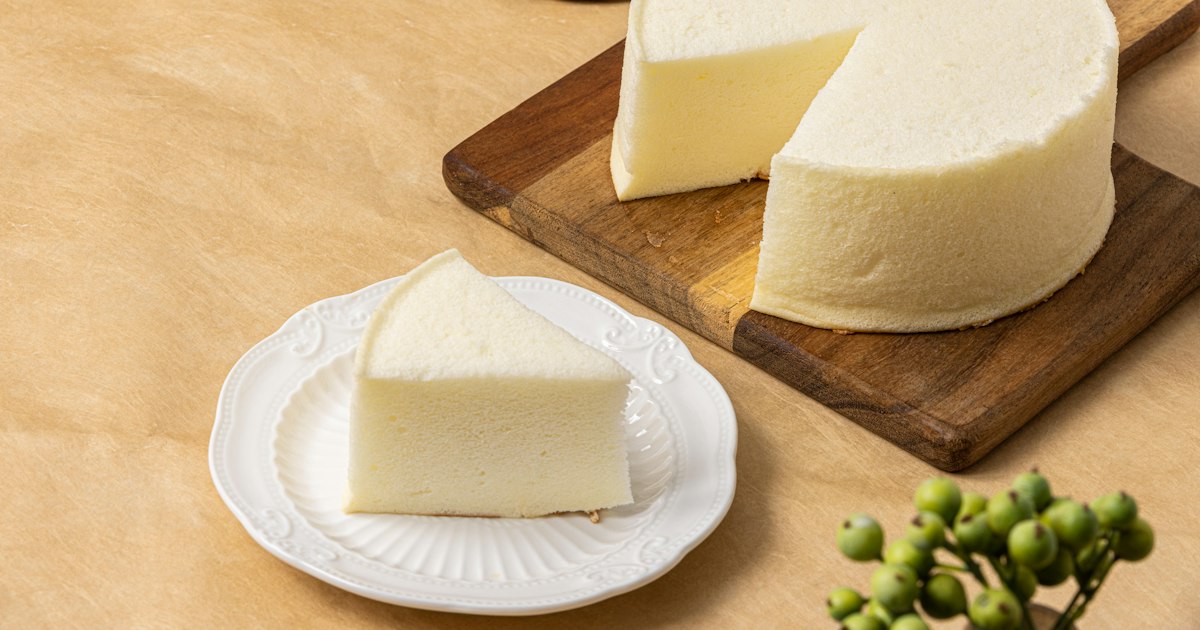
If you’ve seen a video of a golden-brown cake jiggling like a waterbed on a store counter in Japan, there’s a good chance it was either Rikuro’s in Osaka or Uncle Tetsu’s in Fukuoka. Japanese soufflé cheesecake — lighter, eggier and far less dense than the New York-style block you might be picturing — has become one of the country’s most photographed desserts, and the two chains that popularized it still draw lines of visitors every single day. Here’s what the hype is actually about, what it costs, and how to get a slice without wasting half your trip standing in a queue.
What Makes a Cheesecake “Soufflé” Style
Japanese soufflé cheesecake gets its wobble from technique, not magic. Egg whites are whipped into a meringue and folded into a cream cheese batter, which is then baked slowly in a water bath (bain-marie). The steam keeps the cake from browning too fast or drying out, and the whipped egg whites give it a texture closer to a cloud than a cheesecake — somewhere between a sponge cake, a chiffon cake and the dense cheesecake you’d get in New York. It’s noticeably less sweet and less rich than Western cheesecake, which is part of why it’s easy to eat a whole slice in one sitting without feeling like you need a nap afterward.
The “wobble” itself is a side effect of all that trapped air: a fresh-from-the-oven cake will visibly shake when the tray is set down or tapped, and both Rikuro’s and Uncle Tetsu lean into this as their signature selling point.
Rikuro’s Osaka: The Face That Jiggles
Rikuro’s Cheese Cake (りくろーおじさんの店) is an Osaka institution, with its most famous branch right by Namba Station, a few minutes from the Dotonbori canal. The cakes are printed with a smiling cartoon face on top — the “uncle” of the name — and part of the appeal is watching that face sink and wrinkle as the cake cools and settles over the following hour, like a time-lapse of a soufflé deflating.
The Namba store bakes in small batches, and staff call out when a fresh tray comes out of the oven, which is the moment the queue surges forward — fresh, warm cakes jiggle far more dramatically than ones that have been sitting for a while. A plain cheesecake runs around ¥875 for the standard size (prices do creep up over time, so treat this as a ballpark rather than a guarantee), and you can usually buy a single cake to eat on the spot from a side counter without queuing for the full bakery line. Hours are roughly 10:00 am to 8:00 pm, though exact times vary by branch — Rikuro’s also has locations in Abeno, Shinsaibashi, and a few spots in Tokyo, so if the Namba queue looks brutal, a satellite store is often a faster bet.
Uncle Tetsu: Fukuoka’s Plain and Fluffy Original
Uncle Tetsu’s Cheesecake started in Hakata, Fukuoka, named after real-life baker Tetsushi Mizokami, whose cartoon likeness — round glasses, apron, mustache — appears on the packaging instead of being printed on the cake itself. Where Rikuro’s cheesecake includes a few raisins folded into the batter, Uncle Tetsu’s is kept deliberately plain: just cream cheese, egg, butter and a light dusting of flavor, baked in tall round tins that give the cake its characteristic domed top.
The texture is arguably even airier than Rikuro’s — some visitors describe it as closer to a savory-leaning chiffon cake than a dessert. Expect to pay somewhere in the ¥900–¥1,000 range for a whole cake at the original Fukuoka store, with slices sometimes available at busier branches. Uncle Tetsu expanded aggressively overseas in the 2010s (Hawaii, Australia, Canada, Taiwan), so some visitors have actually tried it outside Japan before ever landing in Fukuoka — worth knowing if you’re wondering whether the trip-specific hype is deserved.
Rikuro’s vs Uncle Tetsu: Which to Choose
- Want the more photogenic option: Rikuro’s, for the sinking-face effect and the lively, almost theatrical queue culture at Namba.
- Want the purer, more delicate cheesecake flavor: Uncle Tetsu, which skips the raisins and leans into plainness.
- Only passing through Osaka, not Fukuoka: Rikuro’s wins by default — it’s far more widely available, with multiple Osaka and Tokyo locations.
- Traveling with kids or picky eaters: Uncle Tetsu’s plain flavor is a safer bet than Rikuro’s raisin-studded version.
Budget, Mid-Range and Splurge Options
This is a rare Japanese food category where “budget” and “splurge” aren’t that far apart — a whole cake from either chain is already an affordable treat for two to four people to share.
- Budget: A single slice bought at the counter, where available, usually costs a few hundred yen and is the easiest way to try it without committing to a whole cake you can’t finish before your train.
- Mid-range: A whole plain cheesecake from either chain (¥875–¥1,000) — the standard way most locals buy it, often as a gift or to share at home.
- Splurge: Seasonal or limited flavors (matcha, chocolate, or fruit-topped versions) that both chains occasionally run, typically priced a few hundred yen above the plain version. These rotate and aren’t always available, so don’t plan a visit around a specific flavor.
When to Go and How to Avoid the Queue
Queues build fastest in the late morning through early afternoon, especially on weekends, when tour groups and day-trippers converge on Namba. Arriving right at opening (around 10:00 am) or in the last hour before closing tends to mean a shorter wait, though you’ll trade off freshness slightly if you go late. If you specifically want to see a cake pulled hot from the oven, mid-afternoon on a weekday is usually your best window — batches come out every 15–20 minutes or so, and the line moves in bursts around each new tray.
Because these stores are destination spots tucked into dense shopping districts, double-checking the exact storefront on a map before you set out is worth the thirty seconds — Japanese addresses don’t work block-by-block the way Western ones do, and understanding how Japanese addresses are structured will save you from wandering the wrong side of a busy intersection looking for a storefront.
Common Mistakes to Avoid
The single biggest mistake is assuming the cake travels well. Soufflé cheesecake is at its best within a few hours of baking and needs refrigeration — it is not a shelf-stable souvenir, and it will not survive a multi-day trip or an international flight home in good shape. If you’re hoping to bring a Japanese sweet back for someone, a cheesecake isn’t the one; baked cookies and chocolates travel far better, and it’s worth checking what you’re actually allowed to bring back through customs before you buy anything perishable in bulk. For a sweet that’s built to travel, something like Shiroi Koibito’s white chocolate cookies is a far safer pick for the suitcase.
Another frequent misstep is buying a cake, then immediately hopping on a long train ride — the cake needs to be eaten same-day or kept cold, and a hot afternoon in a backpack is not kind to it. Eat it at a nearby bench or hotel room within a few hours if you can.
Finally, don’t assume the queue photo you saw online reflects current conditions — Rikuro’s and Uncle Tetsu both have multiple branches, and a quieter satellite location can get you the same cake with a tenth of the wait. If you’re already deep into Japan’s dessert culture, it’s worth pairing a cheesecake stop with a look at the country’s other obsessive seasonal treats, like the chestnut-cream Mont Blanc or a box of traditional wagashi from Toraya — proof that Japan’s sweet shops reward patience whether the dessert wobbles or not.