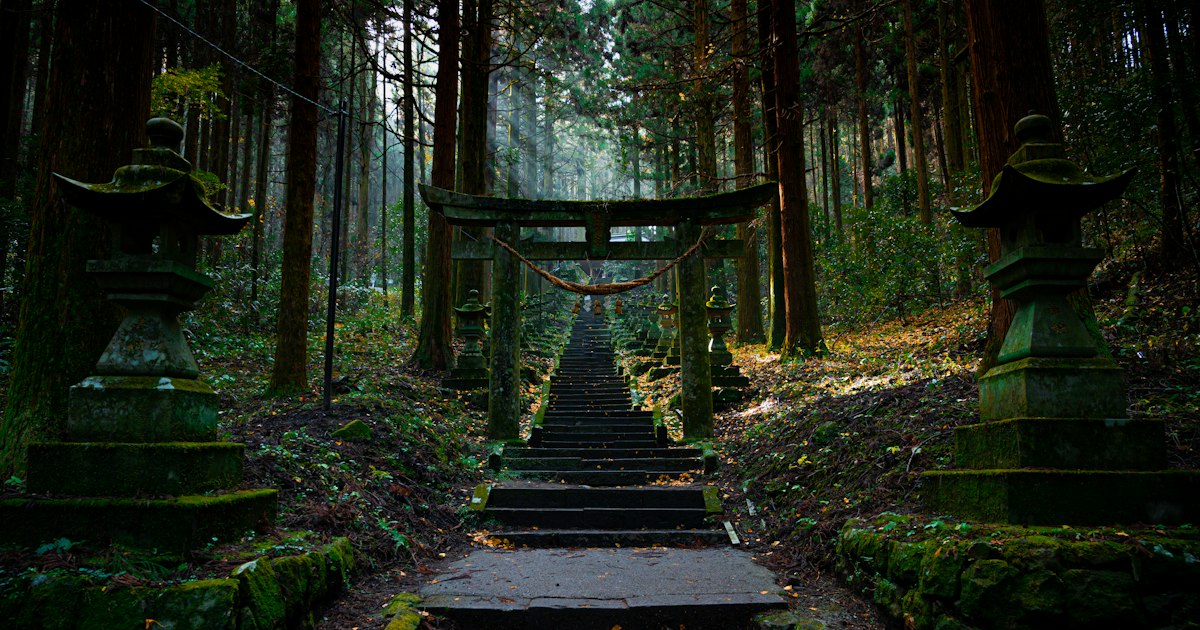
Photo by Samuel Berner on Unsplash
Wedged between Kagoshima and Miyazaki prefectures, Kirishima is one of Kyushu’s great overlooked regions — a cluster of active volcanoes, crater lakes, and sulfur-scented hot spring hamlets that most foreign visitors skip entirely in favor of Kagoshima’s Sakurajima views or the shrines of Kyoto. That’s a shame, because Kirishima is where Japanese creation mythology is supposedly set in stone: this is the spot where, according to the Kojiki and Nihon Shoki, the god Ninigi-no-Mikoto descended from heaven to found the imperial line. Add steaming rotenburo baths tucked into pine forest and a genuinely low-key travel pace, and it’s an easy 1-2 day add-on to a Kagoshima or Miyazaki itinerary.
Kirishima-Jingu Shrine: the mythological heart
Kirishima-Jingu is the obvious first stop. The vermillion-and-gold shrine buildings standing today date to 1715 — the shrine has been rebuilt and relocated several times over its history because earlier structures were damaged by eruptions from the volcanoes it honors. The approach is a long, tree-shaded stone staircase, and the main hall is a designated National Important Cultural Property. Grounds are open from early morning until around 6pm (varies seasonally), entry is free, and the shrine office selling omamori and goshuin stamps is typically staffed 8:30am-5pm.
Don’t confuse this shrine with Takachiho-gawara, a separate site higher up the mountain where the ruins of the original shrine (“Furumiya”) mark the spot nearer the mythical landing place. It’s a 20-minute drive from Kirishima-Jingu and has its own small visitor rest house and a trailhead for Takachiho-no-mine peak (1,574m) — a steep but manageable 1.5-2 hour round-trip hike with views across the whole volcanic plateau on a clear day.
Shinmoedake and checking before you hike
Kirishima isn’t a dormant postcard backdrop — Shinmoedake, the volcano looming behind the shrine, erupted as recently as 2011 and 2018 and remains monitored by the Japan Meteorological Agency. Trailheads around Takachiho-gawara and the summit area get closed without much notice when the alert level rises. Before planning a hike, check the current volcanic alert level (search “JMA Shinmoedake” or ask at the Ebino Kogen Eco Museum Center) rather than assuming last year’s trail map is accurate. This is the single most common planning mistake visitors make here — showing up expecting to summit and finding the approach roped off.
Ebino Kogen: crater lakes and cool-air hiking
About 20 minutes by car above the onsen villages sits Ebino Kogen, a highland plateau at roughly 1,200m elevation ringed by extinct and dormant craters now filled with jewel-toned lakes — Rokkannon Miike, Fudoike, and Byakushiike among them. The full loop trail connecting the lakes takes about 1-1.5 hours at an easy pace, mostly flat boardwalk and gravel path, and the Eco Museum Center at the trailhead (open 9am-5pm, free entry) has maps, restrooms, and a free foot bath fed by natural hot spring water. Because of the elevation, it’s noticeably cooler than Kagoshima city — bring a layer even in summer, and expect near-freezing temperatures with occasional light snow in January-February.
The best time to visit is early-to-mid November for fiery autumn foliage around the lakes, or late May into early June, when the native Miyama Kirishima azaleas turn the slopes pink-red. Midsummer brings humidity and haze that dull the crater-lake views, so if your schedule is flexible, avoid July-August here.
The hot spring villages
Kirishima Onsen isn’t one town but a loose string of small hamlets scattered through the forest below Ebino Kogen — Maruo, Ikoma, Hinatayama, and a few others, each with its own well and slightly different mineral character (sulfur, iron, or the milky white water locals call “nigori-yu”).
- Budget: Several simple public bathhouses allow day bathing for roughly 150-500 yen — basic facilities, no-frills, and the most authentic way to soak alongside locals rather than other tourists.
- Mid-range: Hotels and ryokan around Ikoma Kogen typically offer day-use onsen access for 600-1,000 yen, and an overnight stay with dinner and breakfast usually runs 15,000-20,000 yen per person.
- Splurge: A handful of ryokan built into the hillsides have private or semi-open-air baths overlooking the valley, paired with a multi-course dinner closer in style to the kaiseki ryori served at Japan’s higher-end inns. These run from around 35,000 yen per person per night and up, including dinner and breakfast.
A practical note: many of these smaller ryokan and bathhouses are cash-only or have unreliable card readers, so don’t count on tapping a card at the front desk. If you’re traveling with a card that skips foreign transaction fees — see this rundown of no-foreign-transaction-fee credit cards — keep it as a backup, but carry cash as your primary payment here. The nearest reliable ATMs are at convenience stores back down toward Kirishima-Jingu Station or Kokubu; 7-Bank ATMs at 7-Eleven are the easiest withdrawal option if you’re coming from Kagoshima city before heading up.
Getting there and getting around
Kagoshima Airport is the closest gateway, only about 20-30 minutes by car or taxi from Kirishima-Jingu — taxis run roughly 4,000-5,000 yen, and a few direct airport buses connect to Kirishima-Jingu Station and nearby hotels, though schedules are thin (sometimes just a handful of runs per day), so check times in advance rather than assuming you can walk up and go.
By train, take the JR Nippo Line from Kagoshima-Chuo Station to Kirishima-Jingu Station (about 50 minutes, roughly 1,000-1,200 yen), then a short taxi ride (around 10 minutes, 1,500 yen or so) up to the shrine itself, since onward buses are infrequent. If you’re flying into Fukuoka first, as many Kyushu itineraries do — see our guide to Fukuoka Airport — you’ll want the Kyushu Shinkansen down to Kagoshima-Chuo (about 1 hour 20 minutes) before transferring to the Nippo Line or renting a car.
Honestly, a rental car is the easiest way to see Kirishima properly. Buses between Ebino Kogen, the onsen villages, and the shrine run on a limited, seasonal schedule, and a car lets you chase the volcano views and foliage at your own pace rather than building a day around two or three bus departures.
A few things to plan around
Beyond checking the volcanic alert level, pack for temperature swings — the onsen villages sit at a different elevation than Ebino Kogen above them, so a warm afternoon at the shrine can turn into a cold evening soak. Many ryokan here serve dinner early, often by 7pm, and some of the smaller public bathhouses close by early evening too, so don’t plan a late arrival expecting to bathe before bed. Lastly, if cultural sightseeing is the main draw, pair the shrine visit with Takachiho-gawara in the same day — they’re close enough to combine, and most visitors who skip the ruins site regret it once they realize it’s where the actual legend is supposed to have unfolded.