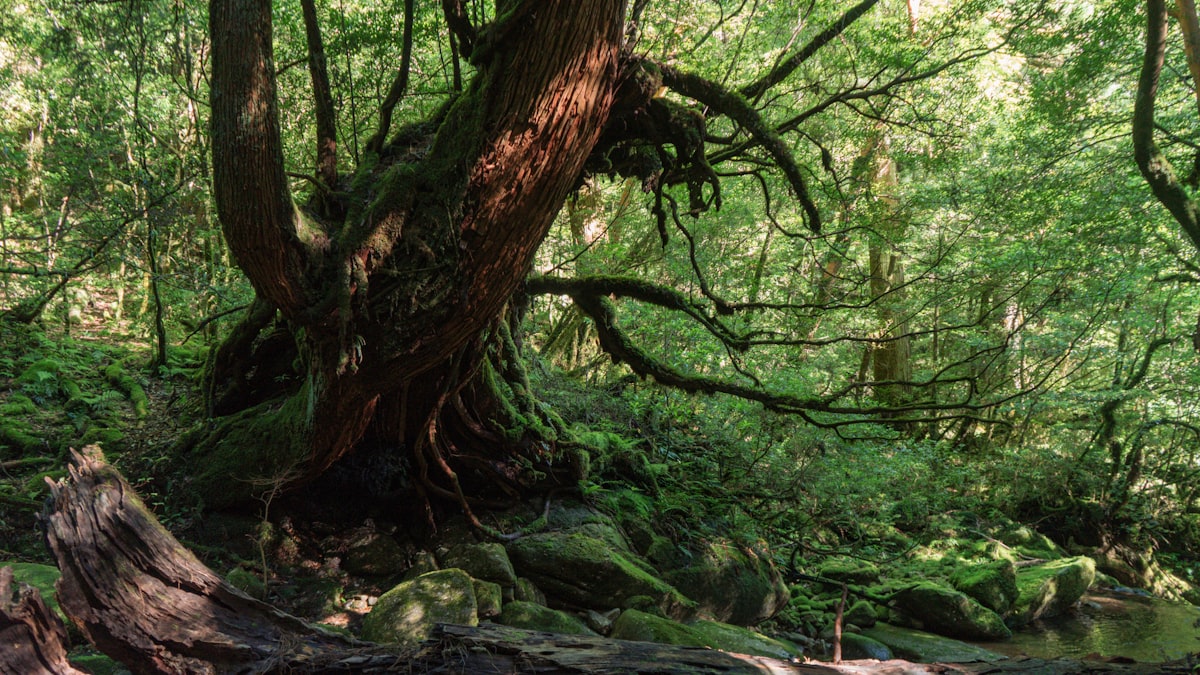
Yakushima is a small, round, mountainous island off the southern tip of Kyushu, covered in a primeval cedar forest so old and mossy it inspired the forest scenes in Studio Ghibli’s Princess Mononoke — see our Studio Ghibli guide if that’s what brought you here. It’s one of Japan’s two original UNESCO World Heritage natural sites, and it feels almost nothing like the rest of the country: wetter, wilder, and far less visited than Okinawa or Hokkaido.
Why Yakushima is different
The island receives extraordinary rainfall — locals joke that “it rains 35 days a month” — which is exactly why its interior supports ancient yakusugi cedar trees, some estimated at over 1,000 years old, with the oldest specimens possibly exceeding 7,000 years. The climate shifts dramatically with elevation: subtropical palm trees near the coast give way to cool temperate forest, then near-alpine conditions at the island’s highest peaks, which top 1,900 meters — genuinely unusual for such a small landmass this far south.
What to do
- Jomon Sugi hike — the trek to Japan’s most famous ancient cedar is a full-day commitment: roughly 10 hours round trip, starting well before dawn, with a shuttle bus required to reach the trailhead (private cars are restricted). This is a serious hike, not a casual walk.
- Shiratani Unsuikyo Ravine — the more accessible option, and the specific forest that inspired the Mononoke imagery. Trails range from an easy 1-hour loop to a 4-hour hike, making it realistic for most fitness levels.
- Yakusugi Land — an easier forest park with boardwalk trails from 30 minutes to 2.5 hours, good if Jomon Sugi’s full-day hike isn’t feasible.
- Sea turtles — Yakushima’s beaches (notably Inakahama) are a major loggerhead turtle nesting site from May to July; guided night viewing tours run in season, though flash photography and unguided visits are restricted to protect nesting turtles.
- Onsen with ocean views — several outdoor hot springs sit right at the coastline, including tidal baths that are only accessible at low tide.
Getting there
- By plane — regional flights connect Yakushima Airport with Kagoshima (about 35 minutes) and, seasonally, Osaka and Fukuoka.
- By high-speed ferry — the Toppy/Rocket jetfoil runs from Kagoshima port in roughly 1 hour 50 minutes to 2 hours 40 minutes depending on the route, a scenic and often cheaper alternative to flying.
- By slow ferry — an overnight or several-hour car ferry option exists for those bringing a vehicle or on a tighter budget.
- Kagoshima itself is reachable from Fukuoka and Kumamoto by train, or directly from Tokyo and Osaka by air.
Getting around the island
Yakushima is genuinely rural — there’s no train, and bus service is limited outside the main trailhead shuttles. Most visitors rent a car at the airport or port; the coastal ring road takes only about 2–3 hours to circle the entire island without stops, but the interior mountain roads are narrow and slow. If you don’t want to drive, most hotels can arrange trailhead transfers and a handful of local tour operators run day trips that include transport, guiding, and permits where required.
Planning your visit
- Best time to visit — spring (March–May) and autumn (October–November) bring the most stable weather; given how much it rains year-round, pack for rain regardless of season.
- How long to stay — two to three nights is the realistic minimum to fit in a major hike plus the coastal sights without rushing; the Jomon Sugi trek alone should be its own dedicated day.
- What to pack — proper rain gear, layered clothing for the elevation swing, and sturdy hiking shoes; the popular trails are well-maintained but can be muddy and root-covered.
- Guides — not required for Shiratani Unsuikyo or Yakusugi Land, but strongly recommended for the full Jomon Sugi trek if you’re not an experienced hiker, since the early start and distance catch people off guard.
Combining it with the rest of Kyushu
Yakushima pairs naturally with a wider Kyushu trip that includes Fukuoka and the hot-spring towns of Beppu and Yufuin — fly into Fukuoka, work your way south, and end with the ferry or flight from Kagoshima to Yakushima as the trip’s final, quietest chapter. It’s a demanding add-on rather than a relaxing one, but for travelers who’ve already done Tokyo and Kyoto and want to see a side of Japan that feels genuinely remote, it’s hard to beat.
Food and where to stay
Accommodation on Yakushima leans toward small family-run guesthouses (minshuku) and mid-size hotels rather than large resorts, concentrated in the towns of Miyanoura and Anbo near the two ferry ports. Many include two meals a day, which is worth taking given how few restaurant options exist near the trailheads. Local specialties include flying fish (tobiuo), often served as sashimi or deep-fried, and the island’s own citrus, ponkan, in season during winter. Because options are limited compared to mainland cities, book accommodation well ahead for peak seasons — Golden Week and the summer school holidays fill up fastest, and some of the smaller guesthouses only take a handful of guests a night.