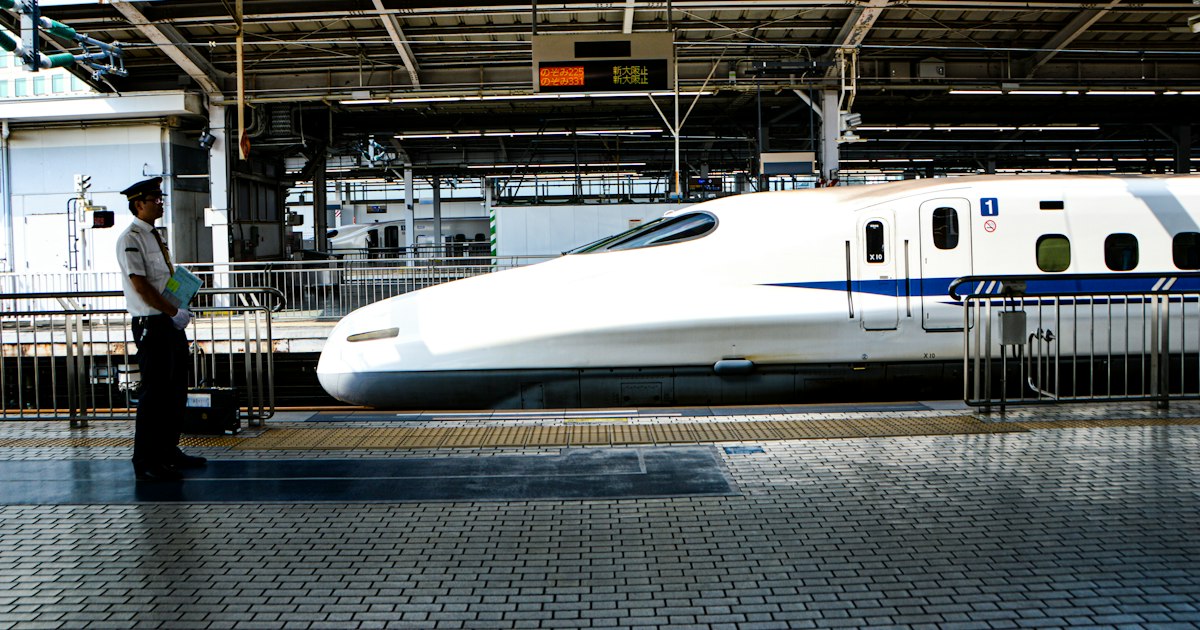
Photo by henry perks on Unsplash
If your Japan itinerary runs from Tokyo through Osaka and on to Hiroshima, Kyoto’s neighbor Himeji, Okayama, Fukuoka, or even Kagoshima, there’s a good chance you’ll have to get off one Shinkansen and board another at Shin-Osaka. It isn’t a difficult transfer, but it catches first-time visitors off guard because they assume every bullet train just keeps rolling west. Here’s exactly what happens at this platform, why it happens, and how to move through it without stress.
Why You Have to Change Trains Here
Shin-Osaka sits at the boundary between two separately operated rail lines that happen to share the same tracks and look like one continuous Shinkansen network. The Tokaido Shinkansen (Tokyo to Shin-Osaka) is run by JR Central. The Sanyo Shinkansen (Shin-Osaka to Hakata) is run by JR West. The Kyushu Shinkansen beyond Hakata to Kagoshima-Chuo is run by JR Kyushu.
The fastest trains, Nozomi and Mizuho, are scheduled to run straight through this boundary without a change, so a Tokyo-to-Hakata trip on a Nozomi stays on the same train the whole way. The problem is Hikari and Kodama. Most Hikari services and almost all Kodama services terminate at Shin-Osaka rather than continuing west, because they’re built around the Tokaido side’s stopping pattern. If your ticket has you on a Hikari or Kodama and your destination is Himeji, Okayama, Hiroshima, or further west, you will need to disembark and board a Sanyo Shinkansen Sakura or Kodama service to continue. The same applies in reverse for eastbound travelers connecting from Kyushu or western Honshu toward Tokyo.
Finding Your Platform
All Shinkansen services at Shin-Osaka use platforms in the 20s, separate from the conventional JR Kyoto Line and Osaka Loop Line platforms (numbered lower, closer to the station’s east side) and from the Midosuji subway line, which runs beneath the station for connections to Namba and Umeda. The Shinkansen platforms are arranged as paired island platforms, and directional boards above each staircase clearly mark which services (Tokyo-bound vs. Hakata-bound) stop there. Overhead and on-platform LED displays show the next few departures by train name (Nozomi, Hikari, Sakura, Kodama), departure time, and platform, in both Japanese and English, so even without Japanese you can confirm you’re in the right spot by matching your ticket’s train name and departure time rather than memorizing a platform number in advance.
If you’re arriving on a Tokaido train and continuing on a Sanyo train, check the connecting platform the moment you step off; Shin-Osaka’s layout often allows a same-platform or adjacent-platform transfer rather than a long walk, but this isn’t guaranteed every time, so don’t dawdle on the platform taking photos before checking the board.
Making the Connection Step by Step
- Stay inside the Shinkansen gates. If your tickets (whether paper or an IC-linked Shinkansen e-ticket like Smart EX) cover the full journey, you do not need to exit through the ticket gates and re-enter. Walk directly to the connecting platform using the overhead signage.
- Check both the departure time and the train name, not just the platform number, since multiple services can use the same platform at different times.
- If you’re unsure, look for staff in the dark-blue JR West or JR Central uniforms near the gates; showing them your ticket and saying your destination gets you pointed in the right direction immediately.
- Reserved-seat holders should note their car and seat number in advance; non-reserved (jiyuseki) passengers should queue at the marked floor numbers for cars 1 to 5 on most trains, which are typically the non-reserved cars.
How Much Time to Leave for the Transfer
Many standard itineraries booked through JR’s reservation systems already build in a connection of roughly 10 to 20 minutes at Shin-Osaka, which is enough if you move at a normal pace. Where it gets tight is self-planned trips where you’ve booked two separate tickets without checking the realistic gap, or where your inbound train arrives late. Shinkansen services run with remarkable punctuality, but if you’re assembling your own connection rather than using a through-booked itinerary, avoid cutting it closer than 10 minutes, especially with luggage, a stroller, or a large item like a musical instrument that needs its own reserved space (if you’re traveling with a cello, guitar case, or similar oversized item, it’s worth reading up on the Shinkansen’s extra-seat rules for musicians before you book, since those reservations work differently from standard luggage).
Where to Spend a Longer Layover
If your connection gives you 30 minutes or more, or you’ve deliberately built in a longer break, Shin-Osaka itself has convenience stores, bento shops, and the Osaka institution 551 Horai selling its pork buns (butaman) from a platform-area counter, usually for a few hundred yen each, a reliable and fast train snack. For anyone with an hour or two to spare and willing to step outside the gates (you’ll need to validate your ticket again to re-enter), the subway or a short taxi ride connects to central Osaka, where Tenjinbashi-suji, Japan’s longest covered shopping arcade, is a worthwhile stretch-your-legs option with food stalls and shops running for nearly 2.6 kilometers. Just build real buffer time around any excursion outside the gates; missing a reserved train because you underestimated the walk back is the single most avoidable travel mistake at this station.
Common Mistakes to Avoid
- Assuming all Shinkansen trains run through. Only Nozomi and Mizuho reliably continue past Shin-Osaka without a change; Hikari and Kodama usually terminate there.
- Confusing train names with destinations. “Sakura” and “Kodama” are train brand names on the Sanyo/Kyushu side, not places; check the name against your ticket, not the city you think you’re heading to.
- Exiting the gates unnecessarily. If your ticket covers the whole route, exiting and re-entering the Shinkansen gates wastes time and risks confusion at the gate itself.
- Underestimating evening connections. The last Sanyo Shinkansen departures toward Hiroshima or Hakata can leave earlier than the last Tokaido train arrives from Tokyo, so check the connecting train’s timing in advance if you’re traveling on a late train.
Best Times to Transfer
Shin-Osaka’s platforms get genuinely crowded during Japan’s three big travel peaks: the few days around New Year, Golden Week in late April and early May, and Obon in mid-August, when reserved seats sell out and platforms fill with people managing suitcases. Early April cherry blossom season adds extra tourist volume on top of the usual business travel crowd on weekday mornings and early evenings. If you have flexibility, transferring mid-morning or mid-afternoon on a weekday outside these peak windows gives you the calmest platforms and the best odds of grabbing a same-platform connection without a crowd crush.