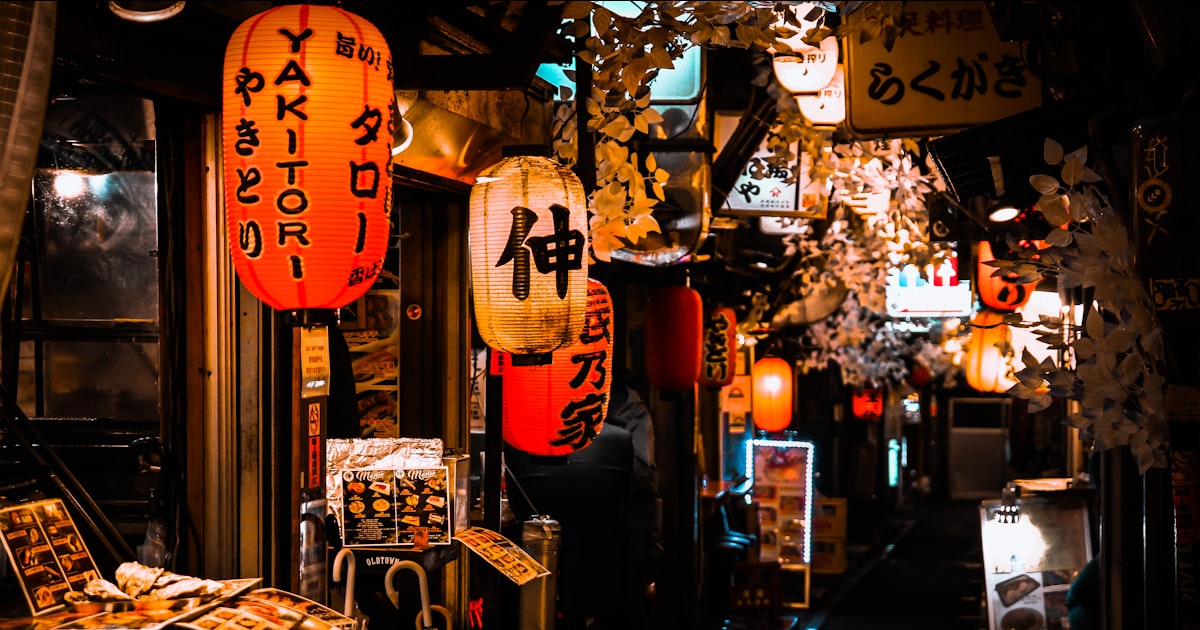
Photo by Pema G. Lama on Unsplash
Wedged between the JR tracks and Yodobashi Camera’s flagship store, Omoide Yokocho is two narrow lanes of yakitori stalls so small that half the seats are just stools facing a grill. Its nickname, Shonben Yokocho (“Piss Alley”), dates back to the postwar black-market years when the area had no public toilets — the name stuck even after the alley cleaned up. It’s touristy now, smoky, and a little cramped, and it’s still one of the best places in Tokyo to eat grilled chicken parts off a stick while a cook two feet away fans the coals. Here’s how to actually do it well.
What Omoide Yokocho Actually Is
This is a cluster of roughly 60 tiny stalls (yatai) spread across two covered alleys just northwest of Shinjuku Station’s West Exit, most seating between 4 and 15 people. Almost every stall specializes in some version of yakitori or motsuyaki (grilled offal) — chicken thigh, skin, cartilage, liver, heart, and the beef and pork intestine dishes that give the alley its slightly funky smell. A handful of stalls do ramen, oden, or unagi instead, so it’s not exclusively a chicken-skewer crawl. The area burned down in 1999 and again partially in 2014, and was rebuilt with modern wiring and fire suppression, so despite the retro Showa-era look, the structure itself is new.
Getting There and Best Timing
From JR Shinjuku Station, take the West Exit (Nishiguchi) and walk about 2–3 minutes north along the tracks; you’ll see the low wooden entrance signs before you reach Yodobashi Camera’s main building. It’s also a 3-minute walk from Seibu-Shinjuku Station. There’s no gate and no admission — you just duck into whichever stall has an open seat.
Most stalls open around 3–5pm and run until midnight or later; a few open for a lunch service around 11am–2pm with cheaper donburi or yakitori sets (around ¥800–1,200), which is a good option if you want the atmosphere without the crowds. The alley is loudest and most packed from 7pm to 10pm, especially Friday and Saturday. If you want elbow room to actually enjoy your beer, aim for a weekday between 5pm and 6:30pm, or go for the quieter lunch window. After 10pm on weekends it can be standing-room only in the narrower lane.
How to Order Like You’ve Done This Before
Walk the alley once before committing — most stalls post a menu outside, often with photos or English/Chinese translations, and you can see how full each one is. Once you sit, a few things are near-universal: many stalls charge a small seating/table charge (otoshi), typically ¥300–500, sometimes in the form of a small starter dish you didn’t order but do pay for. This isn’t a scam, it’s standard izakaya practice across Japan — just budget for it.
Skewers (yakitori/motsuyaki) usually run ¥150–450 each depending on the cut, and most people order 2–3 different skewers at a time rather than a big batch all at once, so you can keep pace with your beer. A mug of draft beer (nama biru) is around ¥500–700; highballs and shochu are similar. Cash is still king in the alley — plenty of stalls, especially the smallest ones, don’t take cards or IC cards (Suica/Pasmo), so carry at least ¥5,000–8,000 in cash for a night out. Seats are limited and shared with strangers, so if a stall is full, it’s completely normal to stall-hop rather than wait.
What to Eat (and What to Skip if You’re Squeamish)
The classics worth ordering: negima (chicken thigh and leeks), tsukune (chicken meatballs, often with a raw egg dip), kawa (crispy grilled skin), and tebasaki (wings). If you’re feeling adventurous, nankotsu (chicken cartilage) and reba (liver) are good gateway items into the offal side of the menu, before you graduate to motsu (intestines) or hatsu (heart). A few stalls do exotic items like grilled frog or horse — these are the exception, not the rule, and are usually clearly marked.
If yakitori isn’t your thing, some stalls in the alley grill unagi or serve oden, and it’s worth knowing more broadly what you’re looking at if eel interests you — see our guide to unagi and where to eat it for context on grades and pricing elsewhere in Tokyo. And if the smoke and offal genuinely aren’t for you, Yodobashi Camera’s building and the station concourse have several conveyor-belt sushi options nearby — our kaiten-zushi chain comparison covers what to expect if you’d rather eat sushi than skewers.
Budget, Mid-Range, and Splurge Nights
Budget (¥1,500–2,500): One drink, 4–5 skewers, and the seating charge at a standing-only stall. This is enough to get the experience without committing to a full meal.
Mid-range (¥3,000–5,000): Two rounds of drinks, 8–10 skewers, maybe a bowl of ramen or oden to finish, split across one or two stalls. This is the sweet spot most visitors land on for a proper dinner-and-drinks night.
Splurge (¥6,000–9,000): A few of the newer, slightly more polished stalls run sake-pairing courses or offer rarer cuts (wagyu skewers, uni add-ons) at proportionally higher prices. Worth it once if you want a step up from the plastic-stool standard.
Common Mistakes to Avoid
- Assuming every stall is tourist-friendly. A few smaller counters are effectively regulars-only in practice — if the staff seem hesitant or the menu is handwritten Japanese with no photos, it’s fine to just move to the next stall rather than force it.
- Not carrying cash. Card and contactless acceptance has improved but is still inconsistent stall to stall; don’t rely on it.
- Confusing this with Golden Gai. They’re both historic Shinjuku alleys but serve different purposes — Omoide Yokocho is about food and standing-bar yakitori, while Golden Gai across town near Kabukicho is almost entirely tiny themed bars with cover charges and little to no food. If you want both in one night, see our guide to Golden Gai and how to drink there — it’s a 10–15 minute walk from Omoide Yokocho and makes a natural second stop.
- Expecting to linger for hours at one stall. Seats are scarce and turnover is part of the culture; if there’s a line forming behind you, it’s polite to wrap up after a round or two rather than camp out.
- Skipping breakfast the next morning. If you overdo the shochu, Shinjuku has several old-school kissaten serving thick coffee and pilaf-style breakfasts that are a good antidote — our guide to kissaten and what to order covers what to look for.
Omoide Yokocho rewards showing up hungry, curious, and with small bills in your pocket. Go early for a calmer meal, go late for the full smoky, shoulder-to-shoulder atmosphere — either way, it’s one of the few spots in central Tokyo where a five-minute walk from a major train station still feels like stepping into 1955.