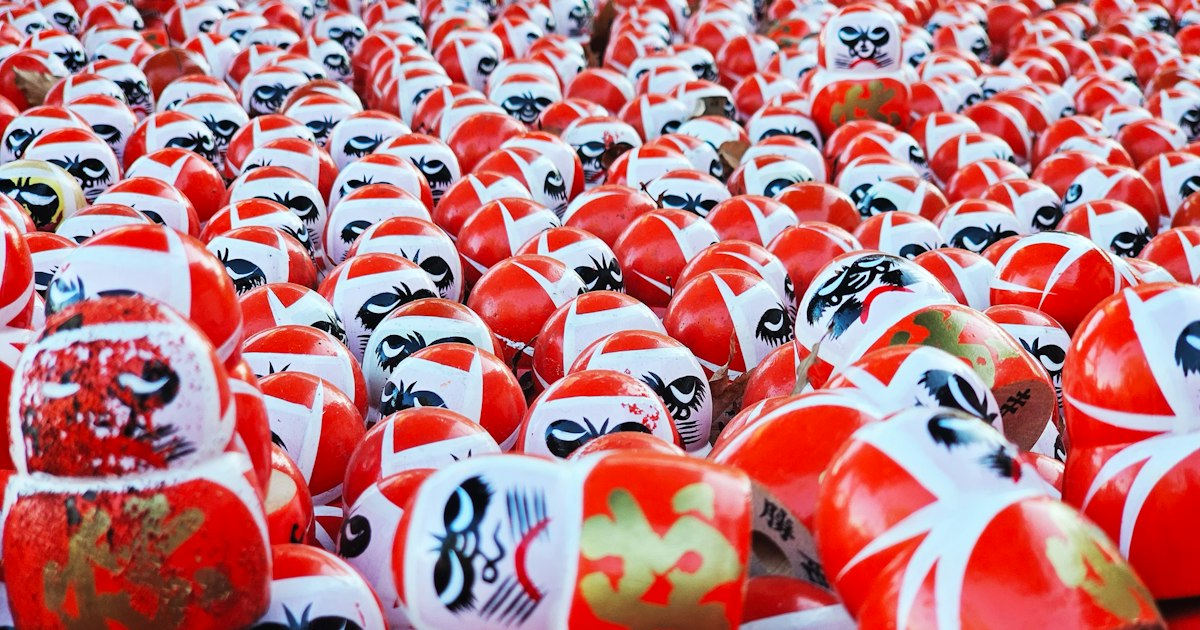
Photo by Max Tcvetkov on Unsplash
That round, red, slightly unnerving doll staring back at you from souvenir shelves across Japan is a daruma — part good-luck charm, part goal-tracker, part folk art. Unlike most souvenirs, a daruma isn’t meant to just sit on a shelf; it’s meant to be used. Here’s what it actually means, how the eye-painting ritual works, and where to buy one that’s more than a mass-produced trinket.
What Is a Daruma Doll, and Why Does It Have No Eyes?
Daruma dolls are modeled after Bodhidharma, the semi-legendary monk credited with founding Zen Buddhism, who is said to have meditated facing a wall for nine years — losing the use of his limbs in the process, which is why daruma have no arms or legs, just a round, hollow, papier-mâché body. That body is weighted at the bottom, so no matter how hard you knock it over, it rights itself. This “roly-poly” quality is the whole point: daruma embody the proverb nanakorobi yaoki — “fall down seven times, get up eight.”
Most daruma are sold with two blank white circles where the eyes should be. That’s not a manufacturing shortcut — it’s the mechanism of the ritual.
The Goal-Setting Ritual: How to Use a Daruma
When you set a goal — passing an exam, starting a business, winning an election, recovering from illness — you paint in the left eye (the doll’s left, your right as you face it) with black ink while stating your intention. The daruma then sits somewhere visible, usually on a household altar, desk, or shop counter, as a daily reminder of the commitment. Only once the goal is achieved do you paint the second eye, “completing” the doll. This is genuinely still practiced — Japanese election candidates painting a daruma eye on victory night is a recurring image on the news every campaign season.
Traditionally daruma are red, a color believed to ward off illness and misfortune, but modern makers sell them in colors keyed to specific wishes: gold or yellow for money and safety, pink for love, green for health, blue for career success, purple for longevity. None of this is centuries-old doctrine — it’s a relatively recent marketing layer on top of the older red-for-protection tradition — but it’s fun to shop by if you have a specific goal in mind.
Takasaki: The Daruma Capital of Japan
If you want an authentic, hand-painted daruma rather than a factory souvenir, go to Takasaki in Gunma Prefecture, which produces around 80% of Japan’s daruma dolls and has done so since the late 1700s. The city’s daruma are made by local craftsmen who hand-paint the face and eyebrows (often stylized as a crane and turtle, both longevity symbols) in a distinctive style known as Takasaki Daruma.
The center of it all is Shorinzan Daruma-ji, a temple on the edge of the city where daruma-making began. The temple grounds are open daily, roughly 8:30am–5pm, and are worth visiting even outside market season to see the hall lined with thousands of retired daruma awaiting their annual burning ceremony. To get there from Tokyo, take the JR Joetsu Shinkansen to Takasaki Station (about 50 minutes from Tokyo Station, or roughly 2 hours on the regular JR Takasaki Line if you’re using a rail pass without shinkansen coverage), then a short taxi ride (about 15 minutes, roughly ¥2,000–2,500) or local bus toward Shorinzan.
Other Places to Buy: Markets, Temples, and Souvenir Shops
Takasaki isn’t the only option, and you don’t need to travel to Gunma just for a daruma:
- Shorinzan Daruma Ichi (Takasaki): the biggest daruma market in Japan, held January 6–7 each year, with hundreds of stalls selling every size at the source.
- Jindaiji Daruma Ichi (Chofu, Tokyo): one of Japan’s “three great daruma markets,” held around March 3–4 at Jindaiji Temple — a much easier day trip from central Tokyo, roughly 20 minutes by bus from Chofu Station.
- Katsuoji Temple (Minoh, Osaka Prefecture): nicknamed the “victory daruma temple,” its grounds are covered in tens of thousands of small red daruma left by visitors praying for success. Admission is around ¥400. It pairs well with a walk to nearby Minoh Falls.
- Souvenir shops everywhere: Asakusa’s Nakamise shopping street in Tokyo, Kyoto’s Nishiki Market area, and Don Quijote stores nationwide all stock smaller daruma year-round, though quality and craftsmanship vary widely.
If you’re building out a broader shopping list of Japanese folk crafts on the same trip, it’s worth comparing daruma to other regional dolls like the kokeshi dolls of Tohoku — both are simple, symbolic, handcrafted, and tied to specific production towns rather than mass manufacturing.
Sizes, Prices, and Colors: Budget to Splurge
Budget (¥500–¥1,500): Small souvenir daruma, roughly 5–8cm tall, sold at Nakamise, Don Quijote, or station gift shops. Fine for a quick gift, but usually machine-stenciled rather than hand-painted.
Mid-range (¥2,000–¥6,000): Genuine Takasaki daruma in the 12–18cm range, hand-painted by a named workshop, sold at Shorinzan or specialty craft stores. This is the sweet spot for a first “real” daruma.
Splurge (¥10,000–¥30,000+): Large daruma (30cm and up), sometimes custom-ordered with calligraphy or a company name painted on the belly for a business launch — a common corporate gift in Japan for a new store opening or product launch.
Best Time to Visit
Early January through early March is the daruma season in Japan, bookended by the Takasaki market (Jan 6–7) and the Jindaiji market (Mar 3–4), which roughly overlaps with the run-up to Setsubun in early February — another good-luck ritual worth combining into the same winter Japan itinerary if you’re interested in seasonal customs. Outside those market dates, temples and craft shops sell daruma year-round, so there’s no need to time a trip specifically around them unless you want the festival atmosphere.
Common Mistakes to Avoid
- Painting both eyes at once. This defeats the purpose — the second eye is meant to be earned, not painted for symmetry on day one.
- Throwing an old daruma in regular household trash. The proper way to retire a daruma, completed or not, is to return it to a temple for a ceremonial burning (often at New Year’s dontoyaki bonfires), not the bin. Most temples, including Shorinzan, accept old daruma from any region, not just their own.
- Assuming any red round doll is “the same.” Regional styles differ noticeably — Takasaki, Shirakawa (Fukushima), and Mibu (Kyoto) daruma all have distinct eyebrow and mustache patterns, so a souvenir-shop version won’t match what you’ll see at a craft market.
- Forgetting it’s fragile-ish. Papier-mâché daruma pack well in a suitcase if wrapped, but avoid checking them loose in luggage — the paint can chip on the raised eyebrows and mustache.
A daruma makes an unusually good souvenir precisely because it isn’t passive — it’s a small, physical commitment device you actually engage with, whether that’s a goal you set the day you buy it or one you finish months later back home when you finally paint in that second eye.