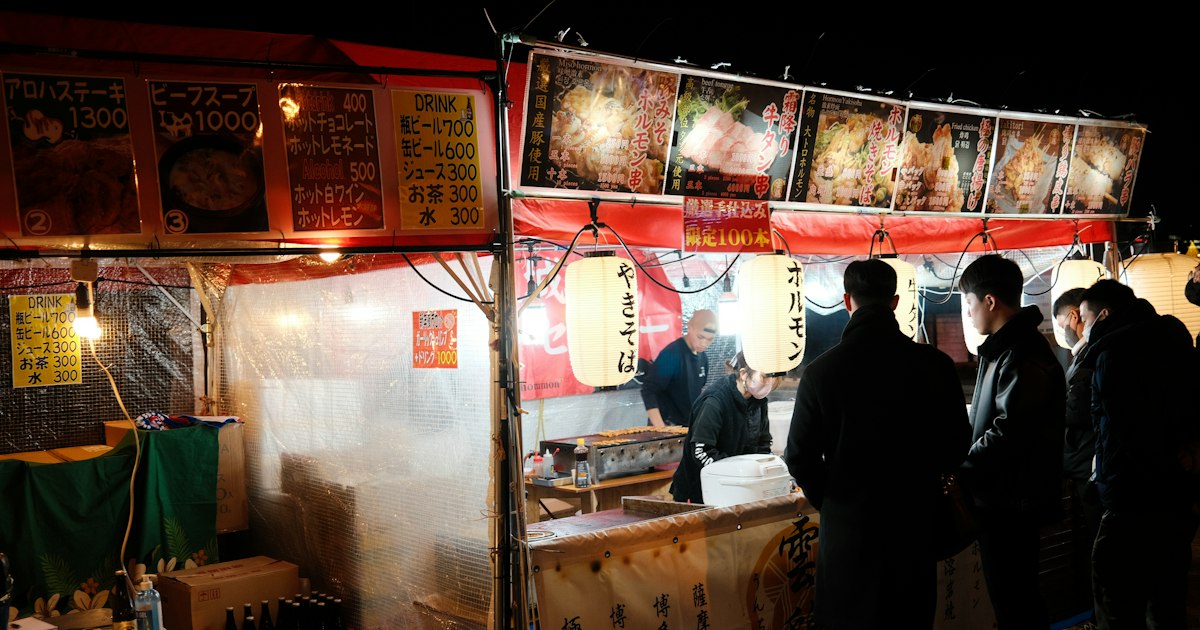
Every evening around sunset, a strip of riverside pavement in central Fukuoka fills with wheeled carts, plastic tarps, and folding stools. Chefs light burners, hang paper lanterns, and within an hour a parking lot has become one of Japan’s last surviving open-air dining scenes. This is Nakasu’s yatai district — and while the ramen and yakitori are reason enough to go, the ordering etiquette trips up almost every first-time visitor. Here’s what you actually need to know.
What Makes Nakasu’s Yatai Different
Yatai are mobile food stalls — essentially a cart with a counter, a tarp roof, and eight to ten stools — that get assembled each evening and packed away by early morning. Fukuoka is the only major Japanese city where this culture survives at scale, with roughly 100 licensed stalls citywide, split mainly between Nakasu (around 40 stalls), Tenjin, and Nagahama. Nakasu, the narrow island between the Naka and Hakata rivers, has the highest concentration and the most atmospheric setting, with stalls lined up along the riverside promenade facing the water and the Fukuoka Tower-lit skyline behind you.
Each stall specializes in a narrow menu — one might do only tonkotsu ramen, another only yakitori, another motsunabe (Fukuoka’s beef and pork offal hot pot) or tempura. Regulars “yatai hop,” eating a small plate or bowl at two or three stalls over the course of an evening rather than settling in at one.
Getting There and Best Time to Go
The closest station is Nakasu-Kawabata on the subway’s Kuko Line, about a two-minute walk to the riverside stalls. From Tenjin, it’s a 10–15 minute walk across the Fukuhaku Deai Bridge. If you’re arriving from Tokyo or Osaka, the Sanyo/Kyushu Shinkansen runs directly into Hakata Station, about 15 minutes by subway or taxi from Nakasu — worth booking a Green Car seat if you want extra legroom on the long ride down.
Stalls typically open around 6pm and run until 1–2am, though exact hours vary stall by stall and many close on Sundays or in bad weather (there’s no shelter beyond a tarp, so rain thins the crowds). Late spring and autumn are the most comfortable seasons to sit outside for a couple of hours; winter stalls stay open with vinyl side-curtains and portable heaters, while summer nights can be humid but lively. Arrive by 6:30–7pm on weeknights to get a seat without waiting; Friday and Saturday nights from 7pm onward routinely produce short queues at the popular stalls.
How the Ordering System Actually Works
There’s no host stand — you simply take an open stool at the counter, and the chef will greet you and often hand over a simple menu (some near Nakasu now have English or photo menus, given the tourist traffic). Most stalls charge a small seating/otsumami fee, typically 300–500 yen, similar to the otoshi charge at a standard izakaya — it usually comes with a small starter dish. Almost every yatai is cash-only, so bring enough 1,000-yen notes; don’t count on a card or IC card reader.
Because seating is limited to under a dozen stools, there’s an unspoken norm of not overstaying — plan for roughly 60–90 minutes per stall if it’s busy, then move on to the next one. Groups larger than four are hard to seat together, so parties often split across two stalls or wait for a full pair of open seats.
What to Order (and What It Costs)
Nakasu’s signature dish is Hakata-style tonkotsu ramen — thin noodles in a cloudy pork-bone broth, usually 700–900 yen a bowl, with a side option to order “kaedama” (an extra portion of noodles for the leftover broth, around 150 yen). Yakitori skewers run 150–350 yen each depending on the cut. Hakata gyoza, pan-fried with a thin, crisp skin, typically comes in sets of five or six for 400–600 yen. If you want the true Fukuoka specialty, order motsunabe — a hot pot of beef or pork offal, garlic, chives, and cabbage in a soy or miso broth, usually sold as a set for two people at 1,500–2,500 yen. The broth here often reflects Kyushu’s sweeter soy sauce tradition, which is worth knowing if you’re curious about how regional shoyu styles change a dish’s flavor. Beer runs about 500–600 yen, and a small flask of local sake is usually 600–900 yen.
Budget, Mid-Range, and Splurge Nights
On a tight budget, one bowl of ramen and a drink at a single stall comes to around 1,200–1,500 yen. A mid-range night — hopping two or three stalls with a few yakitori skewers, gyoza, and drinks at each — lands around 4,000–6,000 yen per person, which is the most common way locals do it. For a splurge, seek out one of the handful of yatai known for higher-end motsunabe or seasonal seafood, where a full course with sake pairing can run 8,000–10,000 yen; some of these require a phone reservation, which a hotel concierge can usually help arrange. If pufferfish is on your list for the trip, Fukuoka is also one of the best and safest places in Japan to try fugu, though it’s served at dedicated restaurants rather than at yatai carts.
Common Mistakes First-Timers Make
- Showing up too early. Most stalls aren’t set up before 6pm; arriving at 5pm just means an empty lot.
- Expecting to pay by card. Bring cash — very few stalls take anything else.
- Not knowing about the seat charge. The 300–500 yen otsumami fee isn’t optional and isn’t a scam; it’s standard practice.
- Overstaying during peak hours. On a packed Friday night, lingering for two-plus hours at a ten-seat stall is considered inconsiderate when people are waiting.
- Turning up as a group of six or more. Stalls physically can’t seat large parties together — split up or pick a bigger izakaya instead.
- Skipping the closed days. Many stalls are shut on Sundays or rotate days off, so if you have one specific stall in mind, check ahead rather than assuming it’ll be there.
Etiquette Tips for a Smooth Night
Let the chef direct you to an open seat rather than picking your own — space is tight and they’re managing the flow. Order isn’t complicated: point at the menu or say the dish name, and food usually arrives within a few minutes since portions are small. Chatting with the strangers next to you is part of the culture, not an intrusion — the counter seating is designed for it. Mention any allergies up front, since these are one- or two-person operations with little room to improvise substitutions. Tipping isn’t expected. And if you’re visiting Fukuoka in late summer, check whether your dates overlap with one of the region’s fireworks festivals — Nakasu gets especially lively on those nights, so book your yatai plans around the crowds rather than against them.