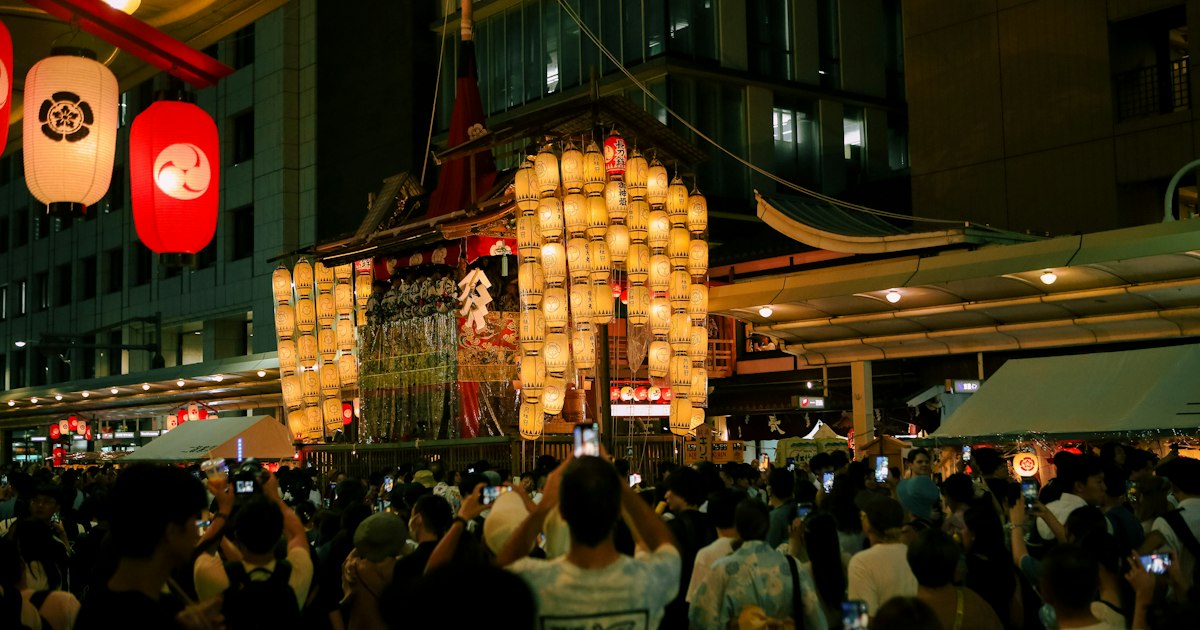
Photo by HANVIN CHEONG on Unsplash
Most visitors think Gion Matsuri is a single parade. It’s actually a monthlong cycle of rituals that runs through all of July, and the two famous processions — Saki Matsuri on July 17 and Ato Matsuri on July 24 — are just the public peak of something far bigger. If you only show up for the floats, you’ll miss the three evenings beforehand when Kyoto’s downtown streets close to traffic and turn into the best part of the whole event.
What Gion Matsuri actually is
Gion Matsuri belongs to Yasaka Shrine and dates back over a thousand years, originally a purification ritual against plague and disaster. Today it’s organized around 33 neighborhood floats (yamaboko) built and maintained by individual machi (town blocks) in central Kyoto. Each float is a wooden structure, some over 20 meters tall, assembled by hand with rope joinery and no nails, then hung with imported tapestries, lanterns, and carved details that often reference the neighborhood’s trade history. The floats split into two groups that process on different dates: Saki Matsuri (23 floats, July 17) and Ato Matsuri (11 floats, July 24).
Yoiyama: the nights before the parade
This is the part locals actually go for. On the three evenings before each procession — July 14-16 for Saki Matsuri and July 21-23 for Ato Matsuri — the floats are assembled and lit with paper lanterns along Shijo, Karasuma, and the surrounding blocks. Streets close to cars from around 6pm, food stalls line the roads, and many neighborhoods let visitors climb onto their float for a small donation, usually 500-1,000 yen, which often includes a souvenir chimaki (a bamboo-leaf charm, not food) believed to ward off illness for the year. July 15-16 is the busiest and most atmospheric of the Saki Matsuri yoiyama nights; go earlier in the evening (5-7pm) if you want to actually move through the crowd rather than shuffle with it.
Some older homes and shops in the float neighborhoods also open their doors during yoiyama to display family heirlooms — folding screens, armor, and antique textiles — in a custom called Byobu Matsuri. It’s free, low-key, and easy to miss if you don’t know to look for the open sliding doors along the shopping streets.
Watching the float processions
The Saki Matsuri procession starts around 9am at Shijo-Karasuma and moves along Shijo-dori, turns north on Kawaramachi-dori, then west on Oike-dori, finishing by early afternoon. Ato Matsuri on July 24 runs the same route in reverse, starting around 9:30am. Free viewing is possible anywhere along the route if you arrive by 7:30-8am for a curbside spot, especially near the Shijo-Kawaramachi turn where the floats are pulled and rotated by hand — this is the single best photo moment, since the turn requires bamboo mats laid under the wheels and a visible team effort to swing each float 90 degrees.
Paid reserved seating (yuryo-kanransheki) is sold through the Kyoto Tourism Council, typically 4,000-6,000 yen for a numbered chair seat with a program, and is worth it if you’re not willing to stand in July heat for hours beforehand. Seats are usually along Oike-dori. Book as early as June through the official Kyoto Gion Matsuri website or convenience store ticket terminals (Lawson/7-Eleven), since good rows sell out weeks ahead.
Getting there and when to go
The float zone centers on Shijo-Karasuma, reachable via Karasuma Line (Shijo Station) or Hankyu Kyoto Line (Kawaramachi Station). From Kyoto Station it’s about 15 minutes by subway for roughly 220-260 yen one-way. During yoiyama evenings and procession mornings, nearby streets close and buses reroute, so the subway is more reliable than a taxi or bus. If you’re coming from Osaka or elsewhere on a JR pass, note that the Karasuma subway line is not JR — you’ll need a separate IC card tap or ticket.
July in Kyoto is brutally hot and humid, regularly 33-35°C with high humidity, so plan for heat rather than rain. Bring a hand towel, a refillable bottle (convenience stores sell cold drinks everywhere), and consider the portable fan/neck-fan setup that’s ubiquitous with locals during yoiyama. If you leave anything behind at a konbini while cooling off, it’s worth knowing what actually happens to lost items left at a Japanese convenience store — staff log and hold them rather than tossing them, so it’s always worth asking.
Common mistakes to avoid
- Assuming it’s one night. Many visitors book one night in Kyoto around “the festival” and miss both the yoiyama buildup and the procession because they land on the wrong date. Check whether you’re targeting Saki Matsuri (mid-July) or Ato Matsuri (July 21-24) specifically.
- Standing on the subway escalators wrong. Kyoto crowds move fast during yoiyama, and local etiquette here follows the Tokyo-style stand-left pattern rather than Osaka’s stand-right — if you’re coming from Osaka, see this breakdown of regional escalator etiquette so you’re not blocking a packed platform transfer.
- Skipping priority seating awareness on crowded trains. Subways get packed with families and elderly yukata-clad visitors during the festival; if you’re not sure when to give up a seat, this guide to yuusenseki priority seats covers what’s actually expected.
- Not budgeting for July travel chaos generally. Gion Matsuri overlaps with the run-up to Obon season, and while it’s not as extreme as mid-August, hotel prices in Kyoto spike for mid-to-late July. Booking a month or more ahead matters.
Budget, mid-range, and splurge options
On a budget, yoiyama itself is free beyond festival food — expect 500-1,500 yen per street-food item (yakitori, takoyaki, kakigori shaved ice) and skip the float-climbing donation if funds are tight; the lantern-lit streets are the real draw anyway. Mid-range travelers should budget 4,000-6,000 yen for reserved procession seating plus a few thousand yen for yoiyama food and a chimaki charm or two as souvenirs. For a splurge, some ryokan and restaurants along the parade route offer private window or balcony viewing packages bundled with a kaiseki meal, often 15,000-30,000 yen per person — ask directly with the ryokan when booking, as these aren’t always advertised publicly and sell out first.
Gion Matsuri rewards slow travelers more than checklist travelers. If your Kyoto trip lands in July, build in at least two consecutive evenings — one for yoiyama, one for the procession morning — rather than trying to compress it into a single busy day.