Photo by Kate Kasiutich on Unsplash
An hour and a half from central Tokyo, a jagged ridge of quarried stone rises out of Chiba’s Boso Peninsula, topped with a cliff-edge platform that drops away into thin air and a 31-meter Buddha carved directly into the rock face. Mount Nokogiri (鋸山, “Saw Mountain,” named for its serrated quarry-cut profile) is one of the most rewarding half-day detours from Tokyo that most visitors never hear about — partly because getting there properly means crossing Tokyo Bay by ferry instead of just hopping a train. Here’s how to do the whole loop in a day, what it costs, and where people usually go wrong.
What’s actually up there
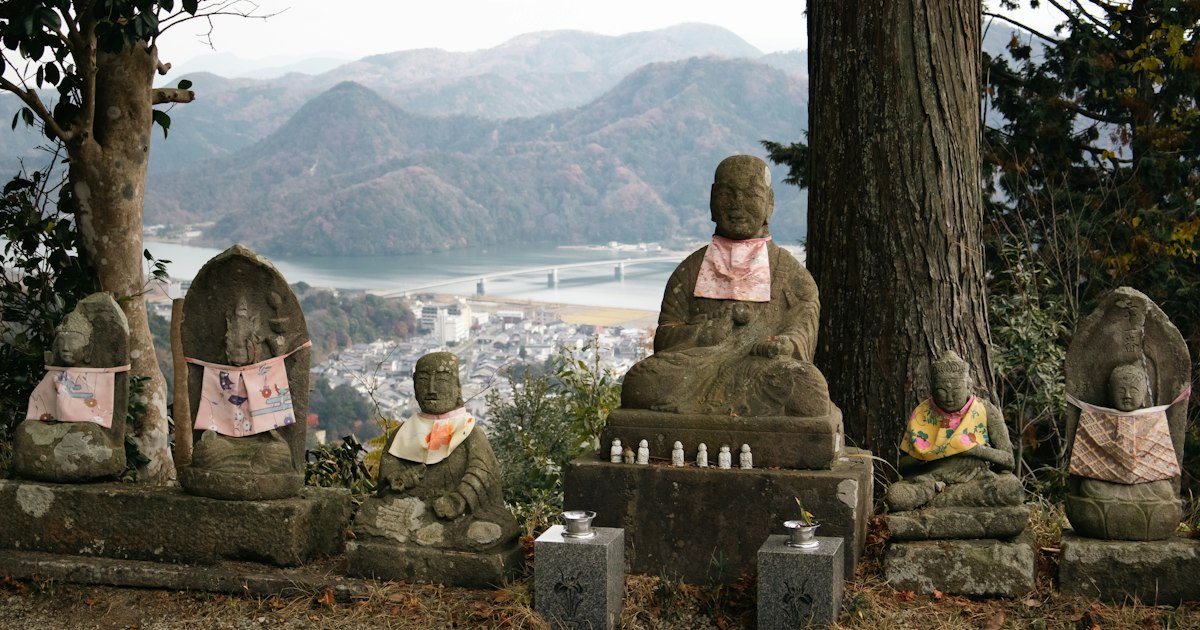
Mount Nokogiri was quarried for stone (known as Boshu stone) from the Edo period through the early 20th century, which is why the cliffs look carved into geometric blocks and overhangs rather than naturally eroded. The grounds now belong to Nihon-ji Temple (日本寺), a sprawling complex founded in 725 that covers much of the mountain. Two things draw people up here:
- Jigoku Nozoki (“Hell’s Peek”) — a narrow stone outcrop jutting over a sheer drop, with a low railing and a view straight down the quarry face to Tokyo Bay. On a clear winter day you can see Mount Fuji across the water.
- The Nihon-ji Daibutsu — Japan’s largest stone-carved sitting Buddha, a Yakushi Nyorai figure about 31 meters tall, originally carved in 1783 and restored in 1969. Unlike the bronze Daibutsu in Kamakura or Nara, this one is cut straight out of the mountain.
There’s also the Hyakushaku Kannon, a smaller cliff-carved figure near the quarry entrance, and a long network of stone-step trails connecting everything — expect genuine stair climbing, not a flat garden stroll.
Getting there: the ferry route (the fun way)
The classic way to do this trip is as a loop using the Tokyo Bay Ferry (Tokyo-wan Ferry), which crosses the bay between Kurihama (Kanagawa, on the Miura Peninsula) and Kanaya (Chiba, at the foot of Mount Nokogiri):
- From Tokyo, take the Keikyu Line to Keikyu Kurihama Station (about 70–80 minutes from Shinagawa), then a short bus or 15-minute walk to Kurihama Port.
- The ferry crossing takes about 40 minutes. One-way adult fare is roughly ¥900; a bicycle or large luggage costs a small surcharge. Ferries run roughly hourly, more frequently on weekends — check the current timetable before you go, since missing one means a long wait.
- From Kanaya Port, it’s a 5–10 minute walk to the base of the Nokogiriyama Ropeway.
Doing the crossing gives you open-deck bay views and, on clear days, Fuji in the distance — arguably as scenic as the mountain itself.
Getting there: the train route (the simpler way)
If you’d rather skip the ferry, take the JR Sobu/Uchibo Line from Tokyo Station toward Kimitsu/Tateyama and get off at Hamakanaya Station, the closest stop to the ropeway base. It’s a direct-ish regional train but usually requires a change at Soga or Kimitsu; total travel time is around 1.5–2 hours, and there’s no need for a reserved-seat limited express unless one happens to be running that day. A regular IC-card fare from Tokyo is roughly ¥1,980 one-way. Many visitors do the loop in one direction — ferry out from Kurihama, train back from Hamakanaya (or vice versa) — rather than doubling back the same way.
Ropeway, hiking, and admission costs
From the Kanaya side, the Nokogiriyama Ropeway whisks you to the mountaintop observation deck in about 4 minutes:
- Round trip: approximately ¥1,200 for adults, ¥600 for children.
- One-way: approximately ¥620 adult — useful if you plan to hike down.
- Last ascent is typically mid-to-late afternoon (earlier in winter), so don’t arrive late and assume you can ride up.
The ropeway deck is a separate area from the Nihon-ji temple grounds where the Daibutsu and Jigoku Nozoki actually are — you still need to walk/climb between them, and pay Nihon-ji’s own entry fee: approximately ¥700 for adults, ¥400 for children. Budget travelers who don’t mind stairs can skip the ropeway entirely and hike up via the marked trails from near Hamakanaya Station, which saves the ropeway fee but adds roughly an hour of climbing on uneven stone steps — wear real shoes, not sandals.
Best time to go and timing mistakes to avoid
Spring (cherry blossoms, March–April) and autumn (foliage, November) are the most comfortable and photogenic seasons; midsummer is brutally humid on the exposed cliff sections, and the stone steps get slick in rain, so check the forecast. Winter mornings after a cold front are your best shot at seeing Mount Fuji from Jigoku Nozoki.
The most common mistake is underestimating total time: between the ferry or train, the ropeway, the walk to Nihon-ji’s upper gate, and the maze of trails to see both the Daibutsu and Hell’s Peek, this easily eats 4–5 hours round trip from Tokyo. Start early — ideally catching a morning ferry or train before 10am — because both the ferry and the ropeway have real last-departure times, not round-the-clock service, and getting stranded on the Chiba side after the last ferry means a long detour by train. Bring cash in small denominations; the ropeway counter and temple entrance both take cash, and food stalls near Kanaya Port often don’t take cards.
Eating and extending the trip
Kanaya and the surrounding Boso coast are known for fresh seafood — look for set meals featuring local fish at the small restaurants near Kanaya Port before you catch your return ferry or train. If you’re visiting in autumn, this stretch of coastal Chiba is also a good spot to try sanma, the grilled autumn saury that shows up on menus up and down Japan’s coastline this time of year.
If you want more flexibility than the ferry/train schedule allows, Chiba’s Boso Peninsula is also popular with riders doing a rented scooter or motorcycle loop along the coastal roads, which lets you combine Mount Nokogiri with other peninsula stops in one day. And if cliffside day trips from Tokyo are your thing, the Enoshima Electric Railway on the opposite side of Tokyo Bay makes a good companion trip for another weekend.
For travelers who like offbeat, slightly haunting sightseeing in the same vein as a cliff carved with a giant Buddha, Nagasaki’s abandoned Gunkanjima and Yamaguchi’s Iwakuni are both worth bookmarking for future trips further afield.