Photo by hiding ninja on Unsplash
Noboribetsu Onsen is the hot spring town where Hokkaido’s volcanic underside is impossible to ignore. Walk five minutes from your ryokan and you’re standing at the rim of Jigokudani — “Hell Valley” — a steaming, sulfur-yellow crater that still bubbles and hisses. It’s one of the few onsen towns in Japan where the geology isn’t just marketing copy; you can see, hear, and smell exactly where your bathwater comes from. Here’s how to plan the trip properly.
What Makes This Hell Valley Different
Jigokudani is a collapsed volcanic crater right at the edge of town, and it’s the reason Noboribetsu exists as a spa destination at all. A paved boardwalk loop (roughly 1 km, free, open around the clock, best lit for walking from early morning to early evening) takes you past vents releasing sulfurous steam and mineral-stained rock in shades of orange and grey. It’s genuinely dramatic, especially at dusk when the steam catches the fading light — in summer, the valley is illuminated for an evening “Fire Festival” walk.
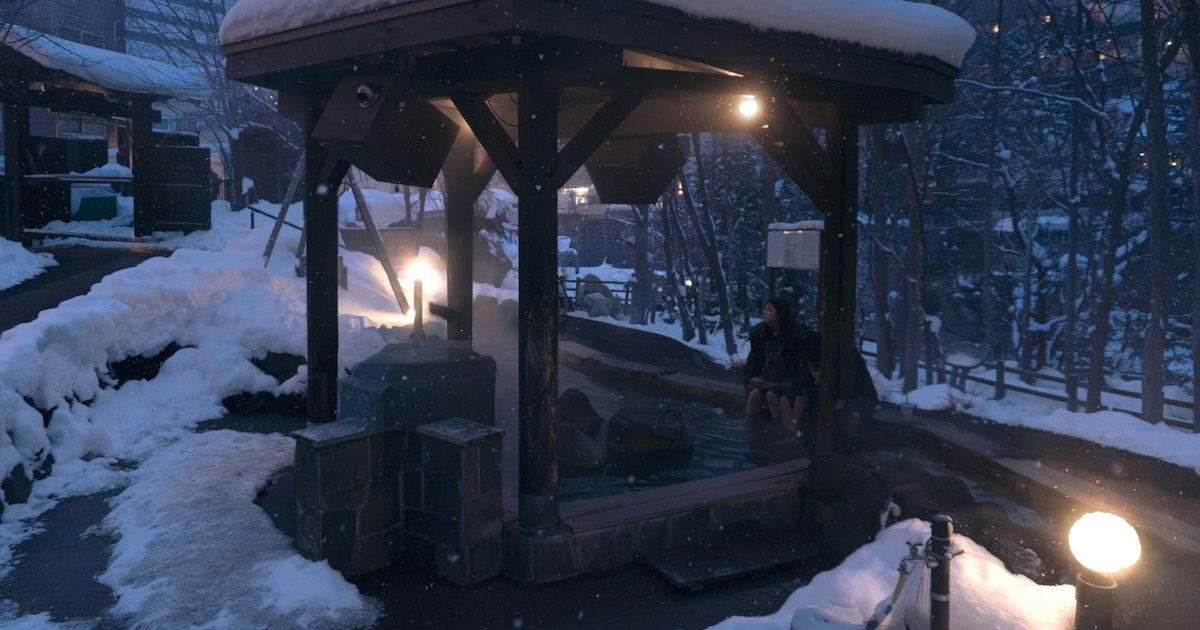
About a 10-minute walk further uphill is Oyunuma, a pond fed directly by the volcanic source, and just below it the Oyunumagawa Natural Footbath — a stream where hot spring water cools as it flows downhill, so you can dip your feet in at a comfortable temperature for free. Bring a small towel; there’s nowhere to buy one on site.
Noboribetsu’s water itself is the other draw: locals claim it has more spring types (sulfur, iron, salt, and several others) feeding the town than almost anywhere else in Japan, which is why so many ryokan here advertise multiple bath rooms under one roof rather than a single tub.
How to Get There
Noboribetsu is in southwestern Hokkaido, inland from the coast between Sapporo and Tomakomai, and it’s a manageable day trip or (better) overnight from Sapporo or New Chitose Airport.
- From New Chitose Airport: Direct highway buses run to Noboribetsu Onsen in about an hour, for roughly ¥2,000–2,500 one-way. This is the easiest option if you’re arriving or departing by air.
- From Sapporo: Direct highway buses (Donan Bus) take around 1 hour 40 minutes and cost roughly ¥2,500–2,800 one-way. Alternatively, take a JR limited express (Hokuto/Suzuran) from Sapporo Station to Noboribetsu Station (around 1 hour, limited express fare included), then a local bus from the station up into the onsen town itself (about 15 minutes, around ¥350). The bus is simpler since it drops you right in the town center; the train requires the extra transfer but runs more frequently.
Either way, budget the better part of a travel day if you’re coming from Sapporo and back — it’s not a quick in-and-out like some hot spring towns closer to Tokyo, such as the ones covered in our Izu Peninsula guide.
Best Time to Visit
Noboribetsu works year-round, but the experience changes a lot by season. Winter (December–March) is the classic choice: snow around the crater rim, steam rising harder in the cold air, and the contrast of a hot bath against sub-zero temperatures is the whole point of onsen culture. Just note that Hokkaido winters are serious — pack real winter boots, since the paths into Jigokudani can be icy.
Summer (July–August) brings warmer, greener valley walks and the town’s Jigoku Matsuri (Hell Festival) in late August, a three-day event with a parade featuring the town’s giant red oni (devil) statue, Yukyu-jin, which normally stands near the main bus stop year-round. Spring and autumn are quieter and avoid both snow hassle and summer crowds — early November is good for fall color on the hills around the crater.
Whatever season, arrive at Jigokudani either early morning or after 5pm if you want it without tour-bus crowds; midday is when day-trippers from Sapporo pass through in large groups.
Where to Stay: Budget to Splurge
Noboribetsu is a classic case where the ryokan isn’t just a place to sleep — the bathing facilities themselves are the attraction, so it’s worth choosing carefully.
- Budget: Smaller family-run ryokan and business hotels in town run roughly ¥8,000–12,000 per person per night without meals. Many still offer access to a decent onsen bath, just smaller than the big hotels.
- Mid-range: Standard ryokan with half-board (dinner and breakfast included) typically run ¥15,000–25,000 per person per night. This is the sweet spot for most visitors and usually includes a multi-course kaiseki dinner featuring Hokkaido seafood and produce.
- Splurge: Dai-ichi Takimotokan is the town’s best-known large-scale bathing complex, with dozens of indoor and outdoor pools drawing on several different spring sources under one roof — some travelers who aren’t staying overnight pay for day-use bathing (roughly ¥2,000–2,500) just to try it. Full-service stays at the larger flagship hotels run well above ¥30,000 per person with multiple dining options.
Book dinner timing when you reserve — most ryokan serve set-time kaiseki dinners and won’t accommodate a late arrival without advance notice.
Onsen Etiquette and Common Mistakes
A few mistakes trip up first-time visitors here more than anywhere else in Hokkaido, simply because Noboribetsu’s baths are so central to the visit:
- Tattoos: Many traditional baths still prohibit visible tattoos. If you have one, check with your ryokan before booking, bring a large waterproof cover sticker, or look specifically for a “tattoo-friendly” property — some of the larger hotels have started relaxing the rule or offer private family baths as a workaround.
- Towel habits: The small hand towel is for modesty walking to the bath and for wiping off before you dry with a full-size towel back in your room — it never goes in the bathwater itself.
- Shoes off, early and often: Between the ryokan entrance, your room, and the bath changing area, you’ll be removing shoes constantly. If you’re not used to this, our guide to shoe etiquette in Japan covers exactly where the line is and how slippers factor in.
- Jigokudani timing: Don’t save the valley walk for after dinner thinking you’ll stroll back at night — some sections of the trail have limited lighting and the smell of sulfur is strongest (and the steam least photogenic) in full darkness. Go before or right after check-in.
Beyond the Baths
If you have an extra half-day, Noboribetsu Bear Park sits on a hilltop reachable by ropeway from the center of town (round-trip ropeway plus park entry runs roughly ¥2,500–3,000 for adults) and houses Hokkaido brown bears along with a small museum on Ainu culture and bear ecology.
Before you leave, the main street through town has omiyage shops selling Hokkaido specialties — melon sweets, dairy products, and sulfur-spring bath salts packaged as souvenirs. If you’re bringing anything back for coworkers, it’s worth skimming our omiyage etiquette guide so individually wrapped portions don’t catch you off guard at checkout. And since you’re already in Hokkaido, it’s worth pairing this trip with the region’s other specialties — fresh sea urchin is one of the island’s signature foods, and our guide to Hokkaido uni points you toward where to eat it well, whether in Sapporo before you head to Noboribetsu or on the coast nearby.
Noboribetsu rewards slowing down — it’s not a drive-by photo stop, it’s a town built entirely around soaking in the thing that makes the ground steam. Give it an overnight if you can.