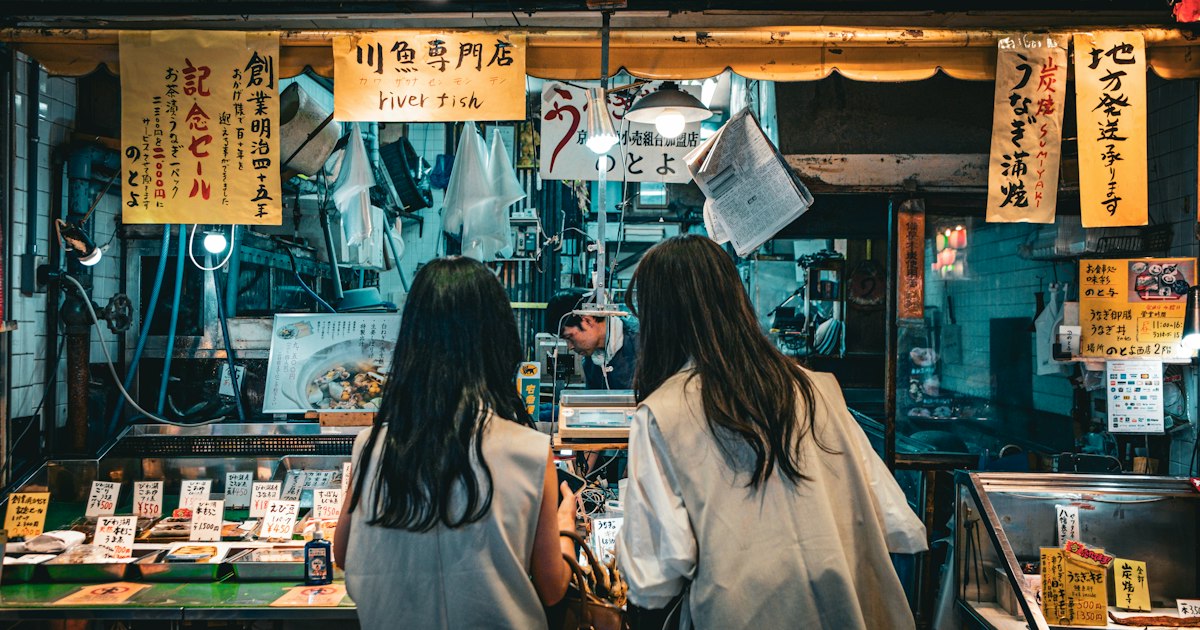
Photo by Owen Roth on Unsplash
In Kochi, on the southern coast of Shikoku, there’s a dish locals will happily argue about for an hour: whose katsuo no tataki is better, which season’s fish is fattier, and whether you’re even allowed to eat it without raw garlic on top. If you’re planning a trip through Shikoku, Kochi’s seared bonito is worth a detour on its own — it’s smoky, citrusy, and nothing like the delicate sashimi most visitors picture when they hear “raw fish.” Here’s how to find the real thing, when to go, and what it should actually cost you.
What Is Katsuo no Tataki?
Katsuo (bonito, sometimes called skipjack tuna) is a migratory fish that passes along Kochi’s coastline twice a year, and tataki is the local way of preparing it: the whole fillet is seared hard and fast over an open flame — traditionally burning rice straw — so the outside turns smoky and lightly charred while the inside stays rare and cool. It’s then sliced into thick pieces, about 1-1.5cm, and plated with a pile of raw garlic slices, sliced onion, myoga (Japanese ginger), scallion, and sometimes shiso or grated ginger. It’s finished with either ponzu (citrus soy sauce) or, in the more traditional Tosa style (Tosa is Kochi’s old provincial name), just a sprinkle of salt and a squeeze of citrus.
The straw matters more than it sounds like it should. Straw burns hotter and faster than charcoal or gas, so the fish gets a few seconds of intense, aromatic heat without cooking through. Some restaurants have switched to gas torches for convenience, but the places worth seeking out still use straw — you’ll smell it before you see it.
Best Season to Eat It: Hatsugatsuo vs Modorigatsuo
Bonito season in Kochi runs in two waves, and locals have strong opinions about both:
- Hatsugatsuo (初鰯) — the “first bonito,” roughly March through June, as the fish migrate north. It’s leaner and prized for a cleaner, firmer texture.
- Modorigatsuo (戻り鰯) — the “returning bonito,” roughly September through October, as the fish head back south after fattening up over summer. This is the richer, fattier catch, closer in texture to tuna belly, and many Kochi residents consider it the better of the two.
If you’re visiting in late October, as many autumn Shikoku itineraries do, you’re actually arriving right in the modorigatsuo window — good timing without even trying. Outside these windows the fish is still served (often frozen or from elsewhere), so if freshness matters to you, ask the stall or restaurant whether it’s today’s catch.
Hirome Market: The Easiest Place to Try It
For most visitors, Hirome Market (ひろめ市場) is the single best introduction. It’s a large indoor food hall a few minutes’ walk from Kochi Castle, packed with roughly 60 stalls selling everything from katsuo tataki to gyoza to local sake, all eaten at shared communal tables in the center. The format is self-serve and informal: you buy from whichever stalls look good, carry your tray to a table, and eat alongside strangers — it’s loud, casual, and very much the point.
Hirome Market is open daily, roughly 8:00am to 11:00pm (some stalls open later or close earlier, and hours shift on Sundays), with no entry fee. A plate of katsuo tataki from one of the dedicated stalls generally runs about 700-1,300 yen depending on portion size, and most stalls also sell it as a donburi (tataki over rice) for a bit more. Go hungry and order from two or three stalls — that’s the normal way to eat here. It gets genuinely packed around lunch (12:00-1:30pm) and dinner (6:00-8:00pm) on weekends, so arriving slightly off-peak makes it easier to grab a table.
Watching the Straw-Fire Performance
Inside Hirome Market, the stall most associated with the theatrical side of this dish is Myojinmaru (明神丸), which sears whole bonito fillets on skewers over a blazing straw fire right in front of customers — the flames leap dramatically for a few seconds before the fish is pulled off and sliced to order. It’s worth timing your visit to catch this if you can; staff generally do the searing in batches rather than continuously, so there may be a short wait.
Outside the market, several standalone restaurants around Kochi city also perform tableside wara-yaki (straw-grilling) as part of a sit-down meal, usually as a multi-course dinner rather than a quick plate. These tend to require a wait or reservation in the evening, especially in peak katsuo season.
How to Get to Kochi
Kochi city is reachable by air or rail. Kochi Ryoma Airport has direct flights from Tokyo Haneda (around 80 minutes) and Osaka Itami (around 50 minutes); from the airport, a limousine bus into central Kochi takes about 25 minutes and costs roughly 740 yen. By train, the JR Nanpu limited express connects Okayama to Kochi Station in about 2.5 hours, which pairs well with a Shikoku or western Honshu rail itinerary. From Kochi Station, both Hirome Market and Kochi Castle are a 15-20 minute walk or a short taxi ride.
If you’re stitching Kochi into a longer multi-stop trip, it’s worth checking discount ticket shops for cheaper routes between Shikoku and the mainland, since JR passes don’t always cover every leg at the best price.
Budget, Mid-Range, and Splurge Options
- Budget: A plate or two at Hirome Market, roughly 1,500-2,500 yen total for a satisfying tasting with a drink.
- Mid-range: An izakaya dinner built around katsuo tataki as the centerpiece, with other Tosa specialties like katsuo no shio-tataki or nira (local chive) dishes on the side — expect roughly 3,000-5,000 yen per person.
- Splurge: A proper tableside wara-yaki course at a specialty restaurant, where the fish is seared in front of you and served as part of a multi-dish set — these courses commonly run 6,000-10,000 yen per person, sometimes more with premium sake pairings.
Common Mistakes to Avoid
- Treating it like plain sashimi. Skipping the raw garlic and onion misses the point — the dish is built around that sharp, pungent contrast with the smoky fish.
- Waiting too long to eat it. Tataki is served immediately after searing and is meant to be eaten within minutes, while the seared edge is still warm and the center still cool. Letting it sit changes the texture.
- Confusing it with katsuobushi. The dried, smoked bonito flakes used for dashi stock are a completely different product from fresh katsuo no tataki — don’t expect the dish to taste like your instant miso soup.
- Only trying ponzu. The traditional Tosa-style version uses just salt and citrus, which lets the smokiness of the straw come through more clearly — ask for it “shio de” (with salt) if you want the more old-school version.
- Not asking about the catch. Outside hatsugatsuo and modorigatsuo season, some of what’s served may be frozen. If you’re particular about freshness, just ask — vendors are generally upfront about it.
If you end up loving it enough to want katsuo flakes or dried bonito products to take home, remember that fish products can be bulky and that checked baggage fees on ANA and JAL add up fast if you’re stocking up — weigh your souvenirs before you get to the airport. And if you order the tataki as a donburi over rice, it’s a good excuse to compare the local short-grain rice against what you might bring home yourself; our guide to Koshihikari and other Japanese rice varieties covers what’s worth packing. Finally, if the garlic and ginger garnish inspires you to recreate the dish at home, a proper oroshigane grater makes a real difference in texture compared to a Western box grater.