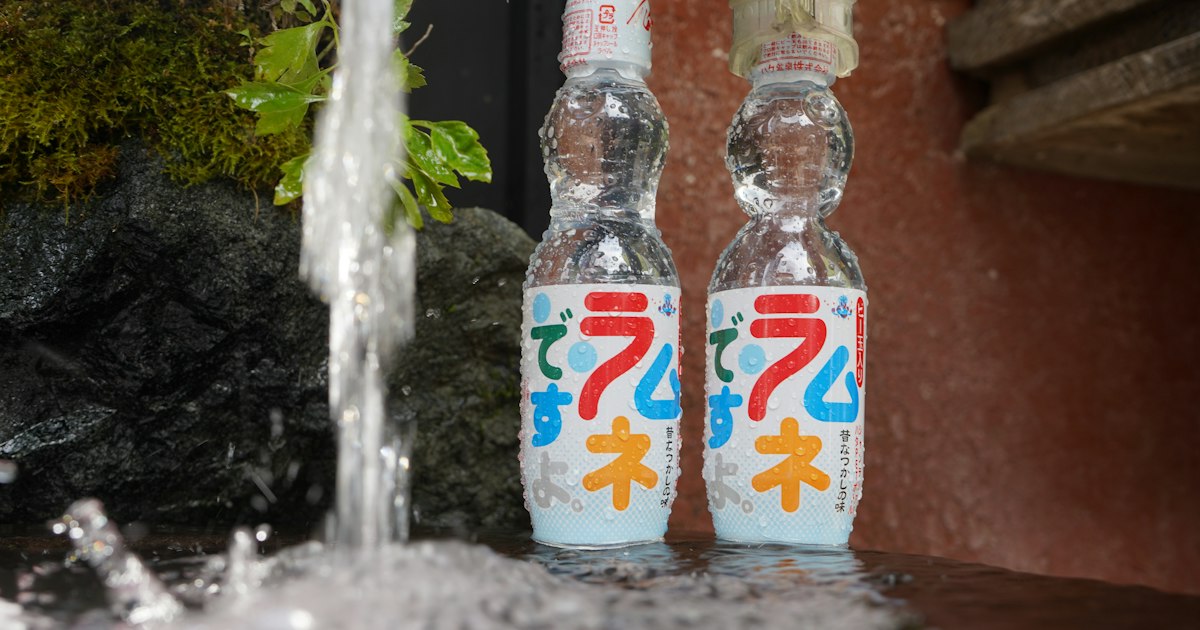
Photo by Yosuke Ota on Unsplash
Walk past any convenience store cooler or summer festival stall in Japan and you’ll spot it: a stubby glass bottle with a glass marble trapped in its neck, fizzing faintly under the lights. That’s ramune, Japan’s original soft drink, and figuring out how to open one without spraying yourself is practically a rite of passage for first-time visitors. Here’s what it actually is, how to drink it properly, and where to find the best versions.
What Is Ramune, Actually?
Ramune’s name is a Japanese transliteration of “lemonade,” and the drink dates back to 1884, when it was introduced as an import from the West. The glass Codd-neck bottle — sealed by a marble pressed against a rubber ring inside the neck by the carbonation itself — was a British design from the 1870s that fell out of use almost everywhere except Japan, where it became permanently associated with ramune. The oldest and best-known maker is Kobe-based Hata Kosen, which has been bottling ramune since 1888 and still uses the traditional glass bottle for its flagship “original” flavor, a pale, faintly citrusy soda that doesn’t map neatly onto any Western soft drink — think somewhere between lemon-lime soda and bubblegum, minus the sweetness overload.
Today most mass-market ramune (Sangaria and Shirakiku are the other big names) comes in cheaper plastic versions of the same bottle shape, but the original glass-and-marble format is still widely sold and is the one worth seeking out for the experience.
How to Open a Ramune Bottle (Without Soaking Your Shirt)
Every ramune bottle comes with a small plastic opener in a seal around the cap — don’t throw it away before you’ve used it. Peel it off, place the ring of the opener over the bottle’s mouth, and press straight down firmly with your thumb. You’ll feel a pop as the marble drops from the neck into the wider chamber below. The common mistake is pressing at an angle or hesitating halfway — the carbonation reacts the moment the marble shifts, and an uneven push is what causes the foam-up-and-over spill that catches people off guard. Push straight down, in one motion, and hold the bottle slightly away from you just in case.
Once it’s open, the marble rattles around a narrowed section of the neck that keeps it from falling back up and blocking your mouth as you drink — an oddly satisfying piece of 19th-century engineering. You can’t fully remove the marble without breaking the bottle, so don’t bother trying; shaking it to “get it out” is the second most common rookie move, and it just means more spilled soda.
Flavors Worth Seeking Out
Original (sometimes labeled “ramune” or “lemon-lime”) is the classic and the one most convenience stores stock. Beyond that, seasonal and regional flavors are where it gets fun: melon, strawberry, lychee, Calpico-style yogurt, and blue “Hawaii” flavor (a blue-curaçao-colored, cotton-candy-adjacent taste with no actual tropical fruit in it) are common year-round. Novelty maker Tomomasu produces joke flavors — curry, wasabi, cola, even octopus — sold mostly as souvenirs rather than something locals drink regularly; you’ll find these in gift shops and at stores like Don Quijote, often boxed as a mixed set for around ¥600–¥900 for four or five mini bottles. They’re a fun, lightweight gift to bring home, though they taste exactly as strange as they sound.
Where to Buy Ramune in Japan
Budget (¥120–¥180): Convenience stores (7-Eleven, Lawson, FamilyMart) and supermarkets stock plastic-bottle ramune year-round, chilled and ready to drink, open 24 hours. This is the easiest, cheapest way to try it, though you miss the marble-bottle ritual since most convenience-store versions use a plastic cap instead.
Mid-range (¥200–�003>¥350): Look for the genuine glass Hata Kosen bottles at department store food halls, retro candy shops (dagashi-ya), and souvenir sections of train stations. These are worth the small premium for the real glass-and-marble mechanism. If you’re exploring old-fashioned candy culture, Kashiya Yokocho (Candy Alley) in Kawagoe, a short train ride from central Tokyo, has several shops selling glass-bottle ramune alongside traditional dagashi snacks — most shops there open around 10am and close in the late afternoon, with some closed on Mondays.
Splurge / experience (¥300–¥500): Festival stalls (yatai) at summer matsuri charge more for the same bottle, but you’re paying for the atmosphere — drinking ramune in a yukata among lantern light is the quintessential version of this experience. Street food crawls like Kuromon Ichiba Market in Osaka also sell cold ramune as a palate-cleanser between stalls, which is a good way to work one into a food-focused day without seeking out a dedicated shop.
Best Time and Place to Drink It
Ramune is technically available all year, but it’s a summer drink through and through — it’s marketed, stocked, and sold overwhelmingly between June and late August, when festival season is in full swing. If your trip overlaps with Obon in mid-August, that’s prime ramune territory: nearly every yatai row at a bon odori festival will have a tub of it on ice. Outside of summer you’ll still find it in convenience stores and specialty shops, but the festival-stall version — cold, fizzy, handed to you in the middle of a crowd — is the one people actually remember.
If you want a quieter, more composed way to try retro Japanese drinks and sweets together, pairing ramune with a bowl of anmitsu or mitsumame at an old-school kissaten (coffee shop) makes for a good non-festival alternative — both are holdovers from the same early-20th-century era of Japanese food culture.
Taking Ramune Home
The glass bottles are heavier and more breakable than they look, so if you’re buying a few as gifts, wrap them well inside your checked luggage or buy from an airport shop just before departure. Unopened bottles survive air travel fine as long as they’re cushioned — clothing works as well as anything. If you’d rather not risk it, the plastic-bottle versions and the novelty mini-bottle gift sets travel much more safely and are sold in most souvenir shops at train stations and airports, so there’s no need to carry a fragile 200ml glass bottle across the country if you’re not planning to drink it right away.