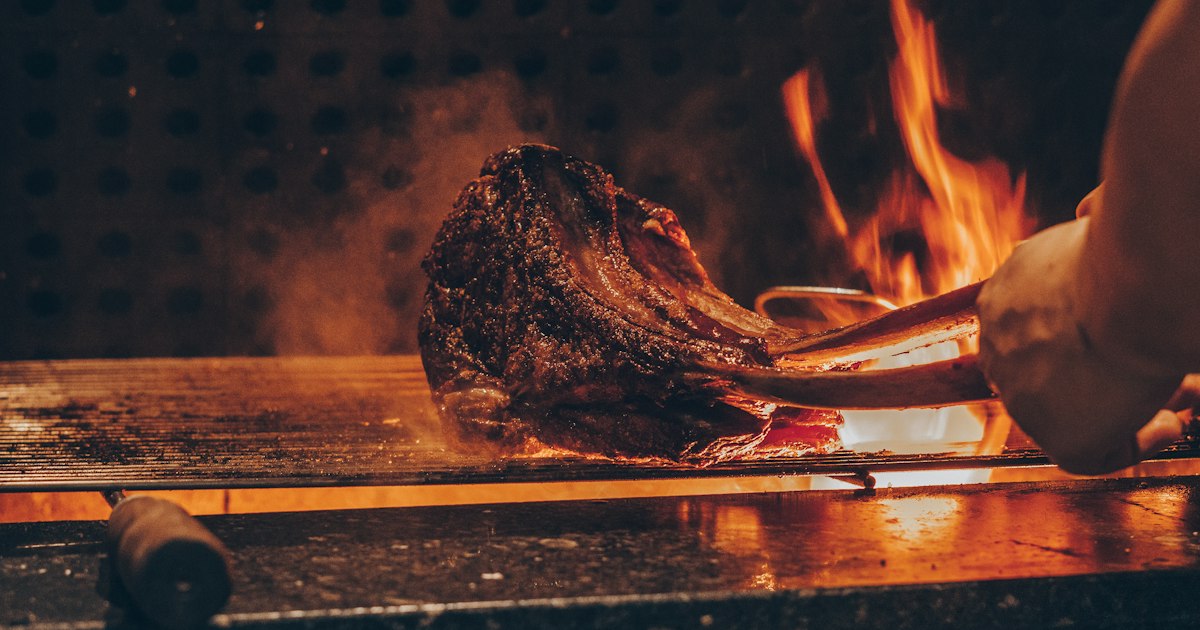
Photo by Emerson Vieira on Unsplash
“Kobe beef” is one of the most misused food names on the planet. Menus from Las Vegas to Bangkok advertise “Kobe beef burgers” for a few dollars, which is a statistical impossibility — genuine certified Kobe beef is one of the rarest, most tightly regulated agricultural products in Japan, with an annual output small enough that it couldn’t supply even a fraction of the restaurants claiming to serve it. If you’re planning to spend real money on Kobe beef during your trip, it pays to know exactly what the certification looks like and where the fakes slip in.
What Actually Qualifies as Kobe Beef
Kobe beef isn’t a marketing term — it’s a legally defined product controlled by the Kobe Beef Marketing and Distribution Promotion Association (神戸肉流通推進協議会). To carry the name, the meat must come from Tajima cattle, a strain of Japanese Black (kuroge washu) raised and born in Hyogo Prefecture, and the animal must be slaughtered at a designated abattoir inside the prefecture. Only virgin cows or castrated steers qualify — bulls don’t. On top of that, the carcass must weigh between 270kg and 499.9kg, and it must grade A or B on the Japan Meat Grading Association scale with a Beef Marbling Standard (BMS) score of 6 or higher, on a scale that runs up to 12.
That’s a narrow set of conditions. Roughly 3,000–5,000 cattle a year actually clear this bar — a tiny number next to Japan’s overall beef output, and microscopic next to global demand for the name. Most of what’s labeled “Kobe beef” outside Japan, and a fair amount inside Japan too, is something else: wagyu from a different prefecture, crossbred cattle, or beef with no Tajima bloodline at all.
The Certification Seal and ID Number to Look For
Genuine Kobe beef comes with paperwork, and good restaurants are proud to show it. Each certified carcass is issued a 10-digit individual identification number that traces back to a specific animal, including its birth farm and nose-print registration — the Japanese cattle traceability system assigns every cow a unique ID at birth, similar to a passport. Restaurants serving the real thing will often display a certificate (証明書) bearing this number, sometimes framed near the entrance or printed at the bottom of the bill.
The official Kobe beef logo is a round seal depicting a cow in profile, used on certificates and promotional material by the Association. If a restaurant can’t produce a certificate with a traceable ID number when asked, or if the “Kobe beef” on the menu is suspiciously cheap, treat the claim skeptically. A proper Kobe beef steak course simply cannot be priced like a standard wagyu dinner — the economics don’t allow it.
How to Verify Before You Order
The Kobe Beef Association maintains an official list of restaurants and retailers authorized to use the name, searchable on their site (kobe-niku.jp). It’s in Japanese, but prefecture and city names are easy enough to pick out, and it’s worth a quick check before booking if you’re traveling specifically for the beef. Within Japan, authorized restaurants display a certified seal sticker near the entrance or on the menu itself; it’s reasonable to simply ask staff, “Kore wa honmono no Kobe-gyu desu ka?” (“Is this genuine Kobe beef?”) — legitimate places expect the question and will happily show you the certificate.
Outside Japan, the pool of truly authorized Kobe beef restaurants is extremely small — exports only began around 2012 and remain tightly limited, so a handful of high-end restaurants in a few cities worldwide hold the real license. If a restaurant outside Japan serves “Kobe beef” at a casual price point, it is not Kobe beef.
Common Imitations and Red Flags
A few patterns show up constantly on menus aimed at tourists:
- “Kobe-style” or “Kobe-inspired” beef — a direct admission it isn’t certified. This is the most common honest dodge.
- Generic “wagyu” — wagyu just means Japanese cattle breed; it covers everything from Kobe-tier marbled beef to ordinary grocery-store cuts. Kobe beef is a subset of wagyu, not a synonym for it.
- Other regional brands sold as “Kobe” — Matsusaka beef (Mie Prefecture) and Omi beef (Shiga Prefecture) are excellent, legitimately prized wagyu brands in their own right, but they are not Kobe beef and shouldn’t be relabeled as such.
- Suspiciously low prices — a genuine Kobe beef steak course in Japan rarely comes in under about 8,000–10,000 JPY even at the simpler end; a “Kobe beef burger” for 1,500 JPY is almost certainly a different cut of beef entirely.
If you want to taste a different, honest category of beef dish while you’re weighing your budget, gyukatsu, Japan’s seared beef cutlet, is a satisfying and transparently priced alternative that doesn’t trade on brand confusion.
Where to Eat the Real Thing in Kobe
Kobe city itself, around Sannomiya and Kitano, has the highest concentration of genuinely certified restaurants, many open roughly 11:00–15:00 for lunch and 17:00–22:00 for dinner, with last orders typically an hour before close. Sannomiya Station is about 2.5 hours from Tokyo via the Tokaido-Sanyo Shinkansen (change at Shin-Osaka or ride direct depending on the service), or roughly 30 minutes from Osaka’s Umeda district by regular train.
Budget-conscious travelers can try a Kobe beef lunch set at a mid-tier teppanyaki counter for around 6,000–9,000 JPY, which usually includes a smaller cut than the dinner course but carries the same certification. Mid-range dinner courses with a proper sirloin or fillet steak, soup, salad, and garlic rice generally run 12,000–20,000 JPY per person at well-regarded teppanyaki houses in the Kitano and Sannomiya area. For a splurge, high-end counters serving A5-grade, high-BMS cuts with a chef cooking tableside can run 25,000–40,000 JPY or more per person — and at this tier, reservations matter. The same reservation discipline that applies to Michelin-starred dining in Japan applies here too; see our guide on booking a Michelin-starred restaurant as a tourist for strategies that transfer directly to popular Kobe beef counters, which can book out weeks ahead during peak travel seasons (spring and autumn).
Bringing the Experience Home
If a trip to Kobe isn’t in your itinerary but you still want to cook high-marbled wagyu-style beef at home, the technique matters as much as the meat. A proper teppan griddle plate lets you replicate the low, even heat that teppanyaki chefs use to render the fat slowly rather than scorch it — the single biggest mistake people make when they finally get their hands on genuinely marbled beef and then overcook it on a standard frying pan.
Whatever you order and wherever you order it, the simplest rule holds: real Kobe beef is rare, traceable, and priced accordingly. If a menu can’t back up the name with a certificate and an ID number, it’s selling you something else — which might still be good beef, just not the beef you’re paying for.