Photo by Yosuke Ota on Unsplash
If you’ve spent any time on a Japanese booking site searching for an onsen stay, you’ve probably hit a wall of unfamiliar terms: ichi shoku tsuki, ni shoku tsuki, sudomari, kaiseki. These aren’t just menu options — they change the price, the schedule of your evening, and sometimes whether you can leave the property at all during dinner hours. Here’s how the three main meal plan types actually work, what you’ll pay, and which one fits your trip.
The three plan types, in plain English
Room-only (sudomari, 素泊まり) gets you the room and the bath, nothing else. You eat elsewhere. This is the cheapest option and the most flexible, but it skips the entire reason many people book a ryokan in the first place — the elaborate dinner.
Half-board / one-meal (ichi shoku tsuki, 一食付き) usually means breakfast only, though a few properties flip this to dinner-only for guests arriving late. Breakfast at a ryokan is still a proper multi-dish affair — grilled fish, rice, miso soup, pickles, a simmered dish, sometimes a tabletop burner for cooking an egg or tofu — just scaled down from dinner.
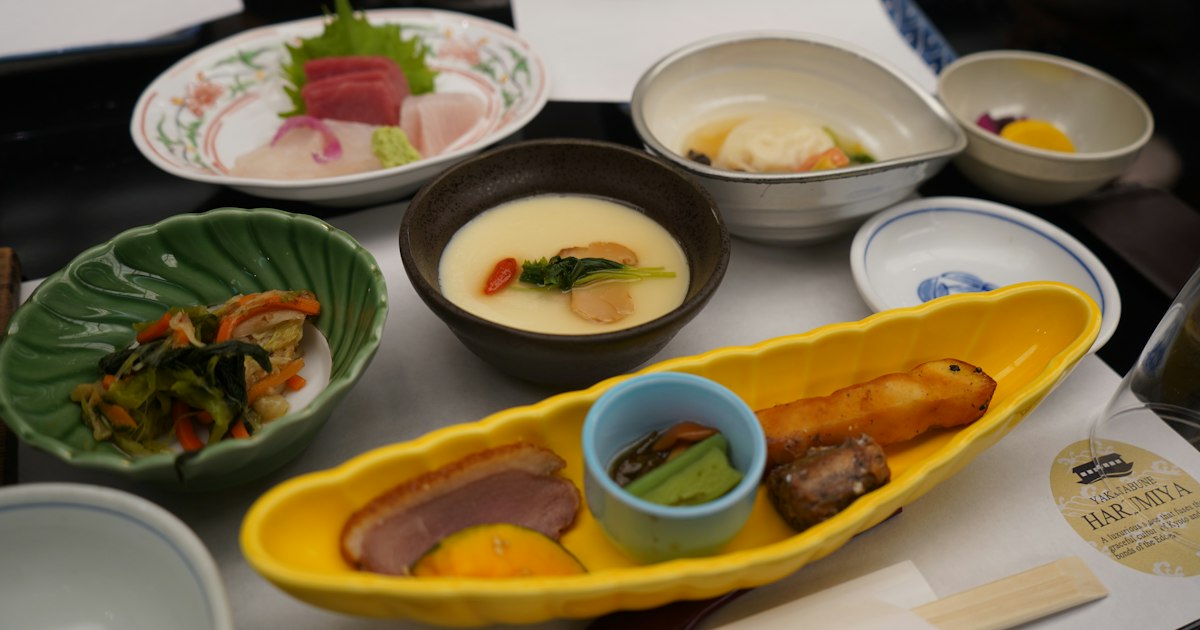
Full board with kaiseki (ni shoku tsuki, 二食付き, “two meals included”) is the classic ryokan experience: a multi-course kaiseki dinner served in your room or a private dining room, plus breakfast the next morning. This is what most photos of lacquered trays and seasonal sashimi are advertising, and it’s the default plan on most booking pages unless you actively select otherwise.
What you actually pay
Pricing is per person, based on double occupancy, and varies enormously by region and property grade — but rough bands as of 2025–2026 look like this:
- Budget (room-only or breakfast-only): ¥8,000–¥15,000 per person. Common at hot spring towns geared toward day-trippers and backpackers, like parts of Beppu or Kinosaki.
- Mid-range (kaiseki dinner + breakfast): ¥18,000–¥35,000 per person. This is the sweet spot for most first-time ryokan guests — think Hakone, Kinosaki, or Kurokawa Onsen.
- Splurge (kaiseki with premium ingredients — wagyu, crab, ise-ebi lobster — often with a private open-air bath): ¥45,000–¥100,000+ per person. Found at high-end properties in Hakone, Kyoto’s Arashiyama, or Yufuin.
Note that these are per-person rates, not per-room — a couple booking a kaiseki plan should budget double the quoted figure, plus the mandatory onsen tax (typically ¥150–¥300 per person per night, paid locally, not included in the online price) and often a bathing/facility fee of a few hundred yen if it’s not bundled in.
Why room-only is riskier than it looks
Many onsen towns are genuinely remote — a handful of streets, maybe one or two izakaya, and everything closes by 8 or 9pm. If you book sudomari assuming you’ll just walk out and find dinner, check the town first. Smaller hot spring villages in places like Nyuto Onsen or rural Kyushu can leave room-only guests with convenience-store rice balls as their only option after dark. Room-only makes much more sense in larger onsen towns with a real dining scene, or if you’re staying near a city and plan to eat out regardless.
There’s also a timing issue: ryokan dinner service is typically a single seating window, often 6:00–8:00pm, and the kitchen stops taking orders after that. If you’re coming from a late train or a sunset hike, confirm the latest check-in time the meal plan allows — some properties require you to be checked in by 6pm to make dinner at all.
How kaiseki dinner actually unfolds
A kaiseki dinner at a ryokan generally runs 8–12 courses over 90 minutes to two hours: an appetizer, sashimi, a grilled dish (often the signature item — regional fish, Hida beef, or in winter, crab), a simmered dish, a steamer or hot pot course, rice and miso soup, and dessert. Staff bring courses in sequence rather than all at once, so this isn’t a meal to rush — if you have an early onsen reservation elsewhere or a train to catch, mention it when you book.
Dietary restrictions need to be flagged well in advance — ideally at booking, and again by phone or email a few days ahead. Vegetarian, halal, and allergy accommodations exist at many ryokan now but require advance prep since menus are often fixed and seasonal, not à la carte. Don’t expect substitutions at the table.
Picking the right plan for your trip
- One-night onsen trip from Tokyo or Kyoto: go full board (ni shoku tsuki). You’re there for the ritual — bath, dinner, bath again, sleep — and skipping dinner undercuts the whole point.
- Multi-night stay in one town: consider breakfast-only or room-only for one of the nights and eat at a local restaurant instead, especially in food-forward areas like Kinosaki or coastal Kochi, where you can try specialties like sawachi ryori seafood platters at a dedicated restaurant rather than a scaled-down hotel version.
- Traveling with a baby or toddler: factor in bath logistics alongside meal plans — our guide on bringing young children into an onsen covers age limits and family bath bookings that often need to be arranged at the same time as your meal plan.
- Budget travelers doubling up on sightseeing: room-only frees you to explore nearby towns for dinner without wasting a paid-for kaiseki course you’re too tired to enjoy after a long travel day.
Common mistakes to avoid
The biggest one: assuming leftovers can be boxed up. Kaiseki is served hot, in sequence, and ryokan kitchens are not set up for takeout the way restaurants are — if you’re full, it’s generally expected you leave the rest, for reasons covered in our piece on why most restaurants in Japan won’t let you take food home. Pace yourself through the early courses.
Second: booking the cheapest plan on a comparison site without checking what “meal included” actually means — some listings bundle breakfast only and call it half-board, others flip the terminology. Always check the Japanese term in parentheses (一食付き vs 二食付き vs 素泊まり) if the English translation feels ambiguous, since machine-translated booking pages occasionally garble this.
Third: not accounting for dinner timing against your travel plans. If you’re arriving in a rural onsen town and relying on infrequent local trains or buses, build in buffer — missing the last connection in a remote area can mean a long wait for a taxi or an unplanned extra night, similar to the scrambling covered in our guide to missing the last ferry on Japan’s remote islands.
Best time to book
Kaiseki menus change seasonally, so autumn (matsutake mushroom, saury) and winter (crab, fugu in some regions) tend to command the highest prices and book out fastest — reserve 2–3 months ahead for weekends in these seasons at popular towns like Hakone or Kinosaki. Early spring and early summer are comparatively easier to book and sometimes slightly cheaper, since they fall between the headline seasonal ingredients.