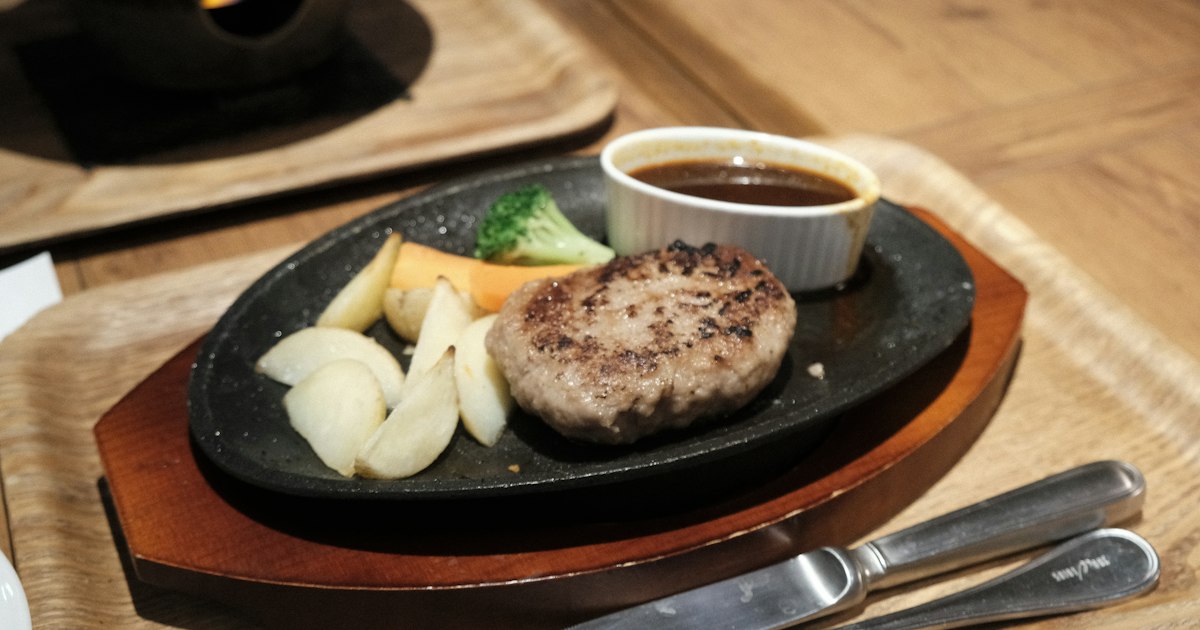
Ask anyone from Shizuoka what you have to eat in their prefecture and you’ll get one answer before they even finish thinking: hambagu, the Japanese hamburger steak, served so rare in the middle that the first cut releases a thin run of pink juice across a scorching iron plate. The texture is the whole point — a loosely packed, fatty patty that’s seared hard on the outside and left almost raw in the center, so it collapses and melts on the tongue the way a good piece of fatty tuna does. Locals just call it “toro no yōna” (like toro). Here’s how to find it, what it costs, and how to avoid the mistakes that trip up first-time visitors.
What makes Shizuoka’s hamburg steak different
Most hamburg steak in Japan is a safely well-done patty of beef and pork mince, closer to a meatloaf slice than a steak. Shizuoka’s version flips that: the patty is shaped thick and fist-sized, cooked hard on both faces on a cast-iron plate, then cut in half at your table by the server and pressed cut-side-down onto the hot iron to finish cooking right in front of you. The center stays a deep pink, almost red near the middle, and the residual heat from the plate keeps cooking it slightly even after it reaches you — so by the time you’ve taken a few bites, the doneness has shifted from rare to medium without you doing anything. It’s a genuinely different eating experience from a Western steak, and it’s the reason people drive an hour out of their way and still wait for a table.
Where to actually eat it: Sawayaka
The restaurant synonymous with this dish is Sawayaka (さわやか), a regional steakhouse chain headquartered in Fukuroi, Shizuoka, with more than 30 branches. For decades every single location was inside Shizuoka Prefecture — no Tokyo branch, no Osaka branch — and that’s still true of the overwhelming majority of them, which is part of its cult status; eating at Sawayaka means you made the trip. The signature order is the genkotsu hambagu (“fist hamburg”), a beef-and-pork patty with a high fat ratio, served in a set with rice, miso soup, and a small salad bar. Expect to pay roughly ¥1,300–1,600 for the standard set and a bit more for the larger “diamond” cut or add-on cheese and sauce options. Portions are generous enough that the larger size is really only for big appetites.
The catch: Sawayaka does not take reservations, at any branch, ever. You take a numbered paper ticket at the entrance and wait — sometimes 30 minutes on a weekday afternoon, sometimes well over an hour on a weekend around lunch (11:30–13:30) or dinner (18:00–19:30). Many branches let you leave the area and come back closer to your number, so it’s worth checking in, getting a ticket, and then walking around nearby rather than standing in line. Bring cash; while card payment has been spreading to more locations, it’s still not universal, and you don’t want to be the person holding up the register after an hour-long wait.
How to get there without a car
Most Sawayaka branches are roadside restaurants built for drivers, which is the biggest practical obstacle for tourists without a rental car. The easiest branch for visitors without wheels is the one inside the Cenova shopping complex a short walk from Shin-Shizuoka Station, which is itself about a 15-minute walk (or a couple of minutes by bus) from JR Shizuoka Station. From Tokyo, JR Shizuoka Station is roughly an hour away on the Tokaido Shinkansen (Kodama or Hikari — the fastest Nozomi trains don’t stop there), making this a realistic half-day detour even as a day trip from Tokyo, or a stop on the way to or from Kyoto/Osaka. If you do have a car, the branches near Hamamatsu and along the coast tend to have shorter waits than the ones close to Shizuoka city center.
Best time to go
There’s no seasonal dependency here — this is a year-round, any-weather dish — but timing within the day matters a lot more than timing within the year. Arrive right at opening (most branches open around 11:00 for lunch) on a weekday and you can often walk straight in. Weekend lunch and the dinner rush are when the one-to-two-hour waits happen. If you’re traveling with a tight itinerary, treat Sawayaka as a late lunch (around 14:00) or early dinner (just after 17:00 opening) rather than trying to hit peak hours.
Common mistakes to avoid
- Looking for it in Tokyo. It mostly doesn’t exist there — this is a reason to leave the capital, not a chain you’ll stumble into near your hotel.
- Expecting a reservation system. There isn’t one at the vast majority of branches. Build in wait time or go at an off-peak hour.
- Assuming “rare” is a mistake by the kitchen. The pink center is intentional and the dish’s whole identity. If you’re uncomfortable eating beef this rare, ask for it cooked further (well-done, or “yaki o shikkari” if you can manage a little Japanese) — the staff will happily oblige rather than serving it to you by default.
- Forgetting cash. Card acceptance is improving branch by branch but isn’t guaranteed everywhere yet.
- Skipping the sauce options. The classic demi-glace-style sauce is poured on tableside after the cutting and searing; don’t rush past that moment thinking the dish is already plated and done.
Budget, mid-range, and splurge options
For most visitors, Sawayaka itself is the budget-to-mid-range sweet spot: a full set with rice, soup, and salad for under ¥2,000 that still delivers the rare, cut-and-seared tableside show. If you want to go further up market, Shizuoka’s hotel teppanyaki counters and a handful of steakhouses around Hamamatsu serve the prefecture’s branded wagyu as an actual steak rather than a hamburg patty, typically running ¥8,000–¥15,000 per person with a proper teppanyaki performance — a reasonable splurge if you’re already committed to a beef-focused day in the region. Either way, pair the meal with something distinctly Shizuoka to round out the trip: the prefecture is Japan’s largest tea-growing region, so a cup of its locally roasted hojicha afterward is the natural palate cleanser, and if you want to keep exploring regional meat specialties elsewhere in the country, Mie’s tonteki grilled pork steak makes a good comparison stop. For a drink pairing with a richer meal like this, a cup of cloudy doburoku cuts nicely through the fat if you find it on a nearby izakaya menu.
None of this requires advance planning beyond knowing the wait-time rhythm — just get yourself to Shizuoka, take a ticket, and don’t order it well-done unless you really mean it.