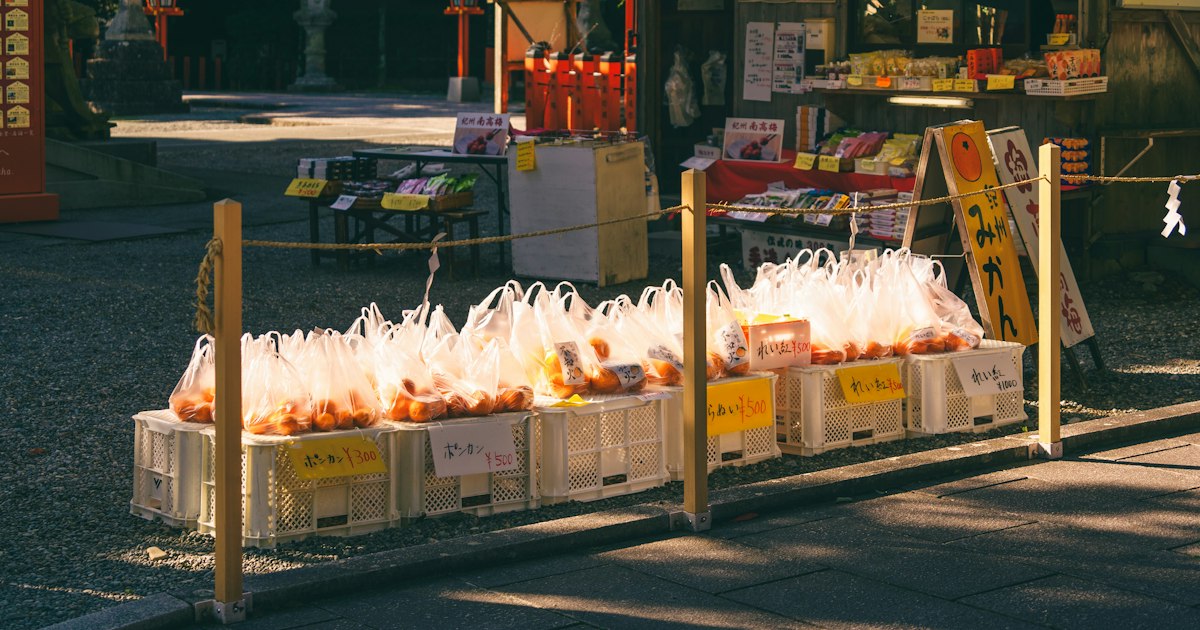
Photo by Red Shuheart on Unsplash
Drive or cycle through almost any rural stretch of Japan — the edges of Kyoto’s mountain villages, the farm roads of Nagano, the backstreets of Okinawa’s sugarcane country — and you’ll eventually spot a small wooden shelf or plastic greenhouse box sitting unattended by the road, stocked with vegetables and a coffee can for coins. This is a yasai chokubaijo (野菜直売所), literally “vegetable direct-sales stand,” and it’s one of the most quietly charming ways to experience rural Japan’s honesty-based culture. Here’s how to actually use one, what it costs, and how not to commit an accidental faux pas.
What exactly is a yasai chokubaijo?
These are self-service farm stands, usually set up by a single household or a small group of neighboring farmers, selling whatever surplus they’ve grown that week. There’s no cashier, no card reader, and often no roof beyond a tarp. A simple setup: a wooden shelf or table, bundles or bags of vegetables with a price written in marker on tape or cardboard, and a payment box — sometimes an actual repurposed instant-coffee can with a coin slot cut into the lid, sometimes a small lockbox. You take what you want, do the math yourself, and drop in the correct change. Nobody checks. This runs on the honor system (*seijitsu*, roughly “good faith”), and locals treat shortchanging a stand as a real breach of etiquette, not a victimless shortcut.
Don’t confuse these with JA (Japan Agricultural Cooperative) direct-sale centers like “JA Farmers’ Market” branches — those are staffed, larger, and take cash registers and sometimes IC cards. A true chokubaijo is unmanned and small-scale, often just a handful of items.
What you’ll find and what it costs
Pricing is startlingly cheap because there’s no middleman, no packaging line, and often no plastic beyond a simple bag. Typical prices run:
- A bundle of 3-5 daikon radishes: ¥100-¥200
- A net bag of tomatoes or cucumbers (5-8 pieces): ¥100-¥150
- A bag of satsuma mandarins (10+ pieces, common in Shizuoka/Wakayama/Ehime winter): ¥200-¥300
- Fresh eggs, sometimes sold alongside produce: ¥200-¥300 per half-dozen
- Seasonal items like corn, edamame, or shiitake: ¥100-¥300 per bundle
Almost everything is priced in round ¥100 increments specifically because there’s no change-making — bring ¥100 and ¥500 coins. Many stands have zero stock left by mid-morning on a good harvest day, so this isn’t a reliable lunch-shopping plan; it’s a bonus if you happen to pass one.
Where to find them
Chokubaijo cluster wherever farmland meets a road tourists actually drive or cycle. Good hunting grounds include:
- Rural Kyoto Prefecture — the drive up toward thatched-roof villages like the one covered in our Kayabuki-no-Sato guide passes several small farm stands along Route 162.
- The Kanagawa/Izu/Hakone foothills — mountain approach roads near shrines and trailheads, including the route up to Oyama Afuri Shrine, often have a stand or two near the bus stop or trailhead parking.
- The Fuji Five Lakes and Hakone region — if you’re exploring with a multi-day transport pass (see our comparison of the Fuji Hakone Pass vs Hakone Free Pass), the local bus routes that loop through farming hamlets pass multiple stands.
- Hokkaido’s countryside and the Nagano/Gunma highlands — dense with these stands in summer and autumn, since both regions have large smallholder vegetable production.
- Okinawa’s rural roads — look for sugarcane, mango, and shikwasa (citrus) stands outside Naha.
There’s no app or map layer dedicated to chokubaijo, so the realistic approach is: rent a car or e-bike, take the smaller prefectural roads instead of the highway, and keep your eyes on the roadside rather than searching for one deliberately.
Best season and timing
Stock is tied directly to harvest, so timing matters more than for any staffed shop. Late May through October is peak season for most of Honshu, with tomatoes, cucumbers, corn, and eggplant dominating summer and daikon, pumpkin, and sweet potato taking over in autumn. Winter (December-February) thins out dramatically in most regions except citrus belts like Shizuoka and Wakayama, where mandarin stands run strong into February. Stands are typically restocked early morning, so if you’re driving through a farm area before 9am you’ll see the best selection; by afternoon on a weekend, popular stands near tourist routes can be picked clean.
How to pay without causing a problem
A few practical rules that locals follow and visitors should too:
- Exact change only. There’s no one to make change, and the box isn’t designed to be opened by customers. Carry a mix of ¥100 coins before you set out — convenience stores will break a ¥1,000 note into coins if you buy a drink first.
- Don’t rummage in the box. If you genuinely can’t make exact change, it’s better to round up than to dig through the coin box looking for change — treat it like a donation box, not a cash register.
- Bring your own bag. Some stands supply a thin plastic bag, many don’t. A foldable tote solves this and also helps if you’re packing produce back to a hotel room.
- Don’t inspect by squeezing or opening sealed bags. Pre-bagged items are bagged for a reason — pick a different bag if one looks damaged rather than opening it to check.
- Cards and IC transit cards don’t work here — this is strictly cash, unlike most convenience stores or train-adjacent shops.
Common mistakes tourists make
The biggest one is treating an empty or near-empty stand as “closed” and leaving produce half-picked-through — if there’s stock and a price tag, it’s open, even with nobody around and no posted hours (most run roughly dawn to dusk, restocked daily). The second is assuming it’s a flea-market-style haggling spot; prices are fixed and the honor system depends on nobody negotiating a self-serve kiosk. Third, don’t expect refrigeration or quality control — a slightly bruised tomato at ¥100 for a bag of six is the tradeoff for the rock-bottom price, so buy to eat that day or the next, not to transport home. Finally, if you’re road-tripping and it starts raining mid-browse, these stands rarely have shelter beyond a tarp; if you’re without one, Japan’s iKasa umbrella-sharing app has pickup spots in some towns, though coverage thins out fast once you’re off the main shopping streets.
What to actually do with your haul
Since most travelers aren’t carrying a kitchen, the realistic use cases are: snack produce (tomatoes, mandarins, corn you can boil at a guesthouse), a gift bag of regional specialties for a home-stay host, or ingredients if you’re staying somewhere with a kitchenette. If you’re the type of traveler who cooks on the road — or is building out a home kitchen with Japanese tools after the trip — a solid hinoki or ginkgo cutting board pairs naturally with a bag of fresh chokubaijo vegetables for a simple ryokan-style dinner. Either way, budget a few hundred yen, keep coins on hand, and treat the honesty box with the respect it’s designed around — it’s a small but genuine window into how rural Japan operates on trust.