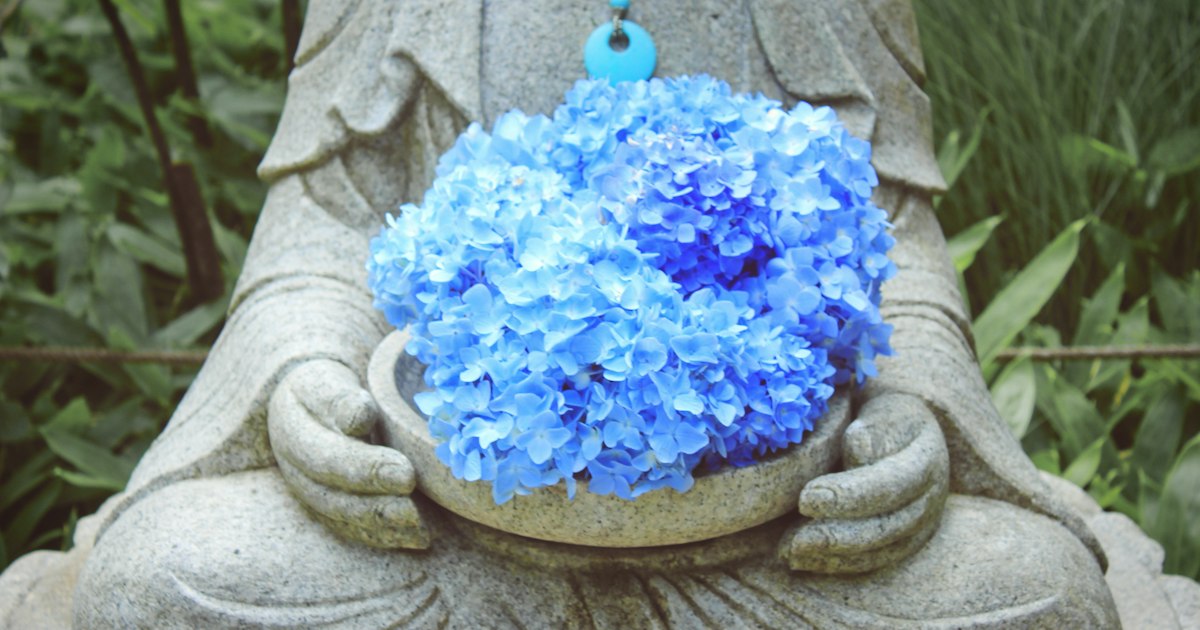
Photo by Weiqi Xiong on Unsplash
Somewhere between the end of the spring flower-viewing frenzy and the start of the sweaty midsummer heat, Japan has a quieter, bluer season that most first-time visitors never plan for: ajisai (hydrangea) season. From early June through early July, temple grounds across the country fill with mophead blooms in shades of blue, violet, and pink, and nowhere is the display more famous — or more photogenic — than in the hillside temples of Kamakura. Here’s how to time it right and which temples are actually worth the trip.
When Is Ajisai Season in Japan?
Hydrangea season overlaps almost exactly with Japan’s rainy season (tsuyu), which isn’t a coincidence — these flowers thrive on the humidity and frequent drizzle of early summer. In the Kanto region (Tokyo, Kamakura, Hakone), ajisai typically start opening in late May, reach peak bloom in mid-to-late June, and begin fading by the first week of July. The exact peak shifts year to year by about a week depending on rainfall, so if you’re planning a trip around a specific date, check a current-year bloom forecast (“ajisai kaika jokyo”) a few weeks out rather than relying on last year’s calendar.
Pack for rain. A collapsible umbrella and water-resistant shoes matter more here than on any other seasonal trip to Japan — the temple paths, especially the stone steps at Kamakura’s hillside temples, get slick.
Kamakura’s Best Ajisai Temples
Kamakura, about an hour south of Tokyo, is the undisputed hydrangea capital of the Kanto region. Two temples do the heavy lifting:
- Meigetsu-in (明月院) — Nicknamed “Ajisai-dera” (Hydrangea Temple), this small Kita-Kamakura temple is famous for its “himeajisai,” a cultivar bred to be a deep, uniform blue that lines the narrow stone approach to the main hall. Regular admission is around ¥500, rising slightly during peak bloom; hours run roughly 8:30 a.m. to 5 p.m. in June (shorter outside the season). The catch: it’s small, the path is a single narrow lane, and on a nice weekend in mid-June the wait to get in can stretch past an hour. Go on a weekday morning, right at opening, if at all possible.
- Hase-dera (長谷寺) — A larger temple near Hase Station with an “Ajisai Path” climbing the hillside behind the main hall, planted with roughly 40 varieties and a couple thousand bushes, with views out toward Sagami Bay between the blooms. Admission is around ¥400. Because the path is narrow and one-directional, Hase-dera issues numbered entry tickets during peak season to control how many people are on the hillside at once — arrive early, because same-day tickets can run out by midday on weekends.
- Engaku-ji — Right at Kita-Kamakura Station, this is Kamakura’s largest Zen temple complex and has hydrangeas scattered through its grounds, though it’s not a single-species showcase like Meigetsu-in. It’s a good lower-stress option if the queues elsewhere are too much, and worth visiting for the temple architecture alone.
If you want a quiet moment amid the crowds, most of these temples sell omikuji fortune slips near the main hall — a small, inexpensive ritual that’s easy to slot in between photo stops.
How to Get to Kamakura from Tokyo
Take the JR Yokosuka Line directly from Tokyo Station to Kamakura Station (about 56 minutes) or Kita-Kamakura Station, one stop earlier (about 53 minutes), which puts you right at Meigetsu-in and Engaku-ji. One-way IC fare from Tokyo is roughly ¥950. From Kamakura Station, the Enoshima Electric Railway (Enoden) — a slow, single-track local line — runs to Hase Station in about 5 minutes and is itself a nostalgic little trip worth taking slowly rather than rushing. An Enoden one-day pass (around ¥800) pays for itself quickly if you’re hopping between Hase, Kamakura, and the coast in one day.
If you’re the type who comps together savings on transport, it’s worth checking discount ticket shops near major Tokyo stations before buying full-fare JR tickets, since Yokosuka Line tickets occasionally show up discounted there.
Avoiding the Crowds
Kamakura’s ajisai temples get genuinely crowded — this isn’t exaggeration for effect. A few concrete tactics:
- Go on a weekday. Weekend queues at Meigetsu-in during peak bloom (roughly the second and third weeks of June) can exceed an hour; weekday waits are usually under 20 minutes.
- Arrive at opening. Both Meigetsu-in and Hase-dera are noticeably calmer in the first 30–45 minutes after opening than at any other point in the day.
- Avoid the first weekend after a sunny forecast. Crowds spike hard whenever the weather looks good, since many visitors are chasing clear photos.
- Skip rainy days only if you dislike rain — otherwise, light rain is arguably the best time to go. The colors look richer when wet, and crowds thin out noticeably.
Beyond Kamakura: Other Hydrangea Spots Worth the Detour
If your itinerary already includes Hakone, you’re in luck: the Hakone Tozan Railway, the mountain line best known for its switchback climb, runs through dense wild hydrangea banks in June, and some evening departures are timed to catch them illuminated after dark. The easiest way to reach Hakone from central Tokyo is the Odakyu Romancecar, a comfortable limited express that gets you to Hakone-Yumoto in about 85 minutes, where you can transfer onto the Tozan line itself. It’s an easy add-on to a Kamakura trip if you have a few extra days, since both are reachable from the Shonan/Odakyu corridor southwest of Tokyo.
Kyoto has its own hydrangea star in Mimuroto-ji, a temple in Uji sometimes called the “Ajisai Temple of Kansai,” though it’s a separate trip entirely from the Kanto temples covered here.
A Few Practical Notes
Most of these temples are hillside sites with uneven stone steps and narrow paths — not easily navigable with a stroller or for visitors with mobility concerns, and generally not dog-friendly inside the temple grounds, even though Kamakura’s streets and cafes are often welcoming to pets. Bring cash in small bills for entry fees, since some of these smaller temples don’t take IC cards or credit cards at the gate. And budget more time than you think you need: between queueing, the slow Enoden ride, and simply wanting to linger over the blooms, a half-day in Kamakura for hydrangea viewing easily stretches into a full day once lunch and a walk to the coast near Hase get added in.