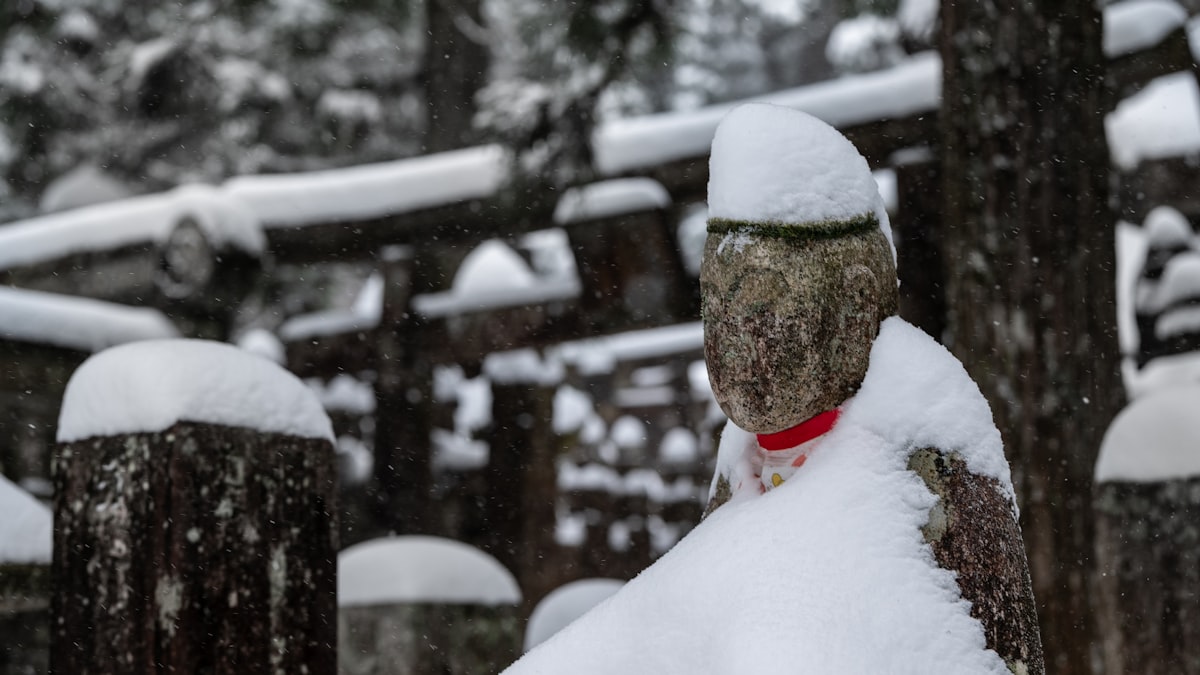
Koyasan (Mount Koya) is one of Japan’s most spiritual places — a mountaintop temple town where you can sleep in a Buddhist temple, eat monk’s cuisine, and walk a lantern-lit cemetery at dawn. Here’s how to visit.
What makes Koyasan special
- Okunoin — a mesmerizing forest cemetery of 200,000 tombs and lanterns leading to the mausoleum of Kobo Daishi. Magical at night on a guided walk.
- Danjo Garan & Kongobuji — the striking central temple complex and head temple.
- Temple lodging (shukubo) — stay overnight in a working temple.
Staying in a temple
A shukubo stay is the highlight: simple tatami rooms, shojin ryori (Buddhist vegetarian cuisine), and optional morning prayers/meditation. It’s a peaceful contrast to the cities — book ahead, especially in autumn. See our traditional-stay guide for what to expect.
Getting there
- From Osaka: train to Gokurakubashi, then a cablecar up the mountain, then a short bus (a scenic half-day journey).
- Consider the Koyasan-World Heritage ticket for transport savings; the JR Pass doesn’t cover the private line up.
Tips
- Do the Okunoin night walk — it’s the unforgettable part.
- It’s cool and quiet up the mountain; bring layers even in summer. See our packing list.
- Pairs well with Osaka and Kyoto.
What a Koyasan visit costs
- A shukubo temple stay with two meals typically runs JPY 12,000-25,000 per person, noticeably more affordable than a comparable ryokan experience elsewhere in Japan given the cultural depth included.
- The Koyasan World Heritage Ticket bundles the cablecar, local bus, and several temple discounts for around JPY 3,000, usually cheaper than buying each separately if you plan to see more than one temple.
- A guided night walk through Okunoin costs roughly JPY 2,000-3,000 per person and is worth it for the history and folklore context that’s easy to miss walking alone in the dark.
Common mistakes to avoid
- Treating it as a rushed day trip — the round trip from Osaka alone takes half a day; without an overnight stay, you’ll miss both the night walk and the morning prayer service that make Koyasan distinctive rather than just another temple stop.
- Skipping dinner at your shukubo to eat elsewhere — the shojin ryori vegetarian meal is a core part of the experience and usually excellent; passing on it defeats much of the point of staying at a temple.
- Underestimating the cold — Koyasan sits at higher elevation than surrounding cities and can be genuinely chilly even in summer evenings.
What to expect from morning prayers
Most shukubo offer an optional early-morning fire ritual (goma) or sutra chanting session, usually around 6am, open to guests regardless of religious background — it’s quiet, meditative, and one of the more memorable parts of a temple stay precisely because it isn’t staged for tourists.
Getting the cablecar timing right
The Nankai cablecar up the mountain runs on a set schedule with gaps of 15-20 minutes between departures — check the timetable before you arrive at Gokurakubashi Station rather than assuming a train-like frequency, since missing one by a few minutes means a genuine wait at a fairly quiet station with limited facilities.