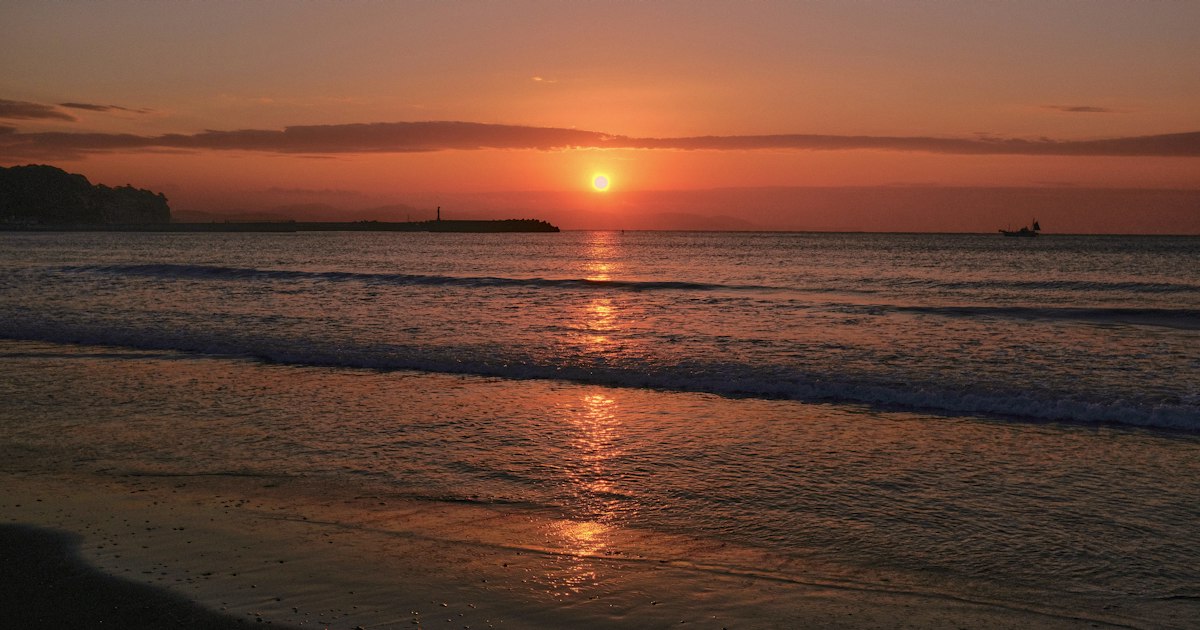
Photo by Shadrina Izzati on Unsplash
On the morning of January 1st, long before most of Japan’s convenience stores have restocked their osechi boxes, thousands of people are already standing on cliffs, mountaintops, and beaches facing east, waiting for the sun. This is hatsuhinode (初日の出) — the “first sunrise” of the New Year — and it’s one of the most low-key but genuinely moving traditions a visitor can join without needing to speak Japanese, book months ahead, or spend much money at all.
What Hatsuhinode Actually Is
Hatsuhinode isn’t a festival with vendors and fireworks; it’s a quiet act of worship. According to Shinto belief, Toshigami — the New Year deity — arrives with the first light of January 1st, so watching the sunrise and offering a silent prayer is thought to bring good fortune for the year ahead. Many people combine it directly with hatsumode, the year’s first shrine or temple visit, by watching the sunrise at or near a shrine and then queuing to pray once the gates open. Some locations even time their shrine opening specifically around sunrise for this reason.
It’s a tradition for everyone, not just the devout — families, couples, and solo travelers all show up bundled in coats with a thermos of hot amazake or coffee, and there’s a genuine shared stillness to it that’s worth experiencing at least once.
Timing: When the Sun Actually Rises
Sunrise on January 1st in Japan falls roughly between 6:50am and 7:10am depending on where you are, with the Pacific coast and higher elevations seeing it slightly earlier than inland valleys. Popular spots fill up 45–90 minutes before sunrise, so arriving “on time” usually means arriving in the dark. Coastal eastern points like Choshi in Chiba Prefecture are often promoted as being among the first places on the Japanese mainland to see the sun that day, which is why they draw dedicated crowds every year.
Check the exact sunrise time for your specific location a day or two ahead — it shifts by a few minutes year to year and varies more than people expect between, say, Tokyo Bay and the Izu Peninsula.
Best Spots Within Reach of Tokyo
You don’t need to leave the Kanto region to get a proper hatsuhinode experience:
- Mt. Takao (Hachioji) — The Takao Tozan cable car and chairlift run unusually early on January 1st, often from around 5am, specifically to get people to the summit area in time. One-way fares are roughly ¥600–¥700, round-trip a bit less than double. From the top you can sometimes see the sunrise alongside a silhouette of Mt. Fuji if the weather cooperates. It’s reachable via the Keio Line from Shinjuku in under an hour.
- Enoshima (Kanagawa) — A short walk from the island’s shrines up to the observation points gives you an open sea horizon, and you can fold in hatsumode at Enoshima Shrine right after. Trains run through the night into early morning on December 31st–January 1st specifically for this.
- Tokyo Skytree and Tokyo Tower — Both towers have, in past years, opened specially in the pre-dawn hours on January 1st for hatsuhinode viewing from their observation decks, with ticketed timed entry. This isn’t guaranteed every year, so confirm on the official site before planning around it.
Beyond Tokyo: Coastal and Mountain Viewpoints
If you’re willing to travel a bit further, the payoff is a less crowded, more dramatic horizon:
- Choshi, Chiba — Cape Inubosaki and its lighthouse sit on one of the easternmost points of the Kanto coastline, making it a classic hatsuhinode pilgrimage spot with open ocean views and no buildings in the way.
- Izu Peninsula (Shizuoka) — Jogasaki Coast’s rocky cliffs offer sunrise over the Pacific with Mt. Fuji sometimes visible behind you to the west once the light comes up — a nice bonus shot.
- Okinawa’s Cape Hedo — Much warmer waiting conditions if you’re traveling south for the New Year, with sunrise over the East China Sea.
Rural coastal viewpoints like these are also where Japan’s countryside rail quirks show up most — many of these lines run with a single car and no staffed gates, so it helps to know how fare collection actually works before you board; our guide to one-man trains in rural Japan covers exactly that.
Getting There: Logistics That Actually Matter
Public transport in major cities often runs through the night on December 31st into the morning of January 1st specifically to support hatsumode and hatsuhinode crowds — but service on January 1st during normal daytime hours can run on a reduced holiday schedule, so don’t assume frequency returns to normal right after sunrise.
For coastal or mountain viewpoints off the main train lines, renting a car is often the more reliable option, especially since taxis can be scarce at 5am on a national holiday. A kei car is a practical choice for narrow coastal roads and cramped parking areas near lighthouses and clifftop lookouts — just budget extra time, since parking lots at famous viewpoints fill up well before sunrise and overflow parking can mean a 15–20 minute walk in the dark.
If your trip timing has you flying out of Tokyo right around New Year’s, note that Haneda Airport Terminal 3 runs a full international schedule through the holiday, so an early hatsuhinode outing followed by a same-day departure is doable if you plan transit time generously.
Common Mistakes
- Underestimating the cold. Standing still for an hour before dawn in January, often on an exposed coastline or mountaintop, is colder than walking around a city. Dress for it — layers, a hat, and hand warmers (sold everywhere at convenience stores) make a real difference.
- Arriving at sunrise time instead of before it. The “first sunrise” crowd gathers in the dark. If you show up at 7am expecting a good spot, you’ll likely be shoulder-to-shoulder at the back.
- Assuming it’ll be clear. Winter mornings on the Pacific side of Japan are often clear, but cloud cover near the horizon can hide the actual moment of sunrise even on an otherwise sunny day. Have a backup plan, like continuing on to hatsumode regardless.
- Forgetting that shops and restaurants are shut. Many convenience stores reduce hours on January 1st and some family-run spots close for several days. Bring your own hot drink and a small breakfast if you’re heading somewhere remote.
Budget, Mid-Range, and Splurge Ways to Do It
At the budget end, hatsuhinode costs nothing beyond transport — walking to a local riverbank, park, or shrine with an open eastern view works perfectly well and is what most Japanese families actually do. Mid-range means taking an early train or cable car to a named viewpoint like Mt. Takao or Enoshima, paying a few hundred to around a thousand yen for transport, and pairing it with hatsumode at a nearby shrine. For a splurge, some hotels near coastal or mountain viewpoints — particularly in Izu, Hakone, and parts of Chiba — offer New Year’s Eve packages with an early wake-up call, hot drinks, and a direct view from the property, which removes the pre-dawn travel entirely and is worth considering if you’re already staying in the area.
Whichever version you choose, hatsuhinode is one of the simplest, cheapest, and most genuinely local experiences available to a visitor in Japan over the New Year — and unlike more elaborate seasonal rituals such as yabusame horseback archery, it requires no special event calendar at all. You just need to set an alarm.