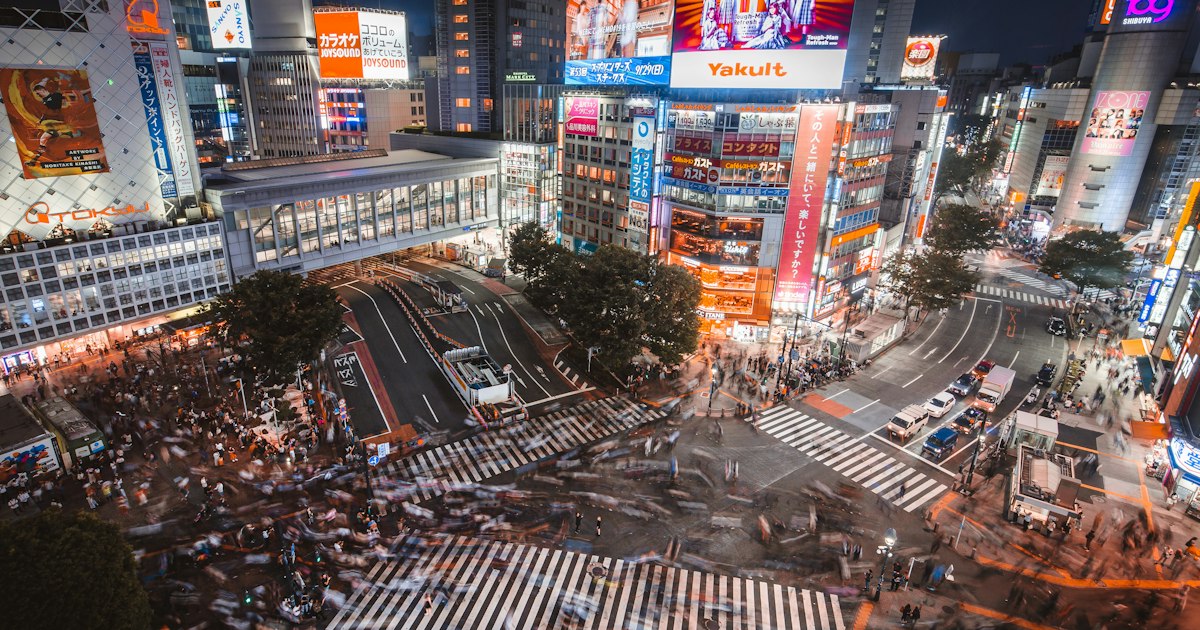
Photo by Denys Nevozhai on Unsplash
Halloween in Japan isn’t really a trick-or-treating holiday — kids barely go door to door for candy. What it has become instead is one of the biggest spontaneous street gatherings on the planet, centered almost entirely on one intersection: Shibuya Scramble Crossing in Tokyo. If you’re visiting Japan in late October, here’s what’s actually worth knowing before you show up in a costume you bought at the airport.
What Shibuya Halloween Actually Is
There’s no official festival, no parade, no ticket, and no stage. Shibuya Halloween is an unofficial street party that grew organically in the 2010s as costumed crowds started gathering around the famous Scramble Crossing and the pedestrian street Center-gai after dark. At its peak, it drew hundreds of thousands of people — and the lack of any central organizer eventually caused real problems: a 2018 incident involving an overturned truck, years of litter and property damage, and crowd densities that made movement through the station nearly impossible.
Since then, Shibuya Ward has taken an unusual position: it actively discourages people from coming. The ward office puts up multilingual signs and sends social media messages asking visitors to celebrate elsewhere, and in recent years it has banned public drinking on the street in the area around the station on and around October 31st (typically from around 6pm to 5am), with convenience stores and liquor shops in the zone asked not to sell alcohol for takeaway during those hours. Riot-style barricades and a heavy police presence now funnel foot traffic around the crossing. None of this has stopped the costumes — it’s just turned the event into a crowd-control exercise with a party happening inside it.
When to Go (and When to Think Twice)
The crowd now builds over the entire weekend closest to October 31st, not just on the day itself, so “Halloween weekend” in Shibuya can mean three or four nights of costumed crowds rather than one. If you want photos and atmosphere without the worst of the crush, aim for early evening — around 6pm to 8pm — before the after-work and late-night crowds stack up. Things intensify sharply after 9pm and often peak between 10pm and 1am, which is also when police begin actively restricting movement around the crossing itself. If you simply want to see costumes and don’t care about being in the thick of it, a weekday evening in the run-up to Halloween is far calmer than the Friday or Saturday night closest to the 31st.
Getting There (and Out) Without Getting Stuck
Shibuya Station is the obvious access point, served by the JR Yamanote Line, Keio Inokashira Line, Tokyu lines, and several Tokyo Metro lines. On peak nights, station staff and police may temporarily close certain exits or make them exit-only to stop the platforms from overfilling — it’s not unusual to be funneled through a longer route than usual just to reach the street. Build in extra time, and don’t assume you can casually dip into the station if you need to leave in a hurry; in a dense crowd, the nearest open exit might be a ten-minute walk away. If you’re relying on cash for taxis or vending machines once the crowds make card terminals slow to reach, a quick top-up from a 7-Bank ATM at a 7-Eleven before you head into Shibuya is worth the two minutes.
Where to Buy a Costume in Tokyo
You don’t need to pack a costume — Tokyo sells them in bulk every October.
- Don Quijote (Donki): The go-to for last-minute costumes. The Shibuya branch near Center-gai is open 24 hours and dedicates significant shelf space to Halloween in the weeks beforehand — full costumes generally run about ¥2,000–¥6,000, with wigs, face paint, and props priced separately from a few hundred yen up.
- Daiso and other ¥100-shops: Cheapest option for accessories — fangs, horns, face paint, small props — mostly in the ¥100–¥500 range. Not the place for a full costume, but excellent for finishing touches.
- Village Vanguard: A pop-culture/novelty chain with a heavier skew toward character and anime-adjacent costume pieces, found in Shibuya and Shinjuku.
- Cosplay specialty shops near Shibuya Station: Several small stores around Shibuya cater specifically to cosplay and costume rental rather than generic Halloween gear, with complete rental sets running roughly ¥3,000–¥6,000 including a changing space — useful if you don’t want to carry a costume home in your suitcase.
If you’re more interested in Japan’s cosplay and costume culture generally than in Halloween specifically, it’s worth knowing that the same shops and neighborhoods that stock Halloween gear also supply Tokyo’s cosplay scene year-round — the crossover is strong enough that regulars at Comiket shop at some of the same stores.
Costume Choices That Work Well
Store-bought costumes from Donki or Village Vanguard are the path of least resistance, but if you want something with a more distinctly Japanese flavor, a happi coat — the short festival jacket worn at summer matsuri — makes an easy, comfortable half-costume layered over normal clothes, and it packs flat for the flight home. Whatever you choose, skip anything that mimics another culture’s dress as a costume punchline (sumo-wrestler bodysuits and geisha-parody wigs are common tourist missteps) — Japanese costume culture leans heavily toward anime, horror, and pop-culture characters rather than caricature.
Staying Safe in the Crowd
The biggest risks aren’t crime — they’re crowd-related. Keep valuables in a front pocket or a bag worn across your chest rather than a back pocket or open tote; pickpocketing upticks in dense crowds anywhere in the world, and Shibuya at capacity is no exception. Don’t try to push against the flow of foot traffic — if the crowd is moving one direction, move with it and loop back rather than cutting across. Avoid drinking heavily before you’re in the crowd itself; separated friend groups and crowded trains are a bad combination with intoxication, and remember that open-container drinking is restricted on the street in the designated zone during the event. If you’re traveling with a group, agree on a specific meeting point outside the restricted area in advance — phone signal gets patchy when tens of thousands of people are on it at once, and you may not be able to simply call or text to regroup.
If Shibuya Isn’t Your Scene
Shibuya gets the headlines, but it isn’t the only place to see costumes. Shinjuku’s nightlife district has its own, smaller version of the scene, with bars and clubs running costume nights throughout the week around Halloween. If you go, the same safety principles that apply to navigating Kabukicho after dark apply doubly on Halloween weekend — stick to venues you can verify, agree on prices before you sit down anywhere, and don’t let a costumed stranger walk you somewhere you didn’t choose. For a lower-key alternative entirely, several theme parks and shopping malls run family-friendly Halloween events in the weeks beforehand that have nothing to do with the Shibuya crowd and are far easier to enjoy with children or if you simply want a quieter night out.