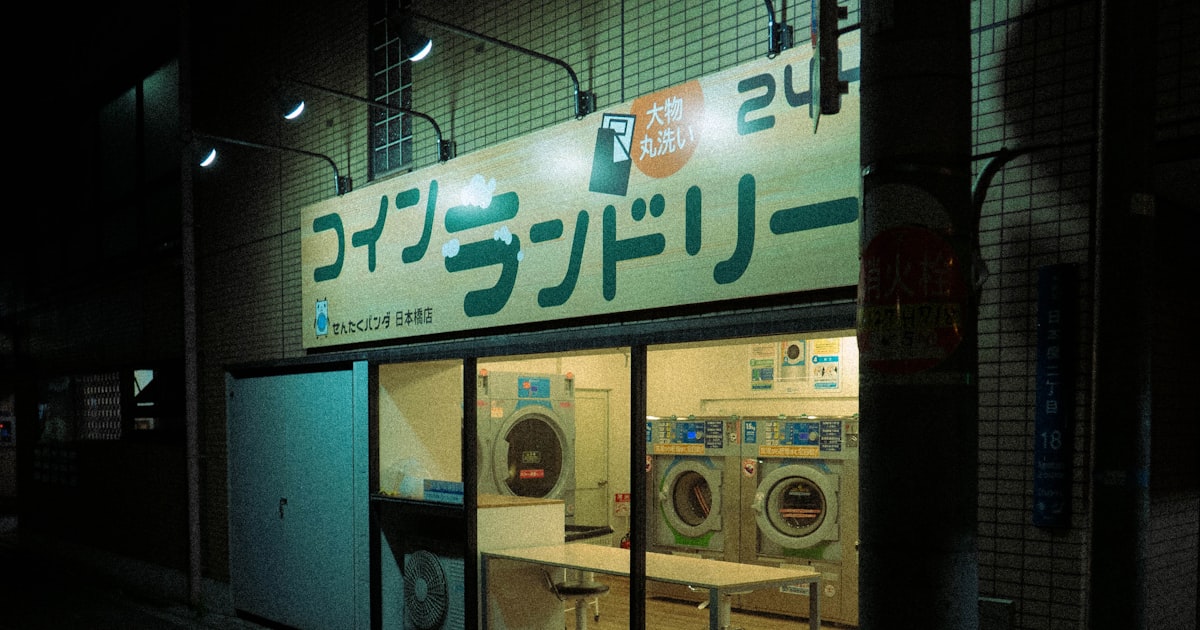
Photo by Jakub Stekla on Unsplash
Pack light, wash as you go — it’s the single best strategy for a trip longer than a week in Japan, and the country makes it easy once you know the system. Coin laundries are everywhere, hotel options range from free washer-dryers to full valet service, and everything you need to do a load is sold at the nearest drugstore. Here’s exactly how it works, what it costs, and the mistakes that trip up first-timers.
Coin Laundries (Koin Randorī): How They Work
A コインランドリー (koin randorī) is a self-service laundromat, and you’ll find one within a few blocks of almost any train station or residential neighborhood, even in small towns. They’re unstaffed, open 24 hours in most cases, and machines take coins (¥100 pieces are essential) or, increasingly, IC transit cards and PayPay.
Typical pricing: a standard washer (7–8 kg) runs ¥300–500 per load, and larger washers (10–12 kg, useful for futon or several days’ worth of clothes) run ¥600–800. Dryers are coin-fed in blocks of time rather than one flat fee — expect ¥100 per 10–12 minutes, and Japanese dryers run cooler than American ones, so a full load of cotton clothing often needs 40–60 minutes (¥400–600) to get properly dry. Bring a stack of ¥100 coins; break larger bills at a convenience store first, since most machines don’t give change for anything bigger.
Some coin laundries are stand-alone buildings; others are attached to a super sento bathhouse, so you can toss in a load, soak for 45 minutes, and come back to dry clothes — a genuinely efficient combo if you’re near one of the facilities in our guide to super sento. To find one, search “コインランドリー” or “laundromat” on Google Maps near your accommodation; the app’s Japanese-language listings are far more complete than English ones.
Hotel and Ryokan Laundry Options
Business hotel chains (Toyoko Inn, APA, Super Hotel, Route Inn) are the most laundry-friendly accommodation in Japan. Most have a small coin laundry room on one of the upper floors, priced the same as a standalone laundromat (¥200–300 wash, ¥100/10 min dry) and reserved for guests only, which means no wait and no lugging a bag down the street. It’s worth checking this when booking if laundry is a priority — it’s usually listed under hotel facilities.
Mid-range and upscale hotels typically don’t have self-service machines but offer a send-out laundry service instead: you fill out a slip, bag your clothes, and get them back same-day or next-day, professionally washed and folded. This is priced per item, not per load — a T-shirt might be ¥300–500, a pair of trousers ¥500–800, and a jacket considerably more — so a full bag can easily run ¥3,000–5,000. It’s convenient but not a budget option; use it for a few key items rather than your whole wardrobe.
Ryokan, including those in onsen towns like the ones covered in our Kinosaki Onsen guide, almost never have guest laundry machines, since stays are typically one or two nights and the whole point is not doing chores. If you’re settling into a ryokan town for several nights of onsen-hopping, do a load at a coin laundry before you arrive rather than trying to find one there.
What to Buy (and What to Pack)
Don’t bother bringing large bottles of detergent — it adds weight and you can buy everything you need cheaply once you land. Drugstores like Matsumoto Kiyoshi, Sundrug, and Daikoku, plus most supermarkets, sell single-use detergent pods (a box of 10–20 runs ¥300–500), travel-size bottles of liquid detergent, and mesh laundry bags (¥100–300) for delicates. Convenience stores (7-Eleven, Lawson, FamilyMart) carry a more limited selection but usually stock at least one small detergent option in a pinch.
Two things worth packing from home: a small tube or capsule-style stain remover pen, since Japanese drugstores mostly stock spray-on stain treatments in Japanese-only packaging that’s hard to read on the fly, and a couple of flat rubber sink stoppers if you plan to hand-wash in your hotel sink — Japanese sinks don’t always have stoppers built in. A collapsible travel clothesline with suction hooks is genuinely useful, since drying space in hotel rooms is limited.
Drying: The Part That Actually Trips People Up
The biggest laundry mistake in Japan isn’t washing — it’s underestimating drying time. Japanese home and coin-laundry dryers are gentler and cooler than what many visitors are used to, so a load that would take 30 minutes elsewhere can take an hour. Budget the coins accordingly, or plan to dry heavier items (jeans, hoodies) overnight on a hotel towel rack or clothesline instead of paying for extra dryer cycles.
Season matters a lot here. During Japan’s rainy season (tsuyu, roughly early June to mid-July) and the humid peak of summer — see our guide to Japan in summer — air-drying indoors barely works at all; humidity sits above 70% for weeks, and clothes hung in a room can take two days to dry and start to smell musty. In this window, pay for the full dryer cycle rather than trying to save a few hundred yen air-drying. In autumn and winter, indoor air is dry enough that hang-drying overnight works fine, and it’s the cheaper choice.
Common Mistakes to Avoid
Skipping detergent measurements: Japanese washers are usually smaller-capacity than what you’re used to, so a home-country “one scoop” habit can oversud a small drum. Follow the line markings on the machine or the pod instructions.
Not carrying coins: many laundromats, especially older ones, only take ¥100 coins and don’t make change. Get a stack of ten to twenty coins in cash before you go, ideally from a convenience store register when you buy something small.
Assuming ryokan or capsule hotels have machines: they usually don’t. If you’re island-hopping or doing a multi-day itinerary through somewhere remote like Yakushima or the Shikoku pilgrimage route, plan your laundry stop for the last city hotel before you head somewhere rural, not after.
Budget vs. Splurge Summary
Budget: self-service coin laundry, wash and dry yourself, roughly ¥700–1,200 total per load including coins and a pod of detergent. Mid-range: business hotel coin laundry room, similar pricing but with the convenience of doing it in-house overnight, useful if you’re arriving late after an overnight bus and want clean clothes waiting the next morning. Splurge: hotel valet service for a handful of items you want professionally pressed, at ¥300–800 per piece — reasonable for a business shirt before a meeting, expensive if you try to do your whole suitcase that way.