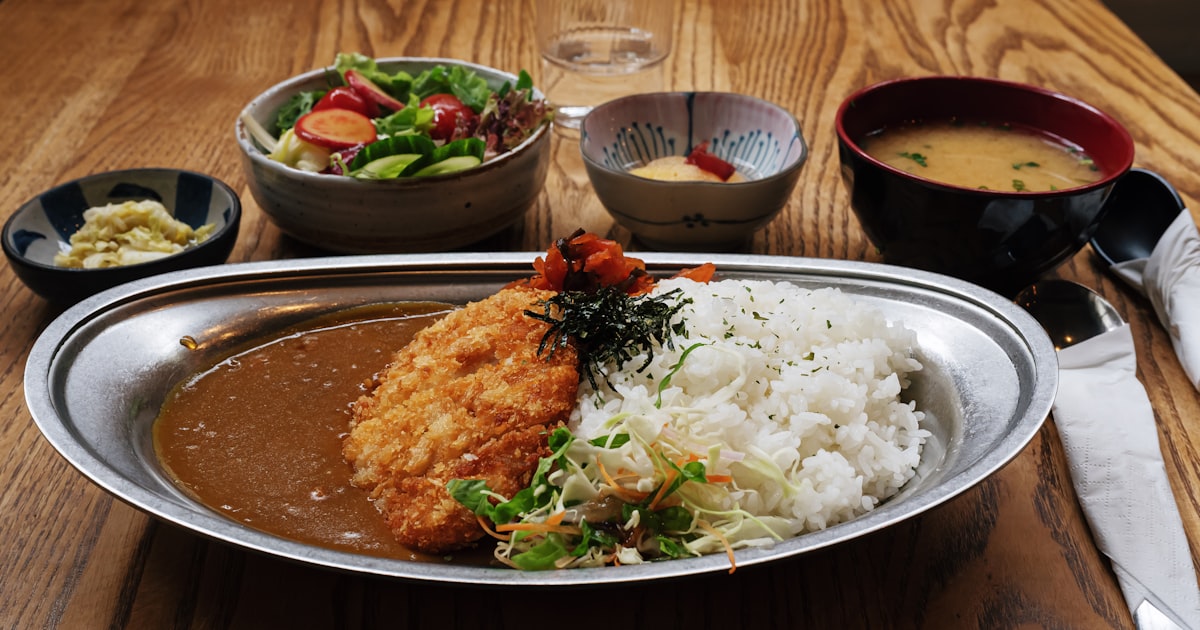
Photo by Kelsey He on Unsplash
Ask any Japanese kid what they want for dinner and there’s a good chance the answer is kare raisu — curry rice. It’s not the curry you’ll find in India or Thailand; it’s a thick, mildly sweet, roux-based stew that Japan adopted from British naval cooks in the Meiji era and then made entirely its own. It’s cheap, it’s everywhere, and it’s one of the easiest ways for a visitor to eat well on a tight schedule. Here’s how to actually order it, where to eat it, and what to avoid.
What Makes Japanese Curry Different
Japanese curry is built on a roux — flour, fat, and curry spices cooked into a solid block — melted into a pot of stewed onions, carrots, potatoes, and meat (usually pork, beef, or chicken). The result is thick, glossy, and closer to a gravy than a soup. It’s mild by South or Southeast Asian standards even at “hot” settings, with a rounded sweetness from caramelized onion, apple, or honey that’s often added to commercial roux. Don’t expect chili heat; expect umami and comfort-food richness. It’s typically ladled over a mound of short-grain white rice on an oval plate, often with a small pile of fukujinzuke (sweet pickled vegetables) or raw shredded cabbage on the side.
Where to Eat It: Chains, Specialty Shops, and Regional Styles
You don’t need to hunt this down — it will find you. The most useful entry point is CoCo Ichibanya (CoCo Ichi), Japan’s biggest curry chain with well over a thousand locations nationwide, including inside train stations and airports. A base plate runs about ¥700–900, and the appeal is total customization: you choose your spice level (usually 1 to 10, sometimes higher), rice amount (from a light 200g to over 1kg at no extra charge, though very large portions cost a bit more), and toppings — cheese, a fried pork cutlet (katsu), a fried egg, or vegetables — each added for roughly ¥100–400. Most branches are open from around 11am to 11pm; some in Tokyo run near 24 hours.
For a very different, thicker, darker style, look for Go Go Curry or curry counters around Kanazawa — this is “Kanazawa curry,” served on a metal plate with shredded cabbage, no rice-plate ceremony, and a fork instead of a spoon. It’s rich, almost espresso-dark, and a specialty worth seeking out if you’re already exploring that region for its crafts — see our guide to Kutani Ware in Kanazawa and pair a pottery afternoon with a curry lunch. Elsewhere, don’t overlook kare udon (curry broth over thick noodles) or curry bread (kare pan) from any bakery, both cheap ways to try the flavor in a different format.
If you’re grazing through a food market, Kyoto’s Nishiki Market occasionally has stalls selling curry-stuffed buns or curry croquettes as a quick snack between stops — a good low-commitment way to sample the flavor without sitting down for a full meal.
How to Order Like You’ve Done This Before
At a counter like CoCo Ichibanya, the order goes: base curry type (there are usually a few, like plain, cheese, or a seafood option) → spice level → rice amount → toppings, all read off a laminated picture menu or ordered via ticket machine at some locations. A word of caution for beginners: the spice scale is not linear the way you might expect. Level 1–3 is genuinely mild; by level 5 it has real heat; level 10 and above is a serious, slow-building burn that many regulars build up to over repeat visits, not something to jump into on a first try. Start at level 2 or 3 if you have no reference point, and remember rice amount is usually free to adjust, so there’s no cost penalty in asking for less if you’re not sure how hungry you are.
Budget, Mid-Range, and Splurge
Budget (¥400–800): Convami-style bakery curry bread, a bowl of kare udon at a standing noodle counter, or a basic CoCo Ichibanya plate with no toppings. Convenience store curry-in-a-bag (retort pouch, heated at the register) is even cheaper, around ¥300–500, and surprisingly decent for a 2am hunger fix.
Mid-range (¥900–1,500): A loaded CoCo Ichibanya or Go Go Curry plate with katsu and cheese, or a sit-down curry specialty restaurant (many independent shops in Tokyo and Osaka serve a slow-simmered version with better-quality meat in this range).
Splurge (¥2,000–4,000+): A handful of high-end restaurants, particularly in Tokyo, serve “European-style” curry with wagyu beef or long-simmered demi-glace bases — some chefs treat curry as a serious craft dish rather than a fast-food staple. These usually require no reservation but do have lines at peak lunch hours (12–1pm), so aim for 11:30am or after 1:30pm.
Bringing the Flavor Home
Curry roux blocks (brands like House Vermont Curry, Golden Curry, and Java Curry) are sold in every supermarket and convenience store for ¥150–300 a box and pack flat in a suitcase — an easy, cheap souvenir that actually gets used. If you want to cook with proper gear once you’re home, Tokyo’s Kappabashi Kitchen Town is the place to pick up the oval curry plates restaurants actually use, along with the distinctive curry spoon (flat-edged, meant for scooping rice and sauce together in one motion). Most Kappabashi shops open around 9am–5 or 6pm, and many close on Sundays, so check before making a special trip.
Common Mistakes to Avoid
- Assuming “curry” means spicy. Default Japanese curry is mild; you have to actively choose a hot level where it’s offered.
- Mixing the curry into the rice before eating. Most locals eat it in sections — a bite of curry-soaked rice, then plain rice — rather than stirring the whole plate into a uniform mush, though nobody will stop you either way.
- Skipping the pickles. The red fukujinzuke or pale pink beni shoga aren’t garnish for show — their acidity cuts the richness of the roux, and it’s worth trying a bite with and without.
- Overordering rice out of habit. Because large portions are often free, it’s easy to over-order and leave a mountain of rice; ask for a smaller size if you’re not sure, since most places let you upsize but not always downsize after the fact.
Best Time to Go
Curry has no real season — it’s a year-round comfort food, if anything more popular in winter for its warmth and in summer as a cheap, filling lunch that pairs well with a cold drink afterward (if you want to turn it into a proper evening, Japan’s growing craft beer scene makes a good chaser to a spicy plate). The main timing tip is about crowds, not weather: chain restaurants near stations and office districts get slammed from 12–1pm on weekdays, so eating slightly earlier or later gets you a table without a wait almost anywhere in the country.