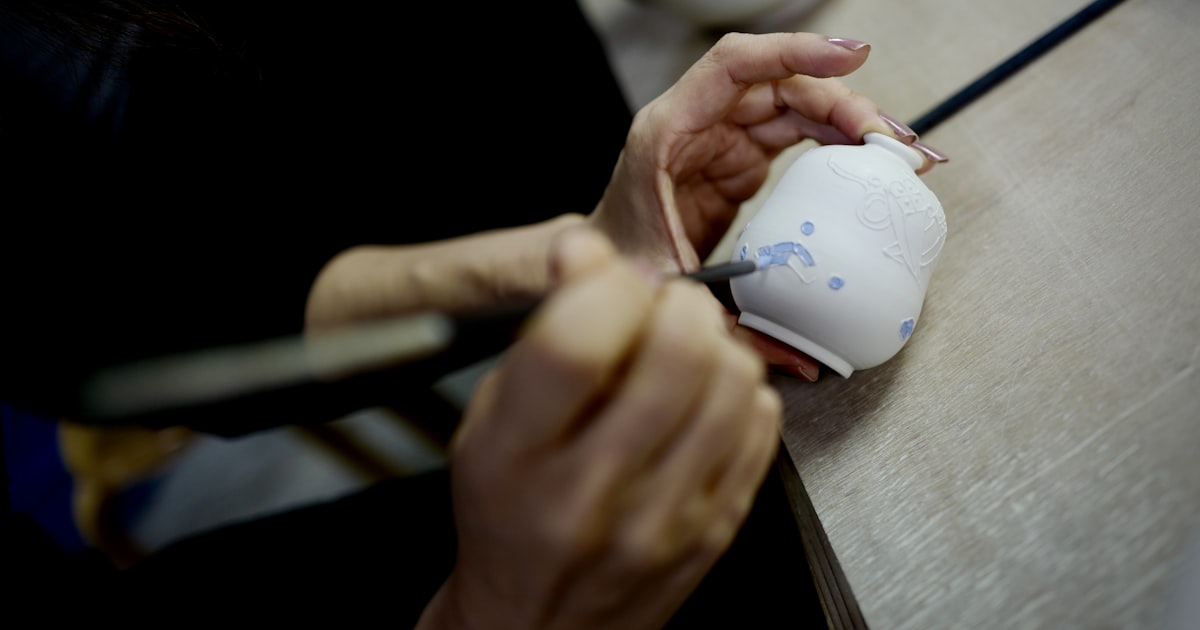
Photo by Kazuo ota on Unsplash
A Porcelain Style Born From Failure
Kutani ware (九谷焼, Kutani-yaki) gets its name from Kutani, a small village in what is now the Kaga area of Ishikawa Prefecture, where kilns began firing porcelain around 1655. Production stopped abruptly roughly 70 years later — historians still argue over whether it was exhausted clay resources, financial collapse, or something else — and the kilns sat dormant for nearly 80 years. When production revived in the early 1800s under new kilns like Kasugayama and Yoshidaya, it kept the old name and the bold aesthetic that made the original ware famous. Today "Kutani-yaki" is produced across the wider Kaga region — Kanazawa, Kaga City, Komatsu, and Nomi — but Kanazawa, with its dense concentration of craft shops and easy access from Tokyo and Kyoto, is where most visitors will actually see and buy it.
What to Look For: Five Colors and a Few Key Styles
Kutani ware is instantly recognizable once you know the palette: gosai, the five colors of green, yellow, red, purple, and deep blue, applied in thick, glossy overglaze enamels that often cover almost the entire surface of a piece. This is a very different look from the airy blue-and-white porcelain of Arita — if you want a point of comparison, our guide to Arita & Imari covers Japan’s other major porcelain region, and seeing both styles side by side makes the difference click immediately. Within Kutani ware itself, dealers and collectors distinguish several sub-styles: Ao-Kutani (heavy on green and yellow, little to no red, from the original 17th-century kilns), the Yoshidaya revival style that echoes it, Iidaya (red-dominant with fine gold linework), and Shoza style, a Meiji-era export favorite dense with red and gold. None of this is essential to enjoy the ware, but knowing the terms helps you ask better questions in shops and understand why a similar-looking bowl can cost ¥3,000 in one store and ¥80,000 in another.
Where to Buy in Kanazawa City
You don’t need to leave central Kanazawa to find genuine, well-made pieces. A few reliable stops:
- Ishikawa-ken Kanko Bussankan (Ishikawa Prefectural Products Center), right by the Ishikawa Gate entrance to Kenrokuen Garden. It’s a multi-floor showcase of regional crafts — Kutani ware, Wajima lacquerware, gold leaf — with clearly labeled kiln and artist names, generally open around 9:00–18:00 with no fixed closed day. It’s the easiest place to compare price points in one visit.
- Kutani Kosen-gama, a working kiln and shop near Nomachi in central Kanazawa, where you can see pieces being painted and sometimes try hand-painting a small item yourself. Good for understanding how much labor goes into a single plate.
- Higashi Chaya District, the old geisha quarter, has several craft boutiques mixing Kutani ware with gold-leaf goods; quality varies more here, so check for a maker’s mark before buying anything priced like a serious piece.
- Kanazawa Station’s Rinto/Anto shopping arcades, useful for a last-minute purchase before your train — open into the evening, though selection leans toward smaller, giftable items.
Day Trip to the Source: Kaga and Nomi
If you have half a day to spare, the actual kiln towns are worth the trip. Nomi City has a cluster of studios collectively promoted as the Kutani Ceramic Art Village, plus a dedicated Kutani ware museum, while Kaga City (which includes the original Kutani village site) has working kilns that sell seconds and overstock at noticeably lower prices than city boutiques. Both are reachable by local train and a short bus or taxi ride from Kanazawa Station, but if you’re also planning to explore the wider Kaga countryside — hot spring towns, rural back roads — it may be worth reading our guide to renting a car in Japan and combining the pottery towns with a small road trip. Time it right and you can catch the Kutani Chawan Matsuri (Kutani Bowl Festival), an annual outdoor market held in early May in the Kutani area where kilns clear out inventory at a fraction of retail price — it’s popular with Japanese collectors, so go early in the day for the best selection.
What to Expect to Pay
Budget (under ¥3,000): chopstick rests (¥800–1,500), a single sake cup or guinomi (¥1,500–3,000), and small dishes make easy, packable souvenirs.
Mid-range (¥3,000–15,000): a rice bowl, teacup, or small decorative plate typically runs ¥4,000–9,000; matched pairs or small sets push toward ¥15,000.
Splurge (¥30,000+): artist-signed vases and large decorative plates from named kilns commonly sell for ¥30,000–150,000, and genuine antique Ko-Kutani or Yoshidaya pieces at specialist dealers can run well into six figures. Larger stores offer tax-free shopping on purchases over ¥5,000 (pre-tax) with your passport, which is worth asking about before you pay.
Common Mistakes to Avoid
Not everything colorful and floral in a Kanazawa souvenir shop is genuine hand-painted Kutani ware — cheaper transferware imitations exist, so flip a piece over and look for a kiln seal or maker’s mark, and don’t hesitate to ask staff whether a piece is tegaki (hand-painted) or printed. Second, porcelain is heavy and breakable: ask the shop for proper packing, or if you’re buying several pieces, ask about domestic courier (takkyubin) shipping to your next hotel or straight to the airport so you’re not carrying fragile boxes on trains. Third, heavily gold-decorated pieces are typically decorative only and shouldn’t go in a microwave or dishwasher, whatever the shop clerk may or may not mention. And finally, don’t leave your shopping until the last twenty minutes before a Shinkansen departure — station shops get crowded right before peak departure times, and careful gift-wrapping takes longer than you’d expect.
Getting There and Practical Tips
Kanazawa is about 2.5 hours from Tokyo on the Hokuriku Shinkansen, or roughly 2.5–3 hours from Osaka, Kyoto, or Nagoya via limited express trains. Local buses around the city accept regional IC cards — see our guide to IC cards beyond Tokyo if you’re not sure which one works where. There’s no strict best season for shopping itself, but pairing your visit with cherry blossoms at Kenrokuen in early April or autumn foliage in November makes for a prettier trip overall. If you’d rather wrap a delicate piece the traditional way instead of asking for plastic packaging, it’s worth picking up a furoshiki cloth beforehand — our guide to furoshiki wrapping covers a few knots sturdy enough for a boxed teacup.