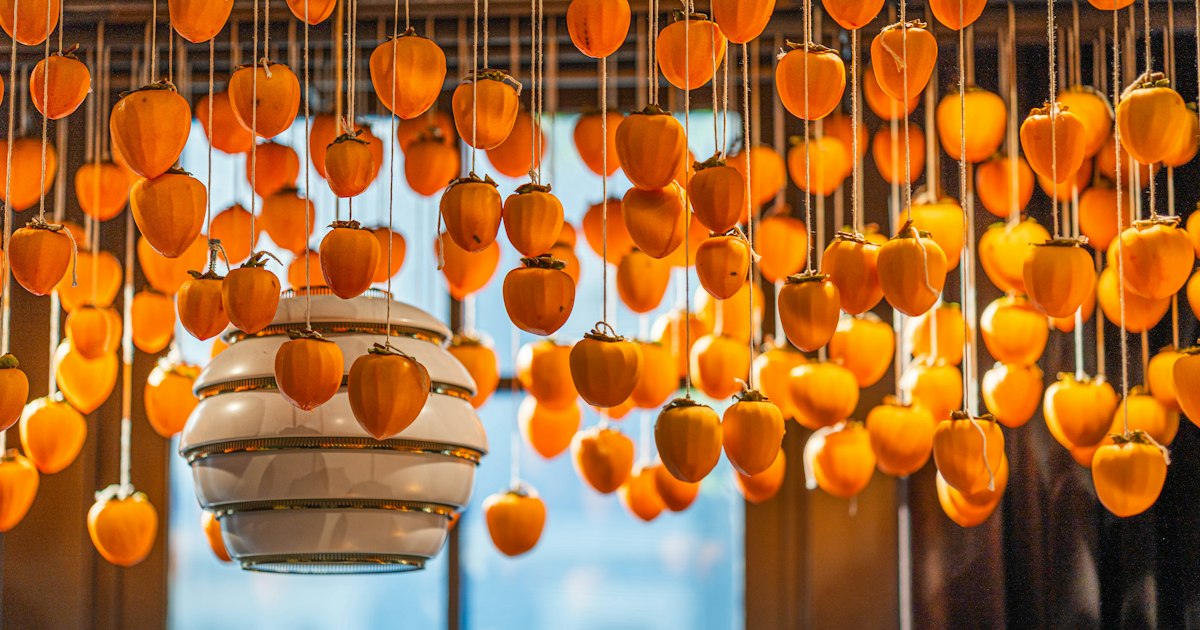
Photo by Madeline Liu on Unsplash
Walk through a department store food hall in Japan in December and you’ll likely spot rows of wrinkled, amber-colored fruit dusted in what looks like frost, priced like jewelry. That’s hoshigaki — dried persimmons that are massaged by hand, day after day, until their tannins mellow and their natural sugars rise to the surface as a delicate white bloom. It’s one of Japan’s oldest preserved foods, it photographs beautifully hanging in curtains outside old farmhouses, and it makes one of the more unusual edible souvenirs you can bring home. Here’s what makes it special, when to look for it, and where to actually buy some.
What Exactly Is Hoshigaki?
Hoshigaki is made from astringent persimmon varieties (shibugaki) — not the sweet, crunchy persimmons you can eat fresh off the tree. Astringent types like Hiratanenashi are inedible raw because of high tannin content, but once peeled and air-dried for three to five weeks, that same tannin breaks down and the fruit turns into something closer to a natural toffee: deeply sweet, chewy at the edges, soft and almost jam-like in the center.
The fruit is peeled, tied with string in pairs or skewered on sticks, and hung outdoors under eaves or on racks where cold, dry winter air does the work. You’ll see this done at an industrial scale in some regions and on a handful of strings outside a single farmhouse in others.
The Hand-Massage Process That Makes It Special
What separates proper hoshigaki from simply “dried persimmon” is the massage. Every two to three days during drying, each piece is gently kneaded by hand to break down the internal fibers, redistribute sugars evenly, and prevent the skin from hardening into a tough shell before the inside has finished drying. Skip this step and you get a fruit that’s leathery outside and unevenly sweet inside — skilled producers massage each piece upward of ten times over the drying period. It’s genuinely labor-intensive, which is a big part of why good hoshigaki isn’t cheap.
Near the end of drying, glucose migrates to the surface and crystallizes into a white, powdery bloom. This “kobuko” or frosted coating is considered the sign of a well-made, properly aged hoshigaki — producers will tell you it should look almost sugar-coated, not just shriveled.
Best Season to Buy
Persimmons are harvested from October into November, and drying takes three to five weeks depending on the region, weather, and variety. That means hoshigaki starts appearing in shops from late November, peaks in December, and is at its best — fully sweetened, properly frosted — through late December into January. It’s closely tied to New Year’s: a skewer of dried persimmons (kushigaki), typically strung in a pattern of two, six, and two, is placed atop kagami mochi as a decoration, since the arrangement puns on a phrase for marital harmony. If you want the full experience, aim for a December or early January trip — by February, remaining stock is often older and drier, and by spring it’s largely gone until the next autumn harvest.
Where to Buy It
Budget (¥500–1,500): Supermarkets and roadside farm stands (michi-no-eki) near persimmon-growing regions sell loose, imperfect-looking hoshigaki for a fraction of gift-box prices — perfectly good eating, just not pretty enough for presentation boxes.
Mid-range (¥1,500–4,000): Department store food halls (depachika) in Tokyo, Osaka, and Kyoto stock seasonal hoshigaki from known production areas from late November through January, usually in boxes of six to ten pieces. Isetan Shinjuku, Takashimaya, and Daimaru Kyoto are reliable bets; most depachika floors open around 10:00 and close by 20:00. If you’re already shopping in a high-end district, the gourmet food floors near Omotesando are worth a detour for winter fruit gifts generally.
Splurge (¥5,000–10,000+): Named regional brands sold as formal gift boxes — the kind given for New Year’s greetings or as a prestige souvenir — command the highest prices, especially the largest, most evenly frosted specimens individually wrapped in paper. These are sized and priced closer to premium melons than to everyday dried fruit.
Regional Varieties Worth Seeking Out
A few production areas have built strong reputations:
- Ichida, Nagano (Iida City): Probably the most famous name in hoshigaki, known for consistent size and a thick, even sugar frost. Iida is reachable by highway bus from Tokyo (around 4–5 hours from Shinjuku) or a shorter run from Nagoya, making it a feasible day-trip base in persimmon season.
- Date, Fukushima: Famous for anpo-gaki, a softer, less fully dried cousin of hoshigaki — more like a moist dried fruit than a chewy sweet, and a good option if you find standard hoshigaki too dense.
- Gifu and the Kansai region (Nara, Wakayama): Smaller-scale producers whose fruit shows up seasonally in Kyoto and Osaka depachika and at local farm markets.
If you’re traveling specifically to see the drying process, late November into December is when strings of fruit are actually hanging outside farmhouses and drying sheds — worth asking at a local tourist information center for which farms allow visitors, since many are working households, not tourist attractions.
Common Mistakes to Avoid
- Buying it outside winter. Hoshigaki is genuinely seasonal; what you find in summer is either imported, old stock, or a different product entirely.
- Judging it by looks alone. The wrinkled, dusty appearance that looks unappealing to first-timers is exactly what you want — smooth, glossy skin usually means it hasn’t dried or frosted properly.
- Expecting it to taste like fresh persimmon. It’s concentrated, intensely sweet, and chewy — closer to a fig or date in texture than to fresh fruit. Start with one piece; a whole box in one sitting is a lot of sugar.
- Packing it carelessly for the flight home. It’s sticky and can soften in heat, so keep boxes upright and out of direct sun in your luggage, and check your destination country’s fresh-produce import rules before bringing dried fruit across borders — some countries restrict it even when dried.
A Gift With Built-In Meaning
Because of its New Year associations, hoshigaki makes a thoughtful gift for a Japan-based friend or colleague in December, alongside other seasonal traditions like toshikoshi soba on New Year’s Eve. If you’re building out a broader gift list of Japanese craftsmanship while you’re at it, hand-finished goods like Suwada nail clippers pair well with a box of hoshigaki — one edible, one built to last decades, both representing the same patient, hands-on approach that runs through so much of Japanese craft.