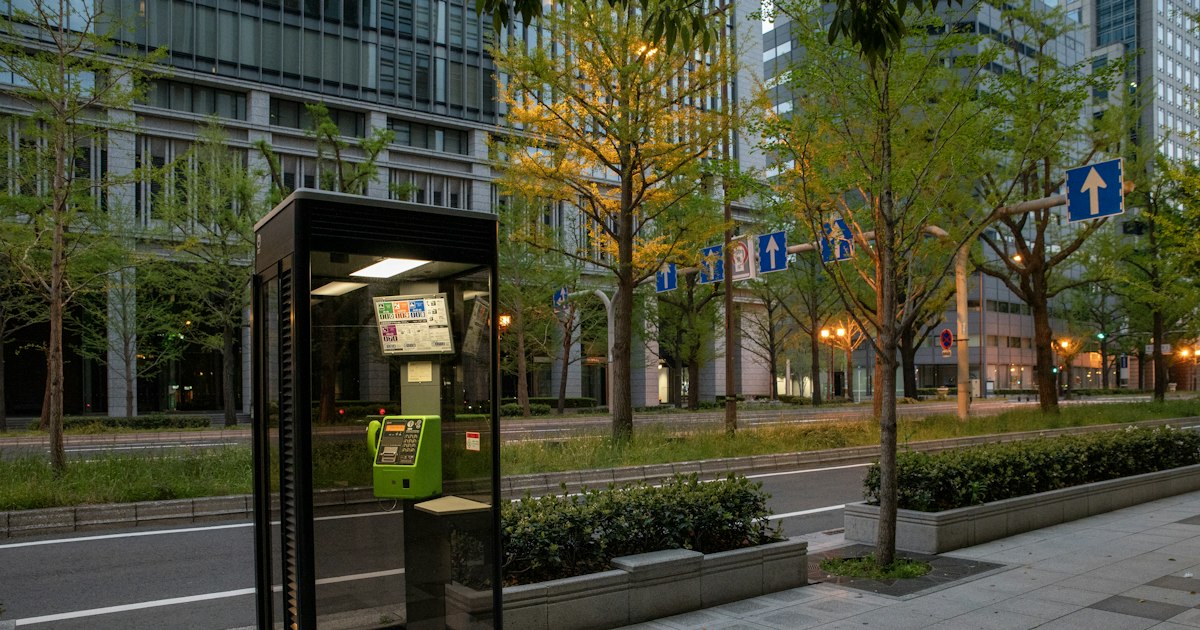
Walk past any major train station in Japan and you’ll likely spot one: a squat grey or green box with a phone bolted inside, usually ignored by everyone holding a smartphone. These are koshu denwa (公衆電話), Japan’s public payphones, and despite looking like relics, they’re still legally required to exist in large numbers across the country. For most visitors they’re invisible. For a small number of travelers each year — the ones with a dead phone, no SIM, or caught in a situation where the mobile network itself has failed — they turn out to be the only working communication tool in the room. Here’s what they actually do, how to use one, and the specific scenarios where it’s worth knowing one is nearby.
Why Japan Hasn’t Removed Them
NTT East and NTT West, the companies that inherited Japan’s former telephone monopoly, operate under a “universal service” obligation written into telecommunications law. It requires them to keep a minimum density of public phones available nationwide — roughly one within reasonable reach of most populated areas — regardless of how unprofitable that is. The number of koshu denwa has collapsed from its mid-1980s peak, but the legal floor hasn’t moved, because the justification isn’t commercial. It’s disaster policy.
During a major earthquake, mobile networks are usually the first thing to buckle: cell towers lose power, data networks get throttled, and carriers often cap or block voice calls entirely to stop the network collapsing under demand. Japan’s fixed-line payphone network runs on a separate system and gets priority call routing during these events, meaning a koshu denwa can sometimes get a call through when every smartphone around it shows “no service.” That single use case is why regulators have never let the network shrink to zero.
How to Actually Use One
Most surviving phones are the pink-topped or grey “Type 1” models. A few rules trip up almost everyone the first time:
- Coins: Only ¥10 and ¥100 coins are accepted — no ¥1, ¥5, ¥50, or ¥500. A local call runs about ¥10 per minute. The catch: if you insert a ¥100 coin and don’t use the full value, you get no change back. Always feed in ¥10 coins unless you’re making a long call.
- Phone cards (テレホンカード): Prepaid cards sold at convenience stores and station kiosks for ¥500 or ¥1,000, worth 50 or 105 “units” respectively. Insert the card, dial, and the remaining balance prints or displays on a small screen. These are also sold as souvenir items with manga and idol artwork, so some tourists buy them purely as collectibles without realizing they still work in any green phone.
- Emergency numbers are free: You can dial 110 (police) or 119 (fire/ambulance) from any koshu denwa without inserting any money or card at all. On older models you may need to press a red emergency button first to activate the call.
- International calls: Only specific grey/orange “international & domestic” phones support overseas calls, and they’re mostly limited to airports (Narita, Haneda, Kansai) and some large hotel lobbies. They take coins, phone cards, or in some cases credit cards, but per-minute rates to most countries run into several hundred yen, so this is a last-resort option, not a cheap alternative to WhatsApp.
The Scenarios Where You’d Actually Need One
For a traveler with an eSIM or pocket wifi, koshu denwa are background noise 99% of the time. The remaining 1% is worth planning for:
- Your phone is dead, lost, or stolen and you need to call your hotel, a taxi dispatcher, or a travel companion. Payphones don’t need a working SIM or battery.
- A large earthquake just hit and mobile networks are congested or down. This is the scenario the whole system exists for — in this situation a nearby koshu denwa can also connect you to NTT’s disaster message board service (dial 171), a free recorded-message system set up specifically after major quakes so families can check on each other when voice lines are jammed. It’s the phone-network equivalent of the safety information covered in our guide to Japan’s tsunami evacuation signs — low-tech, easy to overlook, and exactly what you want to already understand before you need it.
- You’re in a dead zone inside a large underground station complex or a rural area with patchy carrier coverage, where a wired phone line still works fine.
Where to Find One
Koshu denwa cluster around the places that still see steady foot traffic: JR and subway station concourses (usually near the ticket gates or on the platform), post offices, hospital lobbies, and airport terminals. Convenience stores sometimes have one just outside the entrance. In big stations like Tokyo, Shinjuku, or Osaka, they’re easy to miss amid the crowds — if you’re navigating during the crush covered in our guide to Tokyo rush hour, look along the walls near station exits rather than in the main concourse flow, since that’s typically where the phone alcoves are tucked. Outside major cities, expect fewer of them, but post offices and town halls almost always have at least one, since those are the buildings the universal service rule is built around.
Common Mistakes
- Assuming they’re gone entirely. They’ve shrunk a lot, but they haven’t disappeared — every train station of meaningful size still has at least one.
- Feeding in a ¥100 coin for a short call. You’ll lose the unused balance. Carry ¥10 coins specifically for this if you’re even slightly worried about a dead-phone scenario.
- Trying to dial a foreign number from a standard green phone. It won’t connect — you need one of the limited international models, and those are concentrated at airports and major hotels, not neighborhood stations.
- Not knowing the booth exists until you need it. The whole value of a koshu denwa is situational — nobody plans a trip around them, but knowing roughly where the one near your hotel or train station is costs nothing and solves a real problem if your phone ever dies at the wrong moment.
A Quick Pre-Trip Checklist
You don’t need to reroute your itinerary around payphones, but a few minutes of preparation covers the realistic failure cases: carry a handful of ¥10 and ¥100 coins at all times (useful for coin lockers and vending machines anyway), memorize 110 and 119 as free-to-dial numbers, and note that 171 exists as the disaster check-in line if a major quake hits during your stay. None of this requires buying anything or detouring anywhere — it’s the same category of “boring but useful” preparation as knowing what Japan’s blue evacuation signage or winter gear like a denki mofu heated blanket actually does before you need either one. The koshu denwa isn’t a tourist attraction, and you’ll likely finish your whole trip without touching one — but on the day something goes wrong with your phone or the network itself, that unremarkable green box might be the most useful piece of infrastructure in the city.