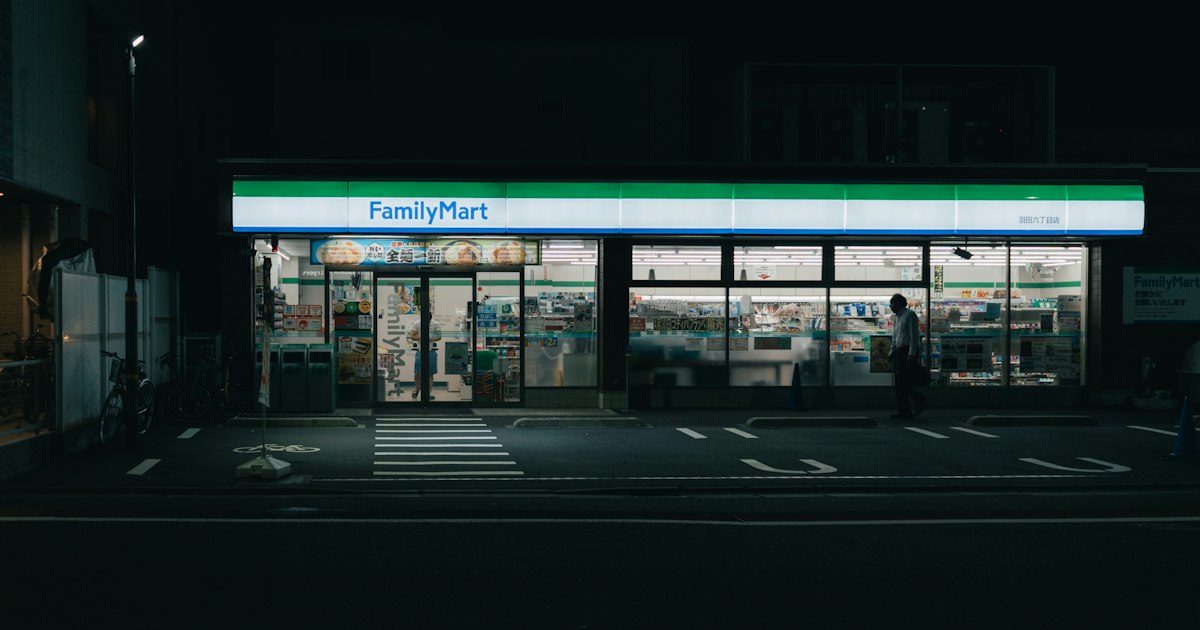
Photo by Frank Huang on Unsplash
Ask any Japan regular where to find the country’s best fast food and you’ll get the same two answers, usually argued about with surprising passion: Famichiki, the single golden fillet sold at FamilyMart, and Karaage-kun, the bite-sized nuggets sold at Lawson. Both are convenience store fried chicken, both cost less than a coffee, and both have loyal followings that border on tribal. If you’re spending any real time in Japan, you will walk past dozens of these stores, and knowing what you’re looking at — and how to order it without fumbling — will save you confusion and get you a better snack.
What Makes Famichiki and Karaage-kun Different
Famichiki, sold exclusively at FamilyMart, is one large boneless chicken thigh fillet, battered and fried to order (or kept warm in a heated case) and handed over in a small paper sleeve. It’s juicy, thick, and meant to be eaten in a few big bites — closer to a fast-food chicken sandwich patty than nugget-style karaage. It was introduced in 2006 and has become one of FamilyMart’s signature products, with the chain selling hundreds of millions of pieces a year.
Karaage-kun, sold exclusively at Lawson, is the older of the two, launched back in 1986. It comes in a small paper bag of five bite-sized pieces rather than one fillet, and it’s designed to be eaten with a wooden pick or your fingers while walking. The chicken is marinated before frying, so the flavor goes deeper into the meat rather than sitting mostly in the crust. Lawson leans hard into the branding too — Karaage-kun has its own cartoon mascot and even its own commemorative merchandise over the years.
In short: Famichiki is one big juicy piece built for a quick, filling bite; Karaage-kun is a shareable, snackable bag with more complex marinated flavor. Neither is “better” — they’re built for slightly different cravings.
How to Order (and What to Expect)
Both are sold from a heated glass case near the cash register, usually next to the oden pot in winter or iced drinks in summer. You don’t need much Japanese — point and say “Famichiki, onegaishimasu” or “Karaage-kun, onegaishimasu” and the staff will grab one with tongs and bag it. At busier stores near train stations, staff may ask if you want a sauce packet (mayo or spicy mayo is common with Famichiki) — nod or say “hai” if you want it.
If you’ve already used a self-service ordering system like the ones at Marugame Seimen, this is far simpler by comparison — there’s no tray line or customization menu, just a case, a clerk, and a quick exchange at the register.
Price, Portion Size, and Value
Prices tick up periodically with inflation, so treat these as ballpark figures rather than fixed numbers: a single Famichiki fillet typically runs somewhere in the ¥230–280 range (tax included), while a five-piece bag of Karaage-kun (the “Red,” spicy original) is usually a touch cheaper, often ¥210–260 for the pack. Per-bite, Karaage-kun is arguably the better value if you’re sharing or just want a few bites; Famichiki is better value if you want one substantial snack that functions almost like a light meal.
Budget move: either one, eaten standing at the counter or on a park bench, is one of the cheapest hot proteins you’ll find in Japan. Mid-range: pair it with a convenience store rice ball and canned coffee for a full meal under ¥600. Splurge: some FamilyMart locations sell a “Famichiki” sandwich or a double-size version during promotions — worth grabbing if you see it, since it’s not always on the menu.
Flavor Variations and Seasonal Specials
Karaage-kun’s lineup includes the original spicy “Red,” a milder “Shio” (salt) version sometimes called “L,” a cheese flavor, and rotating limited editions — curry, plum-and-shiso, and regional collaborations have all appeared over the years. Lawson treats these rotations like seasonal events, so if a flavor you tried last trip isn’t there this time, that’s normal.
Famichiki’s standard version is a straightforward savory fried chicken, but FamilyMart also runs its own limited flavors and spin-offs — a spicier “Famichiki Red,” cheese-stuffed versions, and occasional collaborations tied to anime or other brands. Both chains announce new flavors on in-store posters and at the register display, so it’s worth glancing at the case even if you think you know what you want.
Best Time to Buy for Maximum Freshness
Convenience stores are open 24 hours at most locations (a shrinking number have scaled back late-night hours due to staffing, mostly in smaller towns), but freshness depends on cook batches, not store hours. The best windows are right around lunch (11:30am–1pm) and early evening (5pm–7pm), when staff restock the warmer most frequently to meet demand from office workers and students. Late at night, chicken may have been sitting in the case for longer, and at very quiet rural stores in the early morning, the case may be empty until the next batch is fried. If you’re near a major train station, turnover is fast enough that freshness is rarely an issue.
Common Mistakes Travelers Make
- Assuming they’re interchangeable. Walking into a Lawson expecting Famichiki (or vice versa) — they’re chain-exclusive, so plan around whichever store is actually in front of you rather than hunting for a specific brand across town.
- Skipping the sauce. Famichiki is often sold with an optional mayo or spicy mayo packet that isn’t automatically included — ask if you want it.
- Not checking spice level. Karaage-kun “Red” has a mild kick that can surprise people expecting plain fried chicken; the “Shio/L” version is the safer bet for kids or spice-sensitive travelers.
- Eating it cold on purpose to save for later. Both are genuinely best eaten within minutes of purchase — the crust softens quickly, so this isn’t great take-back-to-the-hotel food.
- Forgetting cash isn’t required. Nearly all FamilyMart and Lawson locations take IC transit cards (Suica, Pasmo, ICOCA) and most major credit cards, so there’s no need to break a bill just for a ¥250 snack.
Beyond the Big Two: Other Convenience Store and Fast-Food Finds
Seven-Eleven has its own fried chicken, generally less famous than Famichiki or Karaage-kun but worth a try if that’s the store you’re near. And if convenience store food gets you curious about Japan’s other regional comfort dishes, two worth seeking out on a longer trip are Okinawa’s taco rice, a totally different kind of American-influenced comfort food, and Nagasaki’s champon, a seafood noodle dish with its own hybrid origin story. Both make a good contrast to the quick convenience-store bite and show how far Japan’s casual food culture extends beyond what’s sitting in a glass case by the register.
Ultimately, the Famichiki-versus-Karaage-kun debate isn’t one you need to settle before you land — just try both within the first few days of your trip, pick a side if you want to join the argument, and enjoy one of the easiest, cheapest, and most reliably satisfying snacks Japan has to offer.