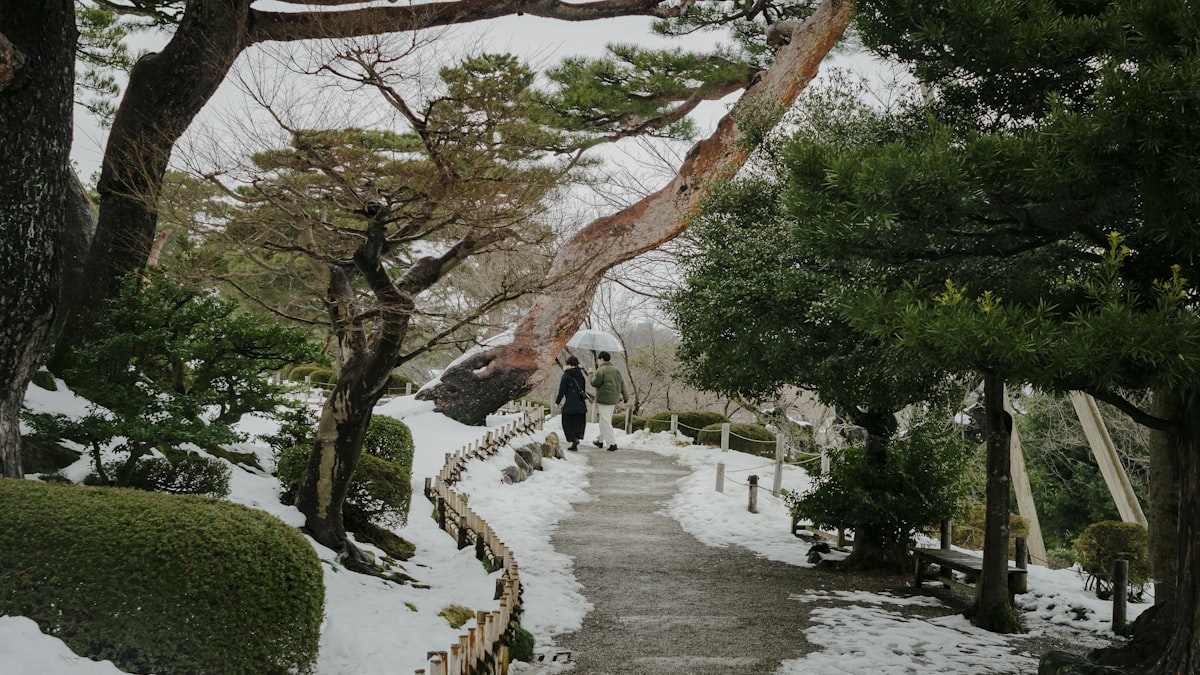
Kanazawa is one of Japan’s most rewarding smaller cities — a beautifully preserved castle town with one of the country’s finest gardens, gold-leaf crafts, and superb seafood. Here’s how to visit.
Top sights
- Kenrokuen Garden — ranked among Japan’s three great gardens; stunning in every season.
- Kanazawa Castle — right next to the garden.
- Higashi Chaya District — atmospheric old teahouse streets, great for gold-leaf treats and crafts.
- Nagamachi — a preserved samurai quarter.
- 21st Century Museum of Contemporary Art — playful modern art, including the famous “swimming pool.”
Food & crafts
- Omicho Market — fresh seafood; try a kaisendon (seafood rice bowl).
- Gold leaf (kinpaku) — Kanazawa makes most of Japan’s gold leaf; even gold-topped soft-serve.
- Kutani ware & Kaga crafts — beautiful ceramics and lacquer; see our Japanese ceramics guide.
Getting there
- The Hokuriku Shinkansen connects Tokyo to Kanazawa in about 2.5–3 hours (covered by the JR Pass).
- It pairs naturally with Takayama & Shirakawa-go by bus for an “old Japan” loop.
- Easy to add between Tokyo and Kyoto — see our 14-day itinerary.
How long to stay
One to two nights is ideal. The center is compact and walkable, with a loop bus linking the main sights; grab an IC card.
Tips
- Kanazawa can be rainy — pack a compact umbrella (locals lend them freely here).
- Go to Kenrokuen early to beat crowds and get soft morning light.
- Gorgeous in autumn and under snow in winter.
What things cost
- Kenrokuen Garden entry is JPY 320, and a combined ticket with Kanazawa Castle Park runs about JPY 500 — both very reasonably priced compared to similar-caliber sights elsewhere in Japan.
- A kaisendon seafood rice bowl at Omicho Market runs JPY 2,000-4,000 depending on how much premium seafood is piled on top — a genuine highlight meal worth budgeting for rather than treating as a quick snack stop.
- Gold-leaf soft-serve ice cream (topped with an edible sheet of gold leaf) costs about JPY 900-1,100 in the Higashi Chaya district — more a novelty photo op than a bargain, but a fun one-time try.
Common mistakes to avoid
- Visiting Kenrokuen at midday — like most famous Japanese gardens, it’s calmest and best-lit in early morning; arriving at opening avoids both crowds and the harsher midday light for photos.
- Skipping the loop bus in favor of walking everywhere — Kanazawa’s center is walkable, but the loop bus (with an unlimited day pass) saves real time between the farther-apart sights like the 21st Century Museum and Nagamachi.
- Forgetting an umbrella — Kanazawa has one of the higher rainfall rates among Japan’s major tourist cities; locals genuinely lend umbrellas at shops and stations as a matter of local hospitality, which tells you something about how often it’s needed.
Kanazawa as part of a wider “old Japan” route
Kanazawa connects to Takayama and Shirakawa-go via a scenic direct bus, forming a natural loop through Japan’s preserved historic towns that avoids backtracking through Tokyo or Osaka — a popular add-on for travelers with 10+ days who want depth beyond the standard Golden Route.
Trying a gold-leaf craft workshop
Beyond buying finished gold-leaf products, several shops in Kanazawa offer short hands-on workshops (applying gold leaf to a small item like a chopstick set or box) for around JPY 1,500-3,000 — a memorable, inexpensive activity that turns a shopping stop into something you actually made yourself.