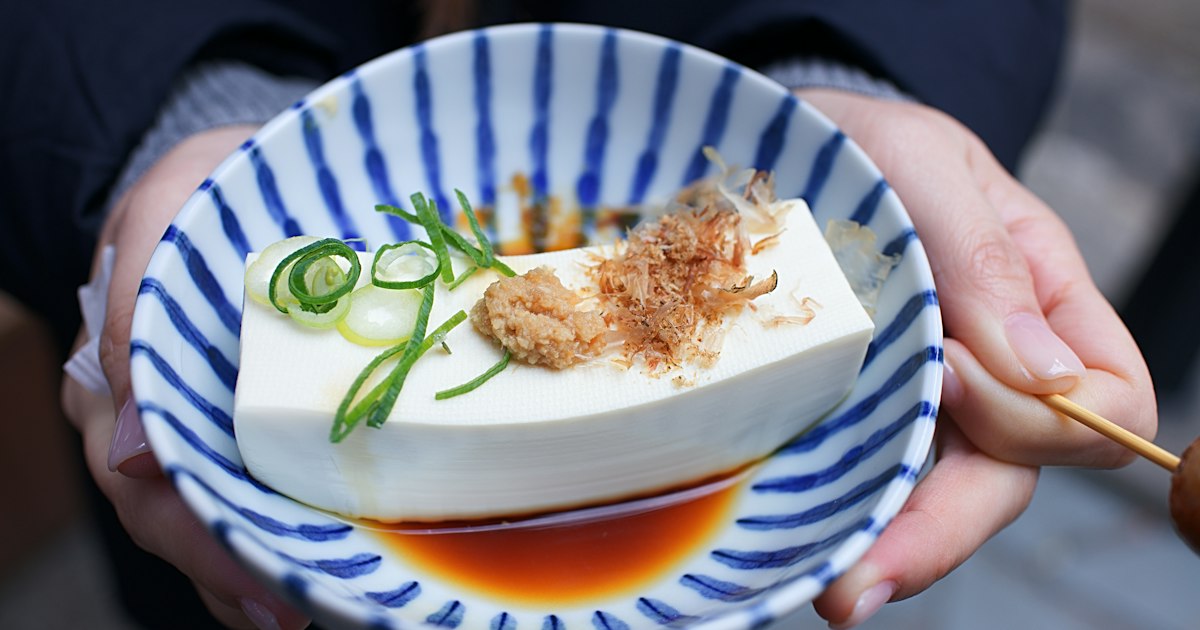
Photo by Sherman Kwan on Unsplash
Ask a Japanese home cook what they’re making for dinner and “tofu” is rarely the whole answer — it’s agedashi dofu with a dashi-soy glaze, or atsuage straight off the grill, or aburaage stuffed into inari sushi. Deep-fried tofu is one of the most underrated categories in Japanese cooking, and it’s also one of the easiest to get wrong as a visitor: order the wrong dish at the wrong kind of restaurant and you’ll get a sad, soggy cube instead of the crisp-outside, custardy-inside version that made this dish famous. Here’s how to find the real thing, from 500-yen izakaya plates to full tofu kaiseki courses.
What Agedashi Dofu Actually Is
Agedashi dofu (揚げ出し豆腐) is silken or soft tofu, lightly dusted in potato starch (katakuriko) or flour, deep-fried just until the surface sets into a thin, golden shell, then served in a pool of warm dashi broth seasoned with soy sauce and mirin. It’s topped with grated daikon, sliced scallion, and often bonito flakes or a touch of ginger. The point isn’t crunch that lasts — it’s the contrast between that fragile fried skin and the hot, barely-set tofu underneath, all swimming in savory broth. Done well, you eat it with a spoon, broth and all. Done badly (reheated, over-fried, bottled sauce), the coating turns rubbery and the tofu goes watery. It’s a staple on izakaya menus nationwide, usually priced between ¥400 and ¥600 as a shared small plate.
Beyond Agedashi: Japan’s Other Fried Tofu Dishes
Agedashi dofu is the gateway dish, but it’s part of a bigger family worth knowing by name:
- Atsuage (厚揚げ) — a thick slab of tofu deep-fried until the outside is firm and golden while the center stays soft, usually grilled or pan-fried again and eaten with ginger and soy sauce, or simmered in oden pots.
- Aburaage (油揚げ) — thin tofu sliced and deep-fried until it puffs up, used for inari sushi pouches, in miso soup, or simmered with kitsune udon.
- Ganmodoki (がんもどき) — a fried tofu-and-vegetable patty mixed with carrot, mushroom, and hijiki seaweed, common in oden and home cooking, especially in autumn and winter.
- Koya-dofu (高野豆腐) — freeze-dried tofu, not deep-fried but worth knowing since it originated at Mount Koya’s temples and shows up in the same shojin ryori (Buddhist vegetarian) meals as agedashi dofu.
Knowing these names helps you read a Japanese-only menu at a neighborhood izakaya, where agedashi dofu might sit right next to atsuage without English translation.
Budget Option: Izakaya and Teishoku Chains (¥400–700)
You don’t need a special trip for your first agedashi dofu — any decent izakaya has it. Chains like Watami, Tsukada Nojo, or local standalone izakaya in any station neighborhood serve a reliable version for ¥450–600. Teishoku (set meal) restaurants and some ramen-adjacent shokudo also offer it as a side dish for around ¥350–500. The quality varies: ask for it “age-tate” (freshly fried) if you can, since izakaya kitchens sometimes pre-fry in batches during a rush. If you’re building a casual dinner crawl, pair it with grilled skewers and a cold beer — this is standard, no-reservation-needed eating.
Mid-Range: Kyoto’s Tofu Restaurants Near Nanzenji and Arashiyama
Kyoto is the undisputed capital of tofu cuisine, thanks to centuries of Zen temple cooking and the city’s famously soft, mineral-light water. The temple district around Nanzenji in eastern Kyoto has several restaurants built specifically around tofu kaiseki — multi-course meals where agedashi dofu, yudofu (simmered tofu), and ganmodoki all appear alongside seasonal vegetables.
Okutan Nanzenji, just outside Nanzenji temple’s gate, has served tofu dishes to temple visitors for over 350 years. A set course with yudofu, a small agedashi-style dish, tempura, and rice runs roughly ¥3,500–5,500 per person. It’s open for lunch (typically 11:00–16:00; check seasonal hours before visiting, as it closes irregularly in winter) and seating is on tatami overlooking a garden — arrive before noon on weekends or expect a wait.
In Arashiyama, several tofu restaurants near the bamboo grove and Tenryuji temple offer similar set menus in the ¥3,000–6,000 range, making it easy to combine a tofu lunch with a morning temple walk. If you’re spending a full day in the Kyoto/Uji area, consider pairing a tofu lunch with a stop at Uji, Kyoto’s matcha capital, about 20 minutes south by train — tofu for lunch, fresh matcha for the afternoon is a genuinely good combination, and both cuisines share the same restrained, dashi-and-umami sensibility.
If you’re driving between temple districts rather than taking trains, note that Kyoto’s old city streets have very limited roadside parking; it’s worth reading up on coin parking lots and apps before you go, since circling for a spot near Nanzenji eats into lunch time fast.
Splurge: Tofu Kaiseki in Tokyo
For a formal tofu-centric meal, Tokyo has two well-known names. Tofuya Ukai, near Tokyo Tower in a converted sake-brewery building with a traditional garden, serves multi-course tofu kaiseki from roughly ¥9,000 up to ¥20,000+ per person depending on the course, with agedashi dofu typically appearing as one of the early courses alongside housemade yuba and grilled dishes. Reservations are essential, ideally weeks ahead for dinner, and smart-casual dress is expected. Sasa no Yuki in Negishi (northeast Tokyo), operating since the 1690s, is more accessible — tofu-focused set meals run around ¥3,000–7,000 for lunch — and is a good middle step between an izakaya plate and a full kaiseki splurge.
Best Season, Timing, and Common Mistakes
Tofu dishes are eaten year-round, but yudofu and agedashi dofu both feel most natural in autumn and winter, when the hot broth is genuinely comforting — many Kyoto tofu restaurants extend hours and add seasonal vegetables (chestnut, yuzu) to menus between November and February. Summer versions lean toward cold hiyayakko instead, so if you specifically want the fried, broth-soaked version, don’t assume every tofu restaurant serves it in August; check the menu or ask.
Common mistakes to avoid: ordering agedashi dofu expecting a crunchy, batter-heavy dish like tempura (it’s meant to be delicate, not crispy-crunchy); eating it slowly while sightseeing-planning at the table, since the fried coating softens fast once it hits the hot broth; and skipping reservations at the famous Kyoto and Tokyo spots during peak cherry blossom (late March–early April) and autumn foliage (mid-November) weeks, when even modest tofu restaurants fill up by 11:30am. If you’re touring temples all day and need a bathroom break between tofu-restaurant stops, Kyoto’s temple areas aren’t always well-supplied — it’s worth knowing the toilet-finding apps and konbini options before you’re far from a station.
Finally, if you want to try making it at home after your trip, agedashi dofu is genuinely simple: press firm or soft tofu briefly, pat dry, dust with potato starch, shallow-fry in neutral oil until golden, and serve over warmed dashi-soy broth with grated daikon. It’s one of the few “restaurant” dishes that travels well from Japan to your own kitchen with almost no special equipment.