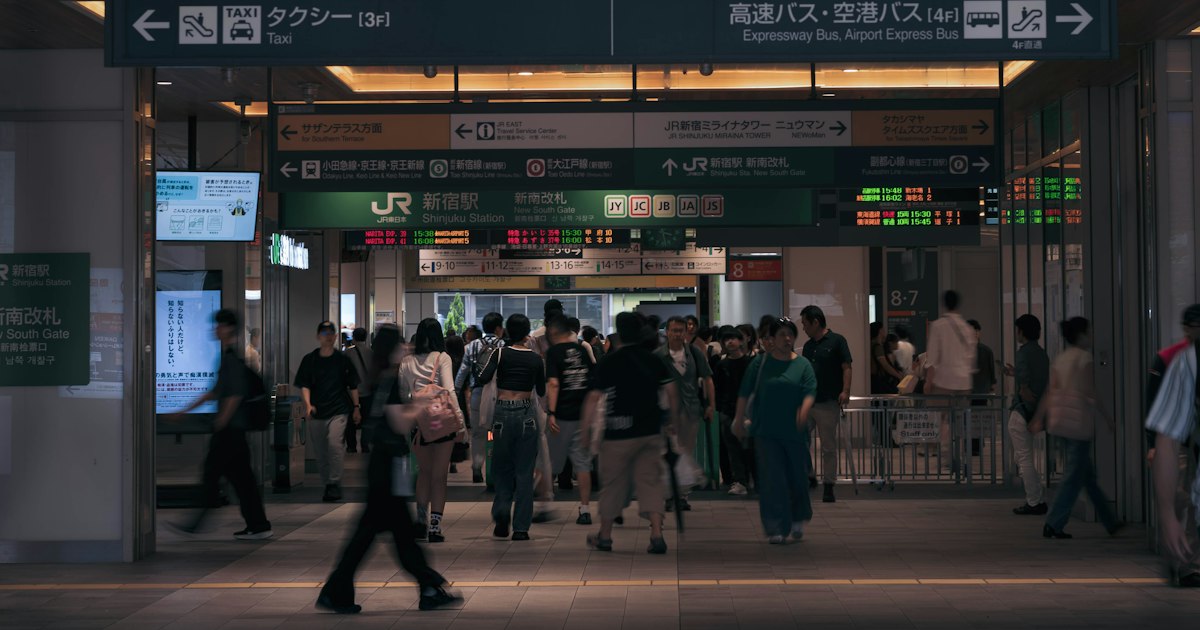
Photo by Fumiaki Hayashi on Unsplash
Shinjuku Station moves more than three million passengers a day, spreads across more than 200 exits, and is shared by five different railway operators plus a separate station next door that also calls itself “Shinjuku.” It’s officially recognized by Guinness World Records as the busiest train station on Earth, and the first time you try to find your platform, it feels like it. The good news is that the chaos has a logic to it — once you know the landmarks, the fare-gate quirks, and a few rookie traps to avoid, Shinjuku stops being scary and becomes one of the most useful hubs in Tokyo.
Why Shinjuku Station Feels Like a Maze
The confusion comes from scale, not design failure. JR East, Odakyu, Keio, Tokyo Metro, and the Toei subway each run their own lines through overlapping concourses, and each company has built its own exits, signage style, and underground passages over nearly a century. Add Seibu-Shinjuku Station — a separate building about a 10-minute walk from the main complex, used by the Seibu Shinjuku Line — and you can see why even Tokyo residents sometimes resurface on the wrong side of the building. Treat your first visit as a scouting mission: give yourself an extra 10-15 minutes buffer the first time you transfer here, especially with luggage.
The Big Four Exits and What’s Near Each One
Instead of memorizing a track map, memorize what’s above ground at each main exit — it’s the fastest way to self-correct when you’re lost.
- East Exit (Higashi-guchi): Studio Alta’s video screen, the Kabukicho entertainment district, Golden Gai’s tiny alley bars, and Don Quijote. If you’re heading to a show at one of Tokyo’s theatrical dinner shows, this is almost always your exit.
- West Exit (Nishi-guchi): The skyscraper district, Odakyu and Keio department stores, and the Tokyo Metropolitan Government Building, which has a free observation deck around 202m up (usually open 9:30am-10:30pm, with occasional maintenance closures — check before you go up).
- South Exit (Minami-guchi) and New South Exit: Busta Shinjuku, the country’s largest bus terminal, plus Takashimaya Times Square and the NEWoMan shopping complex. This is where most long-distance and airport buses depart.
- Southern Terrace: A quieter, street-level walkway linking the South Exit area to Odakyu’s building — handy for avoiding underground crowds if you just want fresh air between transfers.
JR vs. Private Railways: How the Fare Gates Trip People Up
The single biggest mistake foreign visitors make at Shinjuku is assuming it’s one unified station you can walk through freely. It isn’t. JR East, Odakyu, Keio, Tokyo Metro, and Toei each operate behind their own fare gates. If your IC card (Suica or Pasmo) is tapped into the JR side, you generally cannot walk through to the Odakyu or Keio platforms without exiting one set of gates and tapping into another — the fare recalculates automatically, so this isn’t a problem for your wallet, just for your sense of direction. Follow the color-coded line signs (JR uses green for the Yamanote Line, orange for the Chuo Line) rather than trying to beeline toward a platform number, since numbering resets between operators.
Also worth knowing: Shinjuku-Sanchome Station (Marunouchi Line, Toei Shinjuku Line, Fukutoshin Line) and Tochomae Station (Oedo Line, right by the Metropolitan Government Building) are both separate stations a short walk from the main Shinjuku Station complex, not exits of it. If a map app routes you through one of these, don’t panic — it’s often genuinely the faster path, just not technically “inside” Shinjuku Station.
Avoiding the Worst of the Crowds
Weekday rush hours — roughly 7:30-9:30am and 5:30-7:30pm — turn the main concourses and the Yamanote Line platforms into a dense, fast-moving river of commuters. If you’re dragging luggage or traveling with kids, it’s worth timing your transfer outside those windows. Midday (11am-3pm) and after 8pm are noticeably calmer. Weekends are busy in a different way — shopping and entertainment crowds around the East and South Exits — but the pure commuter crush is gone, making it a slightly easier time to practice navigating before a weekday trip through the station.
Tools and Apps That Actually Help
Google Maps’ transit directions are generally reliable for exit numbers inside Shinjuku, and it’s worth zooming in before you arrive so you recognize exit names in Japanese characters as well as English (station signage mixes both). The Japan Official Travel App and Navitime Japan Travel both include indoor station maps that are more detailed than generic map apps for exactly this kind of multi-operator station. If you just need a bathroom break mid-transfer, Shinjuku has well-maintained public restrooms on most concourse levels — our guide to finding a public restroom in Japan covers the apps and station-facility signage that make this easy anywhere, not just here.
Common Mistakes First-Timers Make
- Confusing JR Shinjuku with Seibu-Shinjuku Station. They are different buildings about 10 minutes apart on foot. Check which one your ticket or app directions actually specify.
- Trying to transfer underground between operators without exiting fare gates. It usually isn’t possible — budget time to tap out, walk, and tap back in.
- Skipping breakfast because there’s “no time” between trains. Shinjuku has several standing soba counters right in the station that fit easily into a short layover — see our guide to Tokyo’s standing soba stalls for exactly this situation.
- Not using a locker for daytime sightseeing. Coin lockers throughout the station run roughly ¥400-700 depending on size, letting you drop bags before exploring Kabukicho or the skyscraper district instead of hauling them around all day.
- Underestimating walk times between exits. The East and West Exits, for instance, are a genuine 10-15 minute walk apart via underground passages — don’t assume “same station” means “same door.”
Quick Reference: Getting To and From Shinjuku
Shinjuku is a major long-distance hub as well as a city hub. The Narita Express connects Narita Airport to Shinjuku in roughly 80-90 minutes for around ¥3,250 one-way. Odakyu’s Romancecar runs limited-express service toward Hakone from the West Exit side in about 85 minutes. Busta Shinjuku, at the South Exit, handles highway buses to destinations across Japan, including ski regions and hot-spring towns well beyond the city — if a quieter powder destination like Appi Kogen or a resort town such as Nasu Highland is on your itinerary, this is often where that journey starts. Whichever direction you’re headed, arrive at Shinjuku with a little extra time, follow the exit landmarks rather than platform numbers, and the “world’s busiest station” label starts to feel more like a fun fact than a warning.