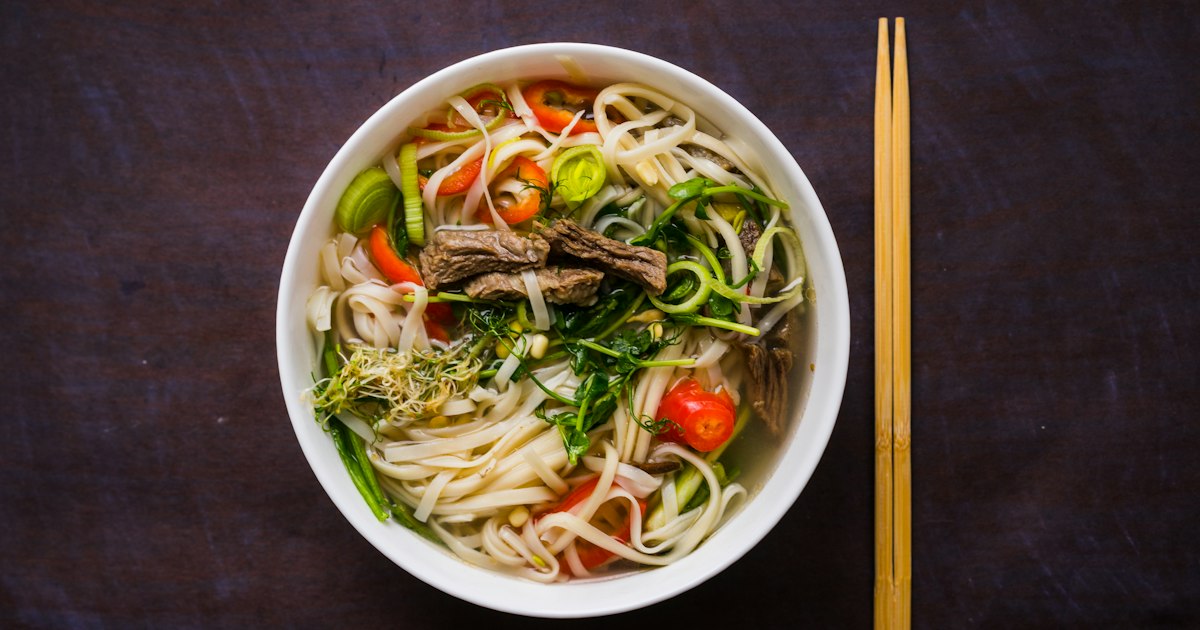
Photo by Kirill Tonkikh on Unsplash
Most visitors who know Japan’s “big three” udon styles can name Sanuki udon from Kagawa without hesitation. Far fewer have heard of the third: Goto udon, hand-stretched on a remote archipelago off Nagasaki, finished with local camellia oil, and traditionally eaten straight out of the cooking pot with a raw egg dip. It’s one of the few regional noodle traditions in Japan that still requires real effort to track down — which is exactly what makes it worth the detour.
What Makes Goto Udon Different
Unlike Sanuki udon, which is kneaded and cut by hand or machine into thick, chewy strands, Goto udon is made using a stretching technique closer to how somen or Chinese hand-pulled noodles are produced. The dough is repeatedly stretched into long loops and hung over wooden rods to rest and elongate under its own weight, which is why the noodles come out notably thinner than Sanuki or Inaniwa udon — closer in diameter to a thick somen than a classic udon strand.
Two local ingredients define the flavor and texture. First, salt harvested from the surrounding Goto Sea is worked into the dough instead of standard table salt, which locals credit for the noodle’s firm, springy bite. Second, and more distinctively, the stretched dough is coated in camellia (tsubaki) oil pressed from trees that grow wild across the islands, rather than the vegetable oil or dusting flour used elsewhere in Japan. The oil keeps the strands from sticking as they’re stretched and gives the finished noodle a faint, clean fragrance that locals consider Goto udon’s signature.
The Jigoku-daki Ritual: How It’s Actually Served
The classic way to eat Goto udon is called jigoku-daki, literally “hell-boiling.” A clay or metal pot of noodles is kept simmering at the table, and diners pull servings straight out of the broth with chopsticks rather than draining them into a separate bowl first. The noodles go into a small dipping cup containing a raw egg beaten with soy sauce, sometimes loosened with a splash of the hot cooking water — the heat from the noodles gently cooks the egg into a silky, custard-like sauce as you eat.
What makes the broth itself worth paying attention to is ago dashi, a stock made from flying fish (ago) that’s a Nagasaki specialty used across the prefecture’s cooking. It’s lighter and slightly sweeter than the kombu-and-bonito dashi used in most of Japan, and it’s the backbone of both the dipping sauce and any accompanying soup. A full jigoku-daki set for one person at a restaurant typically runs somewhere in the ¥1,500–¥3,000 range, depending on whether it comes with extras like tempura, local fish, or seasonal vegetables; ordering it to share among two or three people is common since the pot stays hot and refillable servings are normal.
Getting to the Goto Islands
Goto is a chain of islands roughly 100km west of Nagasaki city, and getting there takes real planning. The jetfoil (high-speed boat) from Nagasaki Port to Fukue, the islands’ main hub, takes about 1 hour 20 minutes to 1 hour 40 minutes and costs roughly ¥6,000–¥7,500 one way. The regular car ferry is slower, around 3 to 3.5 hours, but considerably cheaper at roughly ¥3,000–¥4,500 one way. There are also short flights from Nagasaki Airport to Fukue Airport on regional carrier ORC, taking about 30 minutes, with fares that swing widely by booking window — anywhere from around ¥6,000 if booked early to over ¥13,000 for a walk-up fare. Schedules for all three options are limited and change seasonally, so check current timetables before building an itinerary around a day trip; many travelers plan an overnight stay on Fukue or nearby Naru and Wakamatsu islands rather than rushing back same-day. If you’re arranging local transport on the islands, it’s also worth knowing that fishing is a core part of Goto’s economy and culture — a local fishing boat charter is a genuinely good way to see the coastline and understand where the flying fish in that ago dashi actually comes from.
Best Season and Timing to Visit
Spring (April–May) and autumn (October–November) offer the mildest weather for exploring the islands’ coastline and churches, with calmer seas and more reliable ferry crossings. Summer brings good weather but also typhoon risk from August through September, which can cancel jetfoil and flight schedules with little notice — build in buffer days if you’re traveling then. Winter is quieter and noodle-making itself is at its traditional best, since cold, dry air is considered ideal for stretching and drying udon outdoors, but ferry service can be choppier and some smaller eateries reduce hours.
Where to Eat It — On the Islands and in Nagasaki City
If the ferry or flight doesn’t fit your itinerary, you don’t have to skip Goto udon entirely. A number of udon specialty restaurants and izakaya in Nagasaki city serve it alongside other local dishes, often as part of a set menu that pairs well with a day spent around Glover Garden and the harbor area. Expect to pay roughly ¥900–¥1,500 for a simple hot or cold bowl at a casual shop in the city, versus the full jigoku-daki experience on the islands themselves, which leans toward the ¥2,000–¥3,000 range when it includes local seafood or tempura sides. Budget travelers can find simpler cold Goto udon bowls dressed with ago dashi tsuyu for under ¥1,000 at some lunch counters; splurge-minded visitors should look for ryokan on Fukue or Naru that build an entire multi-course dinner around the jigoku-daki pot, often alongside Goto beef or fresh sashimi.
Bringing Goto Udon Home: Buying Dried Noodles
Dried Goto udon is one of Nagasaki’s most reliable noodle souvenirs — it travels well, doesn’t need refrigeration, and is sold in gift-boxed bundles at souvenir shops around Nagasaki Station, Nagasaki Airport, and on the islands themselves. A standard box of several servings typically costs somewhere between ¥800 and ¥2,000 depending on quantity and packaging, and most boxes include a small packet of ago dashi-based tsuyu so you can recreate something close to the dipping sauce at home. If you’re also passing through Kyushu’s rail network, it’s worth comparing notes with the broader world of JR Kyushu station-limited snacks, since station shops are often the easiest place to grab a boxed set right before boarding a train or bus out of the region.
Common Mistakes to Avoid
The biggest mistake is assuming Goto udon is interchangeable with Sanuki udon and expecting the same thick, dense chew — the whole point of Goto’s noodle is that it’s thinner and more delicate, so judging it by Sanuki’s standards misses what makes it special. Second, skipping the raw egg dip because it sounds unfamiliar: the egg is there to form a sauce as it cooks against the hot noodles, not to be eaten raw on its own, and it’s central to the jigoku-daki method. Third, underestimating ferry and flight scarcity — Goto’s transport links are genuinely limited, especially outside peak travel periods, so booking a fixed return time without a buffer is a common way to get stranded. Finally, travelers obsessed with regional noodle rivalries elsewhere in Japan, like the Onomichi versus Innoshima ramen debate in the Setouchi region, will find Goto udon makes a worthwhile addition to that kind of noodle-tourism itinerary — just one that requires a boat instead of a train.