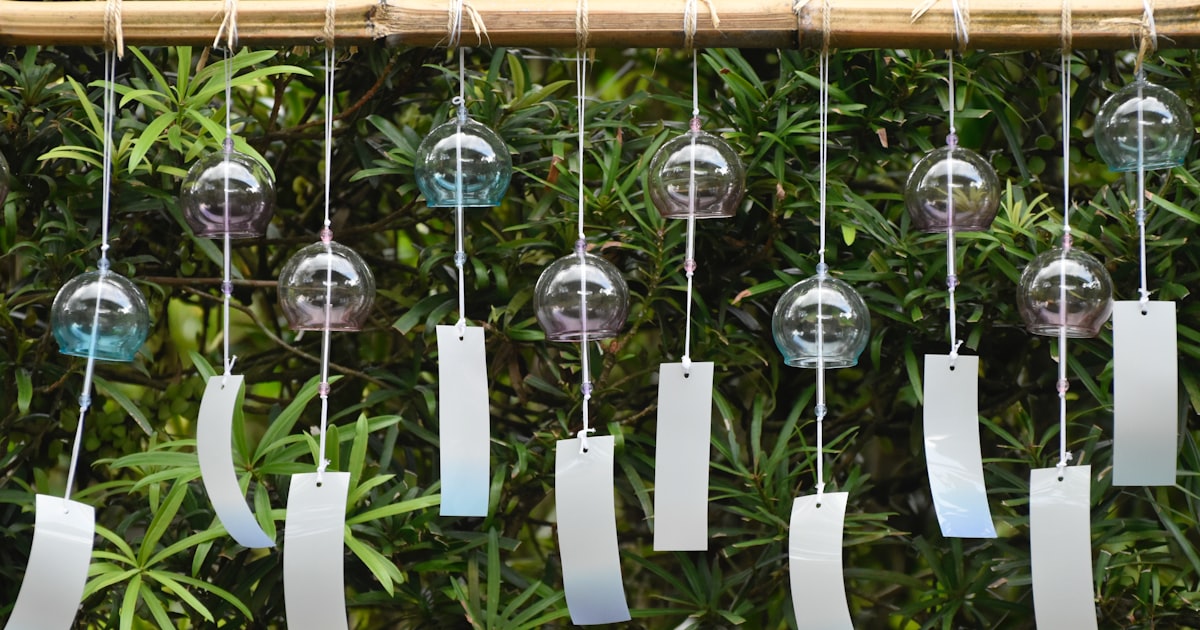
Photo by Geoff Oliver on Unsplash
Walk through almost any Japanese neighborhood in July or August and you’ll hear it before you see it: a thin, glassy chirin-chirin drifting from a shop awning or an apartment balcony. That’s furin, Japan’s traditional wind chime, and it’s one of the most authentic, packable souvenirs you can bring home from a summer trip. Here’s how to buy one that’s actually worth carrying home, where to see the best displays, and the mistakes first-time buyers make.
What Is Furin, and Why Do You Hear Them in Summer?
A furin is a small bell, traditionally glass, iron, or ceramic, hung with a clapper and a dangling paper strip called a tanzaku that catches the wind and swings the clapper against the bell. In Japan, the sound is culturally coded as “cooling” — long before air conditioning, the high, thin ring was a psychological trick to make sweltering afternoons feel a few degrees lighter. That’s why furin appear everywhere from late June through late August and then quietly disappear once autumn starts: they’re a seasonal object (a kigo, in poetry terms), not a year-round decoration, and most Japanese people take theirs down once summer ends.
The Main Types You’ll Find
Not all furin sound or look the same, and knowing the differences helps you pick the right one:
- Edo furin (江戸風鈴) — Hand-blown glass, made in Tokyo, with a deliberately rough, unground rim so the clapper produces a slightly irregular, higher-pitched ring. The inside is hand-painted with goldfish, morning glories, or fireworks motifs, applied from the inside of the glass so the color never rubs off. Expect ¥2,500–¥5,000 for a genuine hand-painted piece.
- Nanbu tekki furin (南部鉄器風鈴) — Cast iron, made around Morioka and Oshu in Iwate Prefecture using the same technique as Nanbu ironware teapots. These have a deep, clear, bell-like tone that carries much further than glass, and they’re virtually indestructible. Prices run ¥3,000–¥8,000 depending on size.
- Ceramic and Ryukyu glass furin — Ceramic ones (often from craft towns) have a duller, softer knock; Ryukyu glass furin from Okinawa are thicker, bubble-flecked, and colorful, with a lower tone than Edo glass. Both are typically ¥1,500–¥3,500.
- Souvenir-grade furin — Mass-produced, machine-painted, sold for ¥500–¥1,500 in tourist shopping streets. Fine as a cheap gift, but the sound is thinner and the paint often sits on the outside, where it can wear off.
Where to Buy Furin in Tokyo
For the real thing, skip the airport gift shop and go to a specialist:
- Shinohara Furin Honpo — A family workshop in Edogawa Ward (near Funabori Station on the Toei Shinjuku Line) that has hand-blown Edo furin since 1915. You can watch the glass-blowing and painting process, and during summer they often let visitors pick a blank bulb and watch it get painted to order. It’s a working workshop, not a polished retail store, so hours can be irregular — call ahead or check with your hotel concierge before making the trip.
- Asakusa’s Nakamise-dori and side streets — The easiest option if you’re already sightseeing near Sensoji Temple. Quality varies from genuine Edo furin to cheap imports, so look for the painted-from-inside detail and ask if it’s hand-painted before paying mid-range prices.
- Department store “furin ichi” fairs — Stores like Isetan Shinjuku, Nihombashi Takashimaya, and Mitsukoshi run temporary wind-chime fairs (usually on a rooftop or event floor) each June, gathering Edo, Nanbu, and Ryukyu furin from different regions in one place. It’s a good way to compare styles side by side before committing. Exact dates shift year to year, so check the store’s event calendar for the current summer.
Kawagoe’s Wind Chime Festival: See Thousands in One Place
If you want the full sensory experience rather than just a single chime, visit Hikawa Shrine in Kawagoe, a small city about 30–50 minutes from central Tokyo (Tobu Tojo Line from Ikebukuro, or Seibu Shinjuku Line from Seibu-Shinjuku Station). Each summer, roughly mid-July through mid-September, the shrine hangs around 1,700 to 2,000 furin from its walkways for the “Enmusubi Furin” display — a tunnel of chimes that ring in unison whenever the wind picks up. On weekend evenings the shrine strings paper lanterns among the chimes for an illuminated night version. Entry is free, and Kawagoe itself (nicknamed “Little Edo” for its preserved warehouse district) makes a pleasant half-day trip on its own, easily combined with a stroll through its old merchant street. Neither Kawagoe nor Morioka requires a rail pass for a single day trip, but if you’re planning a broader Kanto or Tohoku itinerary, it’s worth checking the Regional JR Rail Passes: JR East, JR West & Kansai Explained guide to see if a pass pencils out.
Buying Nanbu Ironware Furin at the Source
If cast iron is more your style, Morioka in Iwate is the source. Foundries there sell direct at their workshop shops, and the local craft center in central Morioka stocks pieces from multiple makers so you can compare tones before buying — the pitch varies noticeably between foundries and sizes. It’s a full-day trip from Tokyo via Tohoku Shinkansen, so it only makes sense if you’re already heading north; otherwise, look for Nanbu tekki furin at traditional craft shops in Tokyo or at the department store fairs mentioned above.
Prices, Shipping, and Common Mistakes
Budget: ¥500–¥1,500 for souvenir-grade glass, fine for gifts but skip if you want the authentic sound. Mid-range: ¥2,500–�¥5,000 for a genuine hand-painted Edo furin or a mid-size ceramic piece — this is the sweet spot for most travelers. Splurge: ¥6,000–¥10,000+ for a large Nanbu ironware furin or a named-artist Edo furin with detailed reverse-glass painting.
The most common mistake is treating furin like a normal souvenir when packing. Glass ones are genuinely fragile — ask the shop to wrap it in bubble wrap and box it (most will, especially at specialist shops), and carry it in your hand luggage rather than checked baggage. Cast iron furin are heavy; factor that into your luggage weight if you’re checking bags for a flight home. The other mistake is losing or discarding the tanzaku paper strip: it’s not just decorative, it’s what catches the wind and makes the clapper move, so a furin without it will barely ring at all. If you’re already thinking about how to wrap and carry delicate purchases home, the same principles that apply to a traditional furoshiki wrapping cloth — snug wrapping, no loose rattling — work well for glass furin too.
Finally, timing matters: shops sell down their furin stock through August and many stop restocking by early September since the item is explicitly seasonal, so if you’re traveling in autumn or winter, expect to find much thinner selection outside of a few year-round craft specialists. Furin pair naturally with other small, quintessentially Japanese purchases — if you’re already building a shopping list, guides on Japanese incense and Kutani ware porcelain cover two other traditional crafts that travel just as well.