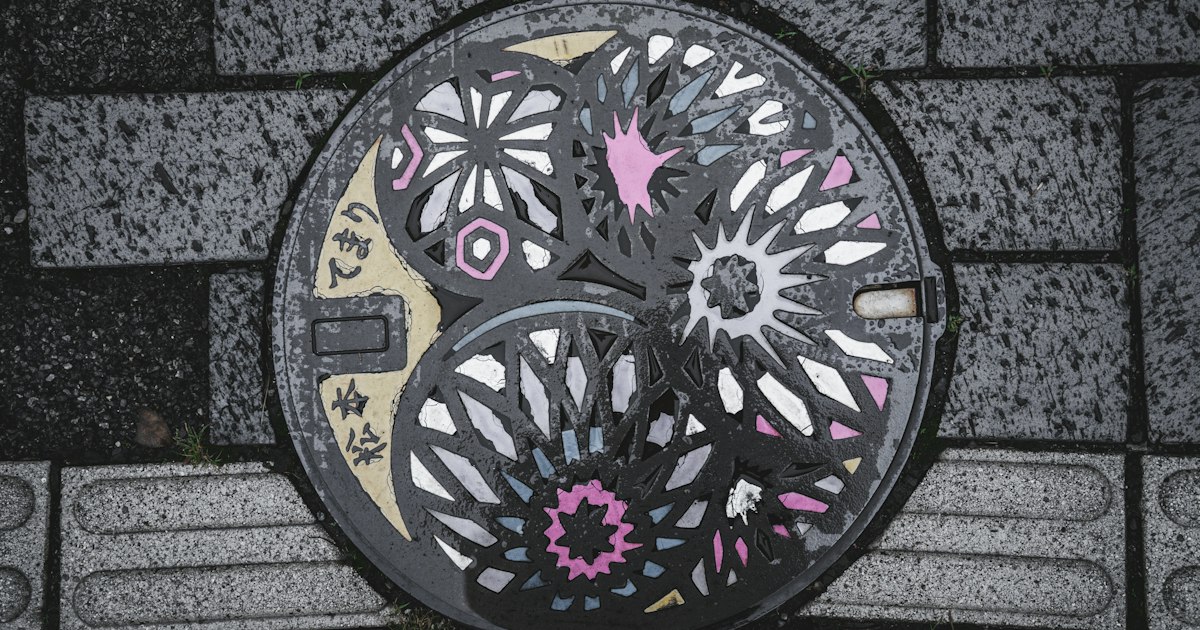
Photo by Alexandre Valdivia on Unsplash
Look down. In Japan, some of the country’s most charming and least-visited “attractions” are bolted into the pavement beneath your feet. Since the 1980s, hundreds of Japanese municipalities have commissioned custom manhole covers — cherry blossoms, koi, castles, folk heroes, and even anime characters cast in iron and painted by hand — turning sewer infrastructure into a nationwide open-air art gallery. The hobby of photographing and collecting these has a name, “drainspotting,” and it costs nothing but a little curiosity and a phone camera. Here’s how to do it properly.
What Is “Drainspotting,” and Why Is Japan Obsessed With Pretty Manholes?
The term was popularized by the 2010 photo book Drainspotting: Japanese Manhole Covers by Australian photographer Remo Camerota, who spent years documenting the country’s design manholes (デザインマンホール). Unlike the plain gray discs found in most cities, roughly 95% of Japan’s ~1,700 municipalities have at least one custom design, often several, tied to a local flower, festival, mascot, or famous product. Many are also produced in a limited-run “color version” (カラーマンホール), hand-painted and usually installed near a train station, city hall, or tourist information center rather than out on a busy road — which conveniently makes them easier and safer to photograph.
A Short History: How a Government Bureaucrat Turned Sewers Into Art
Credit goes to Yasutake Kameda, an official at Japan’s then Ministry of Construction, who in the mid-1980s pushed for decorative manhole designs as a way to build public support for expensive sewer infrastructure spending — money that was, and still is, a hard sell to taxpayers who never see it. Giving each town its own artistic cover turned a buried utility into civic pride. The idea spread fast, and by the 2000s “manhole tourism” had become its own quiet subculture, with local sewerage bureaus leaning into it rather than fighting it.
Where to Find the Best Manhole Covers (Tokyo and Beyond)
You don’t need to plan a special trip — manholes reward whatever walking you’re already doing. A few reliable starting points:
- Azabu-Juban, Tokyo — Sailor Moon–themed covers near the shopping street, tied to the anime’s setting.
- Takadanobaba, Tokyo — Astro Boy (Tetsuwan Atom) covers honoring creator Osamu Tezuka’s old studio in the area.
- Kawasaki — Doraemon designs near the Fujiko F. Fujio Museum.
- Hokuei, Tottori Prefecture — a full “Conan Road” of Detective Conan manholes, since creator Gosho Aoyama grew up there. If you’re already heading to the Tottori Sand Dunes, this makes an easy same-day add-on by local train and rental car.
- Neighborhood shopping streets — older, low-traffic shotengai are surprisingly good hunting grounds because covers near shopfronts get less foot and vehicle wear. Try a slow walk through Kichijoji or the retro streets of Sugamo, both of which reward unhurried, on-foot exploring anyway.
Manhole Cards: Japan’s Free Collectible Game for Drain Nerds
Since 2016, an organization called GKP (the Sewerage Public Relations Platform Japan) has issued official “manhole cards” — trading-card-sized collectibles with a photo of a local design on the front and technical details on the back. There are now well over 900 designs available at distribution points across the country: city halls, water treatment plant visitor centers, tourist information offices, and sometimes local museums. The cards are completely free, limited to one per person per visit, and can only be picked up in person (no mail requests, no online ordering) — part of the appeal is that it forces you to actually go to the town. Pickup counters generally follow local government hours, commonly 8:30am–5:15pm on weekdays and sometimes shorter hours or closures on weekends, so check the specific location before making a special trip. The official list of distribution points is searchable on GKP’s manhole card website by prefecture.
Best Season and Time of Day for Manhole Photography
Manholes don’t care about seasons the way cherry blossoms or autumn leaves do, which is exactly what makes this a great “backup plan” activity for a rainy travel day. That said, a few timing notes help: early morning (before 8am) gives you soft light and empty sidewalks, which matters because you’ll often be crouching in the middle of a pedestrian path. Overcast days are actually ideal for photographing painted color-versions, since direct sun creates harsh glare off the enamel-like paint. Light rain can deepen the colors nicely, but a wet cover is slippery — see the safety note below. Spring (March–April) is a bonus season only because many towns’ cherry-blossom-themed covers look best photographed alongside real sakura in the background.
Common Mistakes First-Time Drainspotters Make
- Standing on the cover to photograph it. Wet or painted metal is genuinely slippery, and a car or bicycle may be approaching from behind you — always shoot from the side, not straddling the design.
- Blocking traffic or shop entrances. The best covers are often right in front of a train station exit or shop door. Take your photo quickly and step aside.
- Assuming every city has one. Rural or newly-merged municipalities sometimes only have the old prefecture-standard design. Search ahead on sites like the manhole card database rather than wandering blind.
- Forgetting cash isn’t needed but ID sometimes is. A few manhole card counters located inside government buildings ask you to sign a simple visitor log; nothing formal, but don’t be surprised.
- Treating it as a five-minute photo op. The most satisfying way to do this is to fold it into a walk you’re already taking — combine it with grazing through Ameyoko Market in Ueno, for instance, rather than a dedicated trip.
Budget, Mid-Range, and Splurge: Bringing the Hobby Home
This is one of the few Japan hobbies that’s genuinely free at every tier. Budget: photograph covers with your phone and collect manhole cards — ¥0 total, aside from transport to reach smaller towns. Mid-range: many city sewerage bureaus and local souvenir shops now sell manhole-themed goods — replica coasters, keychains, and stickers of local designs typically run ¥500–1,500. Splurge: a handful of towns sell small cast-resin or metal miniature replicas of their most famous covers as display pieces, generally ¥3,000–6,000, though stock is limited and usually only available locally, not online. If you’re traveling light and don’t want to carry souvenirs around all day, drop them in a station locker — see our guide to coin lockers in Japan for sizes and prices — and collect them at the end of your trip.
Drainspotting rewards exactly the kind of unhurried, look-around-you travel that Japan does so well. You don’t need a special itinerary, just a habit of glancing down between temples, ramen shops, and train platforms — and a small folder to keep your growing stack of free cards.