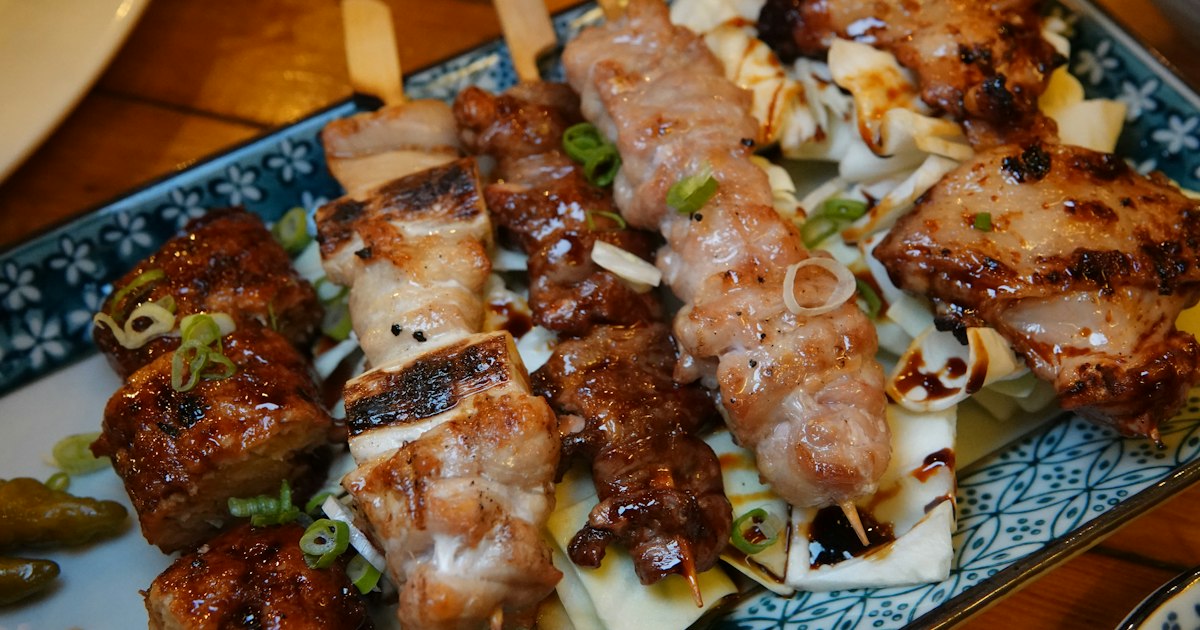
Smoke curling up from a charcoal grill, the hiss of chicken fat hitting hot binchotan, a row of salarymen hunched over beer and skewers after work — yakitori is one of Japan’s most approachable foods, but it comes with its own vocabulary and unwritten rules. This guide covers what to actually order, what it costs, and how to avoid the small mistakes that mark out a first-timer.
What Yakitori Actually Is
Yakitori (焼き鳥, literally “grilled bird”) refers to skewered, charcoal-grilled chicken, but the term covers far more than breast meat. A proper yakitori-ya will serve ten to twenty different cuts and preparations, including parts most Western menus never touch: momo (thigh), negima (thigh alternated with leek), tsukune (minced chicken meatballs, often served with a raw egg yolk for dipping), kawa (crispy grilled skin), reba (liver), hatsu (heart), nankotsu (cartilage, prized for its crunch), and bonjiri (tail, fatty and rich). Skewers are grilled over binchotan charcoal, which burns hotter and cleaner than regular charcoal and is a big part of why good yakitori tastes smoky but never acrid.
Each skewer comes in one of two seasonings: tare, a sweet-savory soy-based glaze brushed on during grilling, or shio, simply salted. If you’re unsure which to get, order shio for anything with strong natural flavor (liver, cartilage, skin) and tare for leaner cuts like breast or meatballs.
How to Order Like a Local
At a standalone yakitori counter, there’s usually no English menu, and that’s part of the experience. The easiest approach: ask for an omakase course (chef’s choice), common at mid-range and upscale shops, which runs you through 8-12 skewers in sequence for a fixed price. If there’s no omakase option, order a few skewers at a time rather than everything at once — yakitori is meant to arrive hot off the grill in small batches, not as one big platter.
Useful phrases: “Osusume wa?” (What do you recommend?), “Tare de” / “Shio de” (With tare / with salt, when asked), and simply pointing at the item on a photo menu or at other tables’ plates works fine too. Most shops bring a small starter dish (often cabbage with miso, or edamame) that’s not free — it’s the equivalent of a seating charge (otsumami or otoshi), typically ¥300-¥500, and is standard izakaya practice, not a scam.
Where to Eat: Budget to Splurge
Budget (¥300-¥500 per person, per skewer): Chain izakaya like Torikizoku built their entire business on uniform pricing — every item on the menu costs the same, somewhere around ¥350-¥400 depending on the current rate, whether it’s a chicken skewer, a salad, or a highball. It’s not artisanal, but it’s consistent, cheap, and has English-friendly touch-panel ordering at most branches, making it a good first stop if you’re nervous about ordering in Japanese.
Mid-range (¥3,000-¥6,000 per person): This is where yakitori shines. Neighborhood yakitori-ya charge roughly ¥150-¥350 per skewer, and a satisfying meal with drinks lands in the ¥3,000-¥5,000 range. Classic hunting grounds include Omoide Yokocho, the narrow lantern-lit alley just northwest of Shinjuku Station’s west exit; Yurakucho’s “yakitori alley,” a string of tiny stalls tucked under the JR train tracks near Yurakucho Station; Nonbei Yokocho in Shibuya, just across the river from Shibuya Station; and Hoppy Street in Asakusa. These alleys are atmospheric, smoky, and often standing-room-only, which is part of the charm.
Splurge (¥10,000-¥20,000+ per person): At the top end, shops like Birdland in Ginza or Torishiki in Ebisu (both Michelin-starred) serve omakase courses built around rare, carefully sourced chicken, with reservations required well in advance — often only bookable through a hotel concierge or a Japanese phone number. If you want this experience, book as soon as your dates are fixed.
Best Time to Go
Yakitori is an evening food. Most dedicated yakitori-ya open around 5pm and serve until 11pm or midnight; very few open for lunch, and the ones that do usually offer a simplified set rather than the full menu. Arrive right at opening (5:00-5:30pm) if you want a seat without a wait at popular alley spots — by 7pm, the small counters in Omoide Yokocho or Yurakucho fill up fast, especially Thursday and Friday nights. Yakitori has no strong seasonal peak the way some foods do, but summer evenings add outdoor seating and cold beer to the equation, while winter is when skewers like skin and tail feel especially good alongside a hot broth dish — if you’re traveling in the colder months, pair a yakitori crawl with a stop for oden from a convenience store on the walk back to your hotel.
Common Mistakes to Avoid
- Removing meat from the skewer with your hands or chopsticks. Etiquette-conscious diners eat yakitori directly off the stick; pulling it off onto a plate is sometimes done at very casual places but looks odd at a proper counter.
- Assuming every shop takes cards. Many of the smallest alley stalls are cash-only or IC-card only. Loading your Suica or Pasmo onto your phone before you go covers both transport to these neighborhoods and payment at a surprising number of counters.
- Walking in as a large group without calling ahead. Many yakitori-ya have fewer than 10 counter seats. Groups of four or more should reserve, especially for dinner after 7pm.
- Skipping the “weird” parts out of caution. Cartilage, skin, and heart are often the most popular items on the menu for a reason — crunchy, rendered, and nothing like the parts get a reputation for. Try one before writing off the rest.
- Not asking about the otoshi/otsumami charge. It’s small and standard, not a tourist tax — budget an extra few hundred yen per person and move on.
Beyond Chicken: What to Pair It With
Yakitori shops nearly always serve more than chicken — look for shiitake, shishito peppers, and tsukune alongside beer, highballs, or chilled sake. If you’re building out a broader grilled-food tour of Japan, it’s worth comparing yakitori’s charcoal-and-skewer approach to Sendai’s grilled beef tongue (gyutan), another regional specialty built around a single cut done exceptionally well. Both reward going somewhere unglamorous and letting the smoke do the talking.