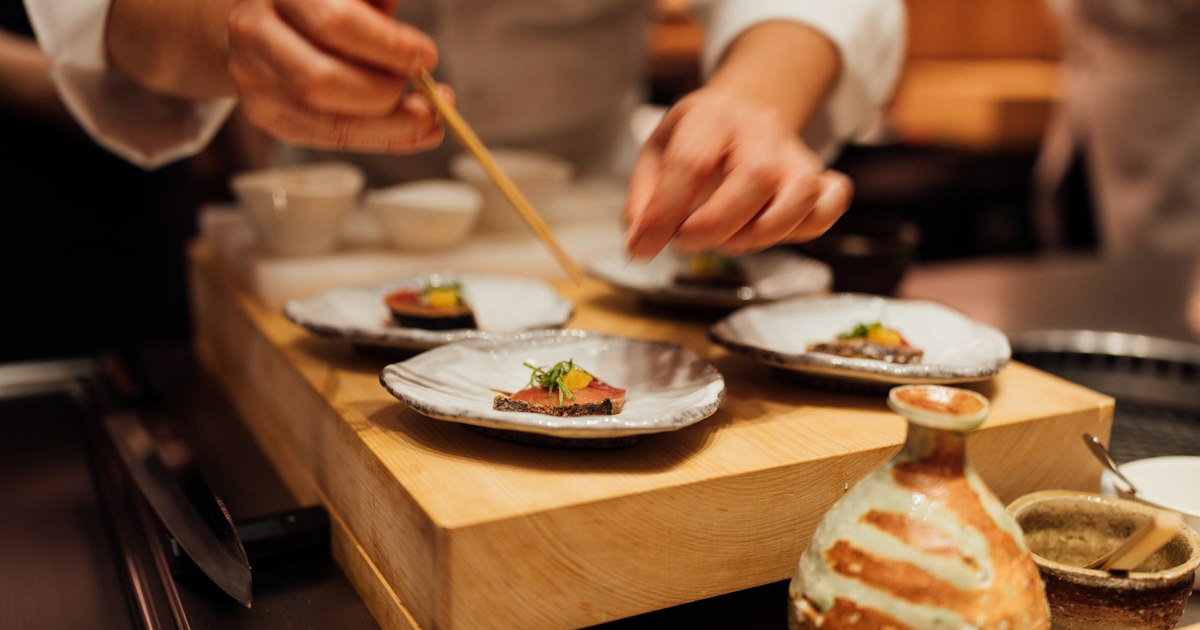
Photo by Lucas Law on Unsplash
Omotenashi gets translated as “hospitality,” but that’s too thin a word for what it actually describes. It’s a whole system of small, often wordless gestures — the folded hand towel, the tray your change is returned on, the umbrella bag by the door — that exist so you never have to ask for help or feel like a bother. Visitors usually sense that something is different about service in Japan without being able to name it. This guide breaks down the specific signals to watch for, what they mean, and the mistakes that make foreign guests miss them entirely.
The oshibori: more than a wet wipe
Almost every restaurant, from a 500-yen noodle counter to a kaiseki dinner, hands you an oshibori — a hot (or cold in summer) damp towel — the moment you sit down. It’s meant for your hands only, not your face or neck, and definitely not the table. In winter it signals warmth and welcome; in summer a cold oshibori is a small act of relief after walking in from the heat. At convenience stores and fast-food counters like Mos Burger, you’ll instead get a packaged wet wipe with your order — same idea, scaled down. The gesture to notice: staff often time its arrival to the second you’re seated, before you’ve said a word. That’s the omotenashi instinct — anticipating need rather than reacting to a request.
Money trays, two-handed presentation, and why nobody grabs your card
Watch how a cashier handles payment. In most independent restaurants and traditional shops, cash or a card is placed on a small tray (kozara) rather than handed directly, and change comes back the same way, often with a slight bow. This isn’t about germs — it predates the pandemic by decades — it’s about not snatching something from a guest’s hand, which is considered abrupt. At department stores and ryokan gift counters you’ll also see items wrapped with both hands, and staff rotating a bag so the handles face you before passing it over. None of this requires a tip; tipping isn’t practiced in Japan and leaving cash on the table is more likely to cause confusion than gratitude — the quality of service is already the expected standard, not something paid for separately.
Seasonal cues built into the menu and the room
Omotenashi shows up seasonally, too. A kaiseki or even a mid-range set-menu restaurant will quietly swap garnishes and tableware with the calendar — a maple leaf pressed into an autumn dessert, a sprig of plum blossom on a February tray, iced glassware in July. If you’ve read about seasonal dango varieties, you’ve already seen this logic applied to sweets — color and shape shift to match the season rather than staying fixed year-round. Ryokan carry it further: staff choose a lighter natsubuton (summer futon) or a thicker fuyubuton (winter futon) for your room without being asked, based on the date and regional climate — our futon weight guide explains how to request a swap if the inn gets it wrong for your comfort level. If you’re traveling in late December or early January, note that many of these small rituals pause entirely — see why Japan shuts down for New Year before assuming a shuttered shop is simply closed for the day.
Reading silence and timing
A lot of omotenashi is about restraint, not action. Staff in higher-end restaurants will often not approach your table while you’re mid-conversation, waiting instead for a lull or eye contact before refilling water or clearing a plate — this can read as slow service to visitors used to attentive check-ins, but it’s deliberate. Conversely, at a counter-seating izakaya or ramen shop, the clatter and shouted orders aren’t rudeness; it’s a different register of the same hospitality, tuned to a fast, communal space rather than a quiet one. The mismatch to avoid: don’t wave down staff loudly in a quiet kaiseki restaurant, and don’t expect hushed, hovering service at a 900-yen ramen counter. This same read-the-room instinct extends outside restaurants — it’s the same logic behind quiet hours at ryokan and apartments, where volume is calibrated to the setting rather than fixed by a posted rule.
Where the gestures scale up — and where they don’t
Budget: convenience store staff and fast-food counters still bow slightly and say a set phrase (“irasshaimase” on entry, “arigatou gozaimasu” on exit) even on a 300-yen purchase — the gesture is consistent regardless of spend. Mid-range: a reserved seat at a sushi-ya or tempura counter (often 4,000–8,000 yen for a set course) usually comes with the chef acknowledging your reservation by name or noting a dietary request you emailed ahead, a small but real sign the booking was read, not just logged. Splurge: a multi-course kaiseki dinner at a ryokan (often 15,000–40,000 yen per person) is where omotenashi becomes the whole product — staff may remember a guest’s name after one introduction, adjust spice or portion based on a passing comment, and times courses to match the pace at which you’re eating rather than the kitchen’s schedule. If you’re arranging a reservation for a larger party, it’s worth knowing that many restaurants need advance notice to prepare this kind of personalized service — our guide to group travel bookings covers how far ahead to call and what group discounts exist.
Common mistakes that break the exchange
- Tipping or leaving cash on the table. It’s not expected and can come across as implying the standard service wasn’t enough — a bow and “gochisousama deshita” (thanks for the meal) on the way out is the correct response.
- Handing over cash or a card with one hand, casually. Using the tray provided, or both hands if no tray exists, mirrors the gesture back and is noticed, even if never commented on.
- Assuming silence means being ignored. At a quiet counter, catch a server’s eye rather than calling out — in a loud izakaya, calling out (“sumimasen!”) is exactly right.
- Treating the oshibori as a napkin. Use it on your hands before the meal, then set it aside; wiping your face or the table with it is a minor faux pas, not a crisis, but staff do notice.
- Rushing a ryokan check-in. The welcome tea, slipper swap, and room explanation are part of the service, not a delay before it — standing through them rather than trying to skip ahead is the expected pace.
None of this requires fluent Japanese or formal training — omotenashi is designed to work even when nothing is said. The fastest way to notice it is simply to slow down for the first thirty seconds of any transaction: watch how the towel, the tray, or the bow arrives before you ask for anything, and respond in kind rather than rushing past it.