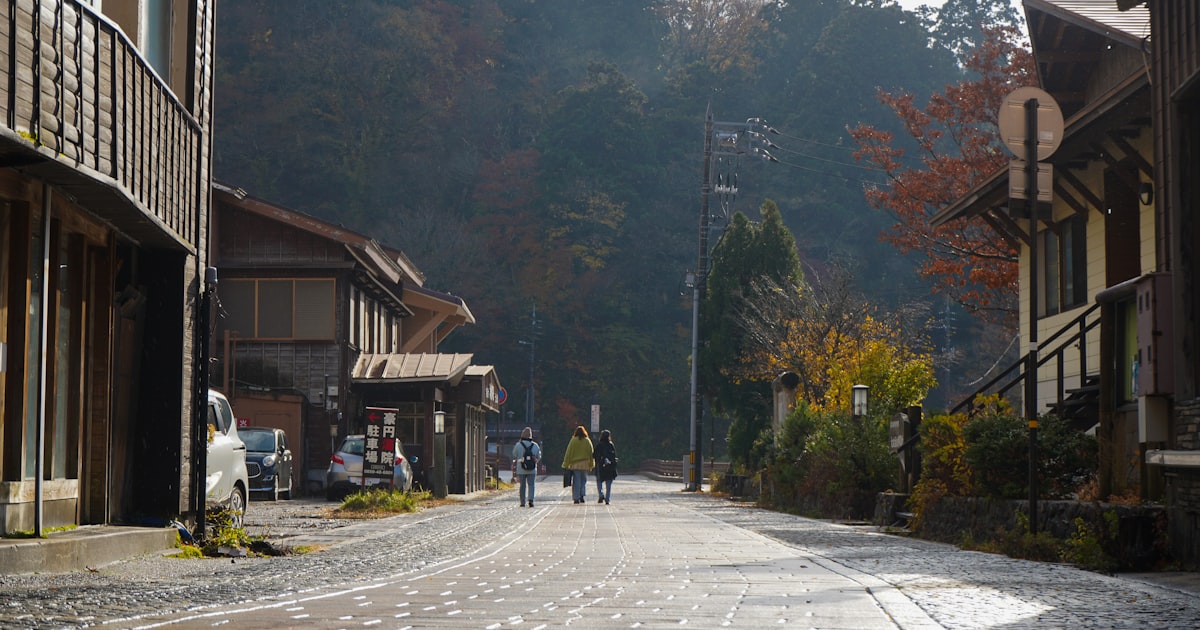
Photo by Yosuke Ota on Unsplash
Long before the Shinkansen, travelers between Edo (Tokyo) and Kyoto walked the Nakasendo, a mountain highway lined with post towns where they could rest, eat, and change horses. Most of those towns were paved over or burned down decades ago. Tsumago and Magome, tucked into the Kiso Valley on the Nagano–Gifu border, are the two that survived — and the roughly 8km trail connecting them is the single best way to feel what Edo-period travel actually looked and sounded like, minus the blisters that come with walking the whole highway.
Why Tsumago and Magome, and Not Some Other Post Town
Tsumago (in Nagiso, Nagano Prefecture) was the first town in Japan to pass local ordinances, back in the 1970s, banning residents from selling or renting their historic houses and requiring that power lines and vending machines stay out of sight. The result is a street of dark wood facades, lattice windows, and hanging lanterns with almost nothing modern visible during the day — cars are barred from the main street from around 8:30am to 5pm. Magome (in Nakatsugawa, Gifu Prefecture) sits on a steep hillside with a stone-paved main street lined with shops and inns; it was rebuilt after fires in 1895 and 1915, so it feels slightly more polished and touristy, but it’s still an atmospheric, car-light village with sweeping views toward Ena-san on clear days. Together they bookend the most scenic and best-signposted stretch of the old highway.
Getting There: Trains, Buses, and Driving
Both towns are most easily reached from Nagoya via the JR Chuo Line. Take a limited express Shinano (around 45–50 minutes, roughly ¥3,000–3,500 with reserved seat) or a slower local/rapid train (about 80–90 minutes, around ¥1,200) to Nakatsugawa Station. From there, a Nohi Bus runs to Magome in about 25–30 minutes for roughly ¥600. For Tsumago, stay on the Chuo Line one stop further to Nagiso Station, then take a local bus (about 10 minutes, around ¥300) up to the village.
If you’re coming from Tokyo, the Chuo Line connects through Shiojiri and Matsumoto rather than Nagoya, adding time; most visitors find it faster to route through Nagoya first. If you don’t already have a Shinkansen ticket booked, an overnight bus from Tokyo to Nagoya is a genuinely useful budget option that also saves you a night of accommodation — see our guide to overnight buses in Japan for how that works. Drivers should note that neither town has a train station right in the center; if you’re doing a wider Kiso Valley road trip, the region’s michi-no-eki roadside stations are worth stopping at for local produce, clean restrooms, and a break from mountain driving.
Walking the Trail: Route, Timing, and What to Expect
The Magome–Tsumago trail is about 7.8–8km and takes most people 2.5 to 3 hours at a relaxed pace, not counting stops. Most walkers start in Magome and head to Tsumago, since it’s a gentler net descent overall, though the first hour out of Magome climbs steadily to the Magome-toge pass at around 801m elevation before dropping into forest. The path is a mix of paved lanes, stone steps, and dirt forest track, well signposted in English with wooden markers and distance signs. Along the way you’ll pass the Magome-toge teahouse (free tea for walkers, seasonal), a couple of waterfalls (Otaki and Medaki), and a stretch of forest where boxes of bear bells are provided for hikers to ring — bears are a real if rare concern in this valley, so use them.
You don’t need special gear beyond decent walking shoes; sneakers are fine in dry conditions. There are vending machines and a rest hut roughly at the halfway point, but no convenience stores on the trail itself, so carry water and any snacks you want. Toilets exist at a few marked points along the route.
Luggage Forwarding and Multi-Day Itineraries
Neither town’s tourist information office wants you carrying a full suitcase over the pass, so both offices run a same-day luggage forwarding service between roughly mid-March and late November. Drop your bag at one town’s tourist office by late morning (the Magome office generally cuts off around 11:30am), pay a flat fee of about ¥1,000 per bag, and your luggage is trucked around by road and waiting at the other town’s office by early-to-mid afternoon. It only runs one direction per day, so plan your walking direction to match your bag’s route, and confirm the current cutoff time when you arrive, since it shifts slightly by season.
Some travelers extend the walk into a longer Nakasendo itinerary, continuing on to Narai or Kiso-Fukushima over two or three days and staying in small minshuku or ryokan along the way. If you’re stringing together multiple nights in small mountain towns, it’s worth reading up on doing laundry in Japan before you go, since coin laundries are sparse once you’re off the main train lines and many small inns don’t offer laundry service.
Best Season and Time of Day
Spring (mid-April to early May, for fresh greenery and mild temperatures) and autumn (late October to mid-November, for foliage) are the most popular and most photogenic times to walk. Summer is doable but humid and buggy in the forest sections; winter is quiet and atmospheric but the pass can have icy patches, and some facilities along the trail close or reduce hours, so check conditions before setting out. Whatever the season, start early — aim to be walking from Magome by 9 or 10am. This gets you into Tsumago’s main street while it’s still car-free and before the mid-afternoon tour bus crowds from Nagoya arrive.
Where to Eat, Stay, and Shop
Budget: both towns have simple soba and udon shops along their main streets, generally ¥900–1,400 for a bowl, plus stalls selling gohei-mochi (grilled rice skewers coated in a sweet-savory sesame or walnut miso glaze, around ¥200–300 each) — a genuinely local Kiso Valley snack worth trying at least once. Mid-range: a set lunch featuring local Kiso soba or river fish (ayu, grilled whole) at a sit-down restaurant runs roughly ¥1,800–3,000. Splurge: staying overnight in one of Tsumago’s traditional ryokan or minshuku, several housed in genuine Edo-period buildings, typically costs ¥12,000–20,000 per person with two meals included — book well ahead, since rooms are limited and fill fast in foliage season. Shops in both towns sell local woodcraft, lacquerware, and hand-dyed textiles; if you’re building out a broader Japanese crafts collection on this trip, it’s a nice complement to browsing Kutani ware in Kanazawa or picking up a piece from our guide to ukiyo-e woodblock prints elsewhere on your itinerary.
Common Mistakes to Avoid
- Treating it as a round trip in one day without checking bus schedules. Buses between Nakatsugawa/Nagiso and the two villages aren’t frequent — often just once or twice an hour — so check return times before you start walking, especially if you’re day-tripping back to Nagoya.
- Skipping the bear bells. The forested middle section genuinely passes through bear habitat; ring the provided bells rather than assuming it’s just tourist decoration.
- Arriving in Tsumago too late. Most shops and the honjin/wakihonjin historic buildings close by around 5pm, and the tourist office’s luggage counter has a hard cutoff — arriving after 3 or 4pm means missing half of what makes the town worth the trip.
- Assuming credit cards work everywhere. Many small shops, teahouses, and food stalls in both towns are cash-only; withdraw yen before you leave Nagoya or Nakatsugawa, since ATMs are scarce on the trail.
- Wearing the wrong shoes. The trail is mostly gentle, but the stone-paved sections in Magome and the forest floor after rain get slippery — trainers with decent tread are fine, but flip-flops or heeled sandals are a bad idea.
Done right, Tsumago and Magome cost a single train ticket, a bus fare or two, and an easy afternoon of walking — and they deliver a more convincing sense of pre-modern Japan than almost anywhere else within day-trip range of Nagoya.