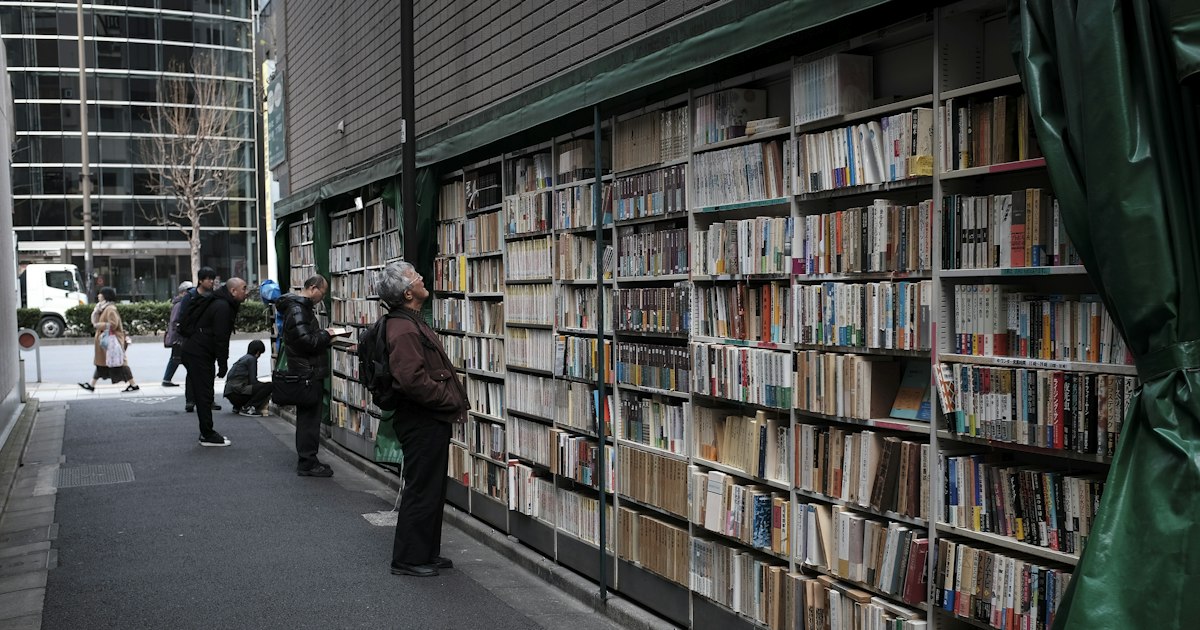
Photo by Hakan Nural on Unsplash
Jimbocho (神保町) doesn’t look like much at first glance — a few blocks of low-rise buildings along a busy avenue in Chiyoda ward. But step inside any of the more than 100 secondhand bookstores packed into this small district and you’ll understand why it’s often called the largest concentration of used bookshops anywhere in the world. Some have been run by the same family for four generations, selling everything from 100-yen paperbacks to Edo-period woodblock prints locked behind glass. Even if you can’t read a word of Japanese, it’s one of the most atmospheric neighborhoods in central Tokyo to spend a slow afternoon.
Getting There
Jimbocho Station is served by three lines — the Toei Mita Line, Toei Shinjuku Line, and Tokyo Metro Hanzomon Line — so it’s an easy stop no matter which pass you’re using. Exit A7 puts you directly on Yasukuni-dori, the main street where most of the bookstores cluster. Ochanomizu Station (JR Chuo/Sobu Line or Tokyo Metro Marunouchi Line) is also about a 10-minute walk away and worth combining with a visit, since the route between the two stations passes musical instrument shops and a cluster of sporting goods stores that make for good browsing on the way.
The core shopping area is compact: Yasukuni-dori (the main road, lined with the bigger antiquarian dealers) and Suzuran-dori (a narrower side street one block south, with smaller and quirkier shops) can both be walked end to end in about 15 minutes — though budget at least two to three hours if you actually want to go inside stores.
How to Browse: Store Types and Prices
Most shops specialize, and it helps to know roughly what you’re looking for before you start:
- General used bookstores stock everything from manga to academic titles, with paperbacks commonly priced ¥100–¥800.
- Kitazawa Bookstore, open since 1902, is the go-to shop for English-language books — antiquarian Western literature, art books, and academic titles, generally ¥1,000–¥10,000 depending on rarity.
- Isseido Booksellers, one of the oldest shops in the district (since 1913), deals in fine Japanese literature, historical documents, and antiquarian material for serious collectors.
- Ohya Shobo specializes in original ukiyo-e woodblock prints and antique maps, with prints typically running from around ¥3,000 for common designs into the tens of thousands of yen for well-preserved Hiroshige or Hokusai pieces. If prints are your main interest, it’s worth reading our guide to Japanese woodblock prints (ukiyo-e) before you go, so you know what separates an original from a modern reproduction.
- Magnif is known for vintage magazines, fashion photography books, and old advertising ephemera — a favorite with designers.
Most stores open around 10:00–10:30am and close between 18:30 and 19:00. A meaningful number close on Sundays, since foot traffic drops without the weekday office crowd from nearby universities and publishing houses, so a Saturday or weekday visit is more reliable than a Sunday one. Prices are fixed and clearly marked in yen — haggling isn’t part of the culture here, even at the small stalls. Bring cash; while larger shops increasingly take cards and IC cards like Suica, many of the smaller family-run stores are still cash-only.
The Kanda Book Festival: Best Time to Visit
If your trip lines up with it, the Kanda Used Book Festival (神田古本まつり) is the single best time to visit. Held annually for about a week in late October to early November along Yasukuni-dori, dozens of shops move discounted stock out onto outdoor tables and stalls, and the street fills with browsers even on weekdays. Exact dates shift year to year, so check closer to your travel dates, but it reliably falls in that autumn window when Tokyo’s weather is also at its most pleasant for walking around outdoors. Outside festival season, weekday afternoons are the quietest and most pleasant time to browse without crowds.
Beyond Books: Curry and Coffee
Jimbocho’s other claim to fame is Japanese curry rice. The neighborhood’s proximity to Meiji-era universities meant cheap, filling curry shops sprang up to feed students, and several from that era are still running — Kyoueikan, founded in 1924, is one of the oldest and most famous, serving a thick, dark roux-style curry for around ¥1,000–¥1,300 a plate. Bondy and Manten are two other long-running favorites nearby. If Japanese curry is new to you, our beginner’s guide to kare raisu explains the different regional styles and what to order.
For a coffee break between shops, Jimbocho has several classic kissaten (retro coffee shops), including Sabouru, a cave-like basement cafe near the station that’s been serving siphon coffee since the 1950s. Our guide to kissaten and what to order is useful background if you haven’t been to one before — the ordering etiquette and menu differ from a modern chain cafe.
Common Mistakes to Avoid
- Expecting mostly English stock. The vast majority of inventory is in Japanese. Kitazawa Bookstore is the reliable exception for English titles; don’t assume other shops will have much for non-Japanese readers.
- Visiting on a Sunday and finding several favorite shops shuttered — check individual store hours if a specific shop is your main target.
- Trying to see everything in one pass. With 100+ shops, it’s more enjoyable (and less exhausting) to pick two or three streets or store types and go deep rather than trying to walk in and out of every storefront.
- Assuming prices are negotiable. They’re not — prices are fixed and typically pencilled directly inside the book’s cover.
- Forgetting how heavy books get. If you buy more than a few, especially large art books or print portfolios, consider shipping them home rather than carrying them for the rest of your trip. Our guide to shipping souvenirs home from Japan compares post office and courier options and pricing.
Budget, Mid-Range, and Splurge Options
On a tight budget, the 100-yen carts and bargain bins set up outside many general stores are genuinely worth digging through — you’ll find old photo books, manga volumes, and Japanese paperbacks for less than the price of a coffee. Mid-range shoppers should budget ¥2,000–¥8,000 for a well-preserved English-language antiquarian title from Kitazawa or a decent ukiyo-e reproduction. For a splurge, an original Edo or Meiji-period woodblock print in good condition from a specialist like Ohya Shobo can run ¥20,000–¥100,000 or more — ask the shop for a certificate or documentation of authenticity, since this matters both for insurance and for customs when you travel home.
Jimbocho rewards unhurried visitors more than almost any other Tokyo neighborhood. There’s no single must-see landmark — the appeal is in the browsing itself, the smell of old paper, and the chance of finding something you didn’t know you were looking for.