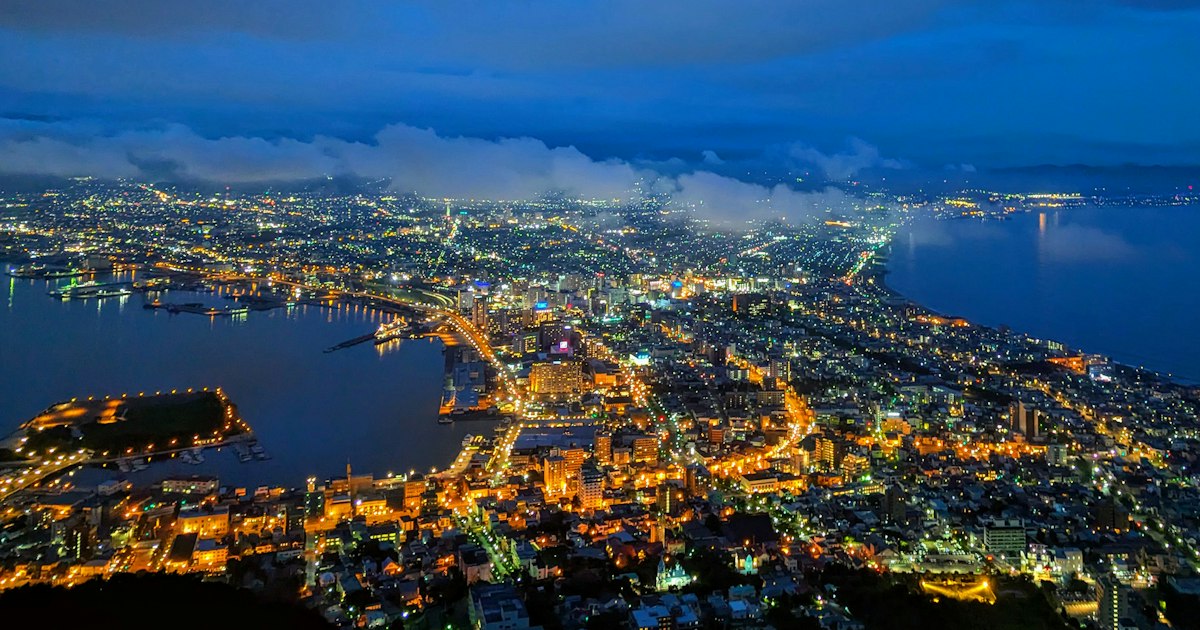
Photo by Daniel Beauchamp on Unsplash
Hakodate doesn’t get the crowds of Sapporo or the ski hype of Niseko, but it packs more into 48 hours than almost anywhere else in Hokkaido: a seafood market you fish your own breakfast out of, one of the three most-photographed night views in Japan, and a genuinely interesting way to arrive — by ferry across the Tsugaru Strait instead of just another train. Here’s how to time it and what it actually costs.
Getting to Hakodate: Shinkansen, Plane, or Ferry
Most travelers arrive by Shinkansen. The Hayabusa line runs from Tokyo to Shin-Hakodate-Hokuto Station in about 4 hours (roughly ¥23,000–24,000 one-way with a reserved seat — see our guide on reserved vs non-reserved Shinkansen seats for how to decide which to book). Shin-Hakodate-Hokuto is not downtown, though — you transfer to the “Hakodate Liner” local train for the final 20 minutes into Hakodate Station proper.
Flying is faster and often cheaper: Hakodate Airport is a 20-minute bus or taxi ride from the city center, with regular flights from Tokyo (Haneda), Osaka, and Sapporo.
The more memorable route is the ferry from Aomori, across the Tsugaru Strait that separates Honshu and Hokkaido. Seikan Ferry runs Aomori–Hakodate in about 3 hours 40 minutes for roughly ¥2,000 per foot passenger. If you’re coming from the Shimokita Peninsula, the Oma–Hakodate crossing (Shimokita Kotsu) is shorter, around 90 minutes for about ¥2,380. Both let you bring a car or bike on for an extra fee, and both dock a short bus ride from central Hakodate. If you’re assembling a slow, budget-first route up from Tokyo on local trains before catching the ferry, the Seishun 18 Ticket can cover the Honshu legs, though note it doesn’t work on the ferry itself or on Hokkaido’s Shinkansen segment.
Hakodate Morning Market: Fish Your Own Breakfast
Hakodate Asaichi (the Morning Market) sits in a covered arcade literally one minute’s walk from JR Hakodate Station’s east exit — you’ll see it before you’ve even figured out which exit leads to your hotel. It’s open daily, roughly 5:00 am to 2:00 pm from spring through autumn, and a bit later-starting (around 6:00 am) with earlier closing in winter. Go before 9 am; by mid-morning the best crab and uni can sell out, and tour groups fill the aisles by lunchtime.
The signature activity is “ikatsuri” — squid fishing. For about ¥500–700 you drop a line into a tank, reel up a live squid, and a stall right there will slice it into sashimi on the spot for a small extra prep fee (often ¥300–500). It sounds gimmicky but the squid is genuinely some of the freshest you’ll eat in Japan, and kids love it. Otherwise, a kaisendon (seafood rice bowl) with uni, salmon roe, and crab runs roughly ¥1,500–3,000 depending on how loaded it is — many stalls let you build your own bowl, picking toppings à la carte, which is a fun way to control the price if you’re traveling on a budget.
Common mistake: assuming the market is purely a tourist trap and skipping it for a “real” restaurant. It is touristy, but it’s also where locals still buy fish — the two aren’t mutually exclusive here. Bring cash; many smaller stalls don’t take cards.
Mt. Hakodate’s Night View: Tickets and Timing
The night view from Mt. Hakodate is routinely ranked alongside Nagasaki and Kobe as one of Japan’s three best, and it’s easy to see why: the city sits on a narrow isthmus, so the lights form an hourglass shape between two dark stretches of sea on either side.
The ropeway (Hakodate Ropeway) from the base near Motomachi to the 334-meter summit takes about 3 minutes and runs roughly every few minutes. A round-trip adult ticket is about ¥1,800 (one-way around ¥1,200), with discounted child fares. Operating hours vary seasonally — typically 10:00 am to around 9:00 or 10:00 pm, with last ascent roughly 30–50 minutes before closing — so check the current schedule before you go, especially in winter when hours shrink.
Timing matters more than most visitors expect. Arrive 30–45 minutes before sunset to catch the transition from daylight to lit-up city, which is the most dramatic version of the view — then stay for full darkness. Weekends and the first clear night after a stretch of bad weather get crowded fast, with lines for the ropeway stretching well past 30 minutes; a clear weekday evening is far more comfortable. Winter nights are colder but the air is drier and the view is often sharper, while summer brings warmer waits but occasional haze. If the ropeway line looks brutal, a taxi up the toll road to the summit parking lot is a reliable backup — see our guide on hailing a taxi with apps like GO and S.Ride for how that works in a smaller city like Hakodate.
Motomachi and the Red Brick Warehouses
Between the ropeway base and the bay, the Motomachi district is Hakodate’s old foreign-settlement neighborhood — a walkable slope of former consulates, an Orthodox church, and a Catholic church, all free to view from outside and genuinely pretty regardless of season. Down at sea level, the Kanemori Red Brick Warehouses have been converted into shops and cafés; it’s a reasonable place to browse for an hour before or after the ropeway, though prices lean toward souvenir-shop rates rather than market-stall bargains.
Where to Stay
- Budget: Chain business hotels cluster around Hakodate Station, often ¥5,000–8,000 a night for a single. If you’re unfamiliar with Japan’s business hotel brands, our comparison of Toyoko Inn, APA, and Dormy Inn is worth a look — Dormy Inn locations in particular often include an onsen bath, a nice touch after a day of hill-walking.
- Mid-range: Hotels near Motomachi or the bay area, often with partial sea or mountain views, generally run ¥10,000–18,000.
- Splurge: Yunokawa Onsen, a hot spring district near the airport with a tram connection downtown, has ryokan-style hotels with private or communal baths from around ¥20,000 up — a good way to end a day that started with a cold squid-fishing tank.
Best Time to Go and Common Mistakes
Hakodate works year-round, but late spring through autumn (May–October) gives you comfortable walking weather for Motomachi’s hills, while winter (December–February) gives the sharpest night views and a snow-dusted old town, at the cost of icy slopes and a shorter ropeway schedule. Avoid arriving on the first Shinkansen of the day expecting a leisurely market breakfast — the best seafood often sells out by mid-morning, so plan the market for the day you arrive, not the day you leave. And don’t treat Hakodate as a single half-day stop between Tokyo and Sapporo; between the market, the ropeway, and the ferry terminal logistics, it comfortably fills one full day, two if you add Yunokawa Onsen or a side trip to the Goryokaku star fort.