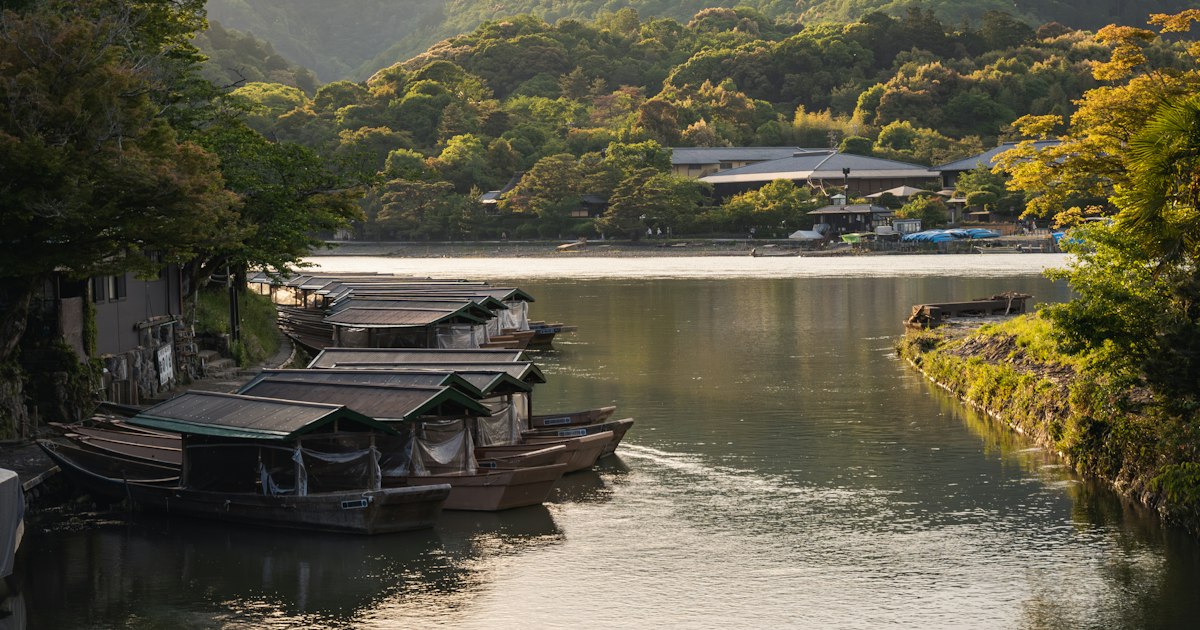
Photo by Artem Shuba on Unsplash
An hour south of Fukuoka city, the small town of Yanagawa is laced with narrow canals that locals have used for irrigation and transport for over 400 years. Today the main reason to visit is a slow, flat-bottomed boat ride through those canals, poled by a guide who sings and ducks under stone bridges, followed by a lunch of steamed eel. It’s an easy, low-effort day trip that feels completely different from the shopping streets and ramen counters of central Fukuoka — and it works as a half-day or full-day add-on if you’re already based in Fukuoka or Kumamoto.
What Yanagawa actually is
Yanagawa was the seat of the Tachibana clan during the Edo period, and the castle town they built still drains through roughly 60 km of canals (hori) that crisscross the town between rice fields and old samurai houses. The canals aren’t a tourist reconstruction — they’re the original waterworks, now lined with willow trees and used almost entirely for sightseeing boats. The town itself is small enough to see on foot in an afternoon: the boat route, the former Tachibana villa and garden (Ohana), and a cluster of eel restaurants are all within a 15–20 minute walk of each other.
Getting there from Fukuoka
Take the Nishitetsu Tenjin Omuta Line from Nishitetsu Fukuoka (Tenjin) Station. The limited express (tokkyu) takes about 50 minutes to Nishitetsu Yanagawa Station and costs roughly ¥950 one-way; local trains run more often but take closer to 70–80 minutes with a transfer. From Hakata Station, you’ll need to get to Tenjin first (a short subway or walk), so budget a bit of extra time if you’re starting there. From the station, it’s about a 10–15 minute walk to the main boat docks, or a short taxi ride (around ¥700–900) if you’re carrying luggage or it’s raining. There’s no need to rent a car — the whole appeal of Yanagawa is a compact, walkable town built around water, not roads. If you want a quick bite before boarding, Nishitetsu Fukuoka Station has a few quick-service noodle counters similar to the standing eki soba stalls found at stations around the country — handy if your train is tight on time.
Riding the boat (donko-bune)
Several boat companies operate from different docks around town — Yanagawa Kankou, Ohana Matsuoka, and Yanagawa Donko Boat are the main ones — but they all run the same basic experience: a flat punt poled by a single guide, carrying 20–25 passengers along a roughly 4 km route that takes about 70 minutes, ending near the Ohana garden. Adult fares run about ¥1,800–2,000, with discounts for elementary-school-age children (roughly ¥900–1,000); exact prices vary slightly by operator and season, so check the board at whichever dock you walk up to. Boats generally run daily from around 9:00 or 10:00 am until 4:00 pm, departing whenever there are enough passengers rather than on a fixed timetable, so you usually don’t need to book ahead on a normal day — just show up at a dock. Boats are suspended in heavy rain or when water levels are too low, which happens occasionally, so build in flexibility rather than treating it as the single fixed event of your day.
The guide narrates in Japanese (sometimes with a laminated English sheet) and will duck the boat under very low stone bridges — lean in when told to. If you’re comparing this to other Japan boat rides, it’s a much slower, more rural experience than something like the Tokyo Water Bus along the Sumida River, which is a commuter-style city cruise; Yanagawa is closer to being poled through someone’s backyard.
Best season and timing
Yanagawa is a year-round destination, but the canals change character with the seasons:
- Late March–early April: plum and early cherry blossoms along the banks; comfortable boat temperatures.
- Early June: hydrangeas (ajisai) bloom thickly along the water, one of the most photographed times of year.
- Late November–early December: autumn foliage around the Ohana garden, with cooler but still comfortable boat rides.
- Mid-December–February: “kotatsu boats” — the same boats fitted with heated blankets and a charcoal brazier, often with hot amazake (sweet, low-alcohol rice drink) served on board. This is a genuinely different, cozier version of the ride, closer in spirit to the roadside hot canned drinks culture of Japanese winters than the summer version of the same route.
Midsummer (late July–August) is the one stretch to think twice about — the ride is pleasant but the midday heat and humidity on an open boat with no shade can be rough; aim for an early morning departure if you’re visiting then.
What to eat: unagi seiro mushi
Yanagawa’s signature dish is unagi no seiro mushi — grilled eel and sweetened rice steamed together in a lacquered box, finished with a thin layer of egg. It’s a regional variation on the more familiar unagi don you’ll find elsewhere (see our guide to donburi-style rice bowls for how these bowl dishes generally work), but steaming rather than simply topping the rice makes it noticeably richer. Expect to pay roughly ¥3,000–4,500 for a set meal at one of the specialist eel restaurants clustered near the boat docks and Ohana garden; lines form at the well-known spots around lunchtime (roughly 11:30 am–1:30 pm), so either arrive right at opening or expect a 20–30 minute wait on weekends.
Ohana: the garden and former villa
The boat route ends near Ohana, the former seaside villa and garden of the Tachibana family, now partly a museum and partly a ryokan. Entry to the garden and historic rooms runs around ¥600–700 for adults, and it’s worth the 30–40 minutes it takes to walk through — the pond garden framed by pine trees is a quieter counterpoint to the boat ride’s motion and narration. It’s an easy add-on since it’s essentially the endpoint of the boat route anyway.
Common mistakes to avoid
The most common misstep is treating Yanagawa as a quick stop — if you only do a drive-by for photos and skip the boat, you’ve missed the actual point of the town. Conversely, trying to combine Yanagawa with a second major destination (like Dazaifu or Kurume) on the same day often backfires because the train connections aren’t direct and you’ll spend more time in transit than at either place; pick one or the other unless you’re starting very early. Cash is still worth carrying — some of the smaller boat-ticket counters and eel restaurants don’t take cards, even though convenience stores and the station do. Finally, don’t skip checking the weather the morning of your visit: boats run rain or shine up to a point, but heavy rain can cancel sailings outright, and there’s no way to confirm this remotely before you’re standing at the dock.