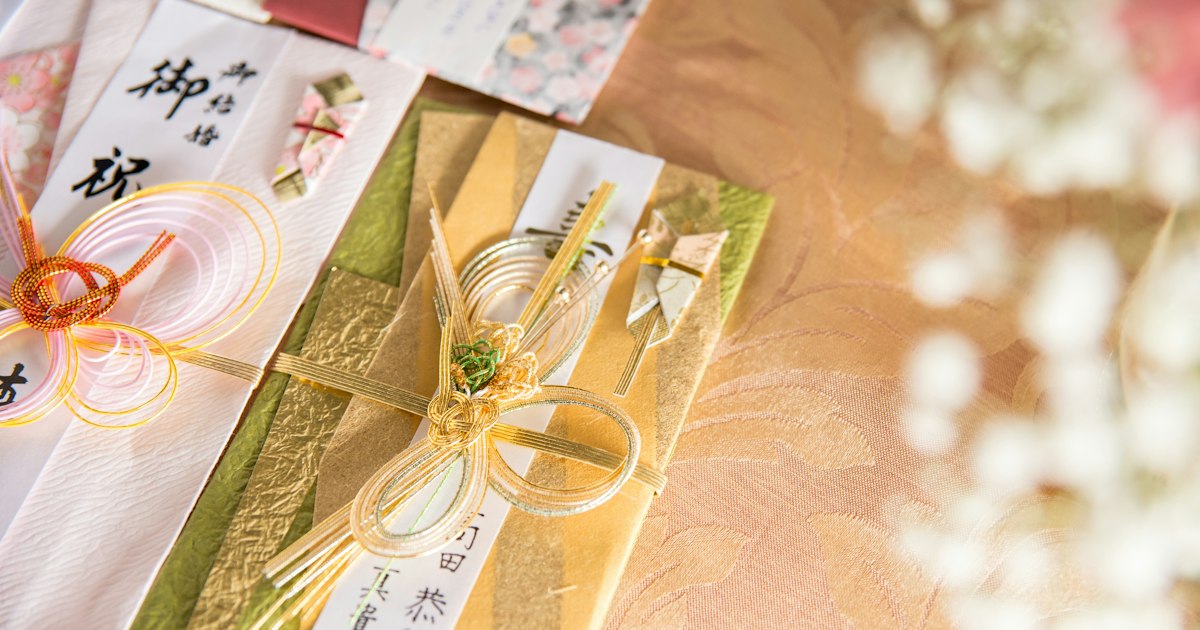
Photo by Mayumi Maciel on Unsplash
If you’re invited to a wedding in Japan, the gift is almost always cash — but showing up with a plain envelope stuffed with whatever bills you have in your wallet is a fast way to signal that you don’t know the rules. Goshugi (ご祝儀) follows a surprisingly strict set of customs: how much you give, which bills you use, how you fold the paper, and even which way the money faces inside the envelope all carry meaning. None of it is difficult once you know it, and this guide walks through exactly what to do.
How Much Is the Right Amount?
The amount depends on your relationship to the couple, not on how generous you feel. These are the standard brackets used across Japan:
- Coworker, acquaintance, or casual friend: ¥30,000
- Close friend: ¥30,000–¥50,000
- Sibling or close relative: ¥50,000–¥100,000
- Boss or senior colleague: ¥30,000–¥50,000
- Attending as a couple (you + spouse/partner): ¥50,000–¥70,000, since the gift covers both your meals
- Guest in their 20s with limited income: ¥20,000–¥30,000 is tolerated, especially among younger coworkers and students
The logic behind ¥30,000 as the baseline is practical: a sit-down wedding reception with a multi-course meal and a gift bag (hikihikimono) typically costs the hosts ¥20,000–¥25,000 per guest, so goshugi is meant to roughly offset that, with a little left over as a genuine gift. If you’re unsure, ask a mutual friend who’s also attending — Japanese guests quietly coordinate amounts so no one’s envelope looks out of step with everyone else’s.
The Numbers to Avoid (and the One Trick to Know)
Japanese gift-giving avoids numbers that sound like bad omens. The number 4 (shi) sounds like “death,” and 9 (ku) sounds like “suffering,” so amounts like ¥40,000 or ¥90,000 are never used. Even numbers are traditionally avoided too, because they can be divided evenly — symbolically suggesting the couple might split up. That’s why ¥30,000 and ¥50,000 are standard, while ¥20,000 and ¥40,000 are not.
¥20,000 is the one gray area. If you genuinely can’t stretch to ¥30,000, the workaround is to make the bill count odd even though the total is even: hand over one ¥10,000 note and two ¥5,000 notes (three bills totaling ¥20,000) rather than two ¥10,000 notes. The number “2” itself has also become more socially acceptable in recent years as a symbol of a couple becoming “two as one,” so some younger guests now give ¥20,000 without worrying about it — but if you want to play it safe, stick to ¥30,000 or the three-bill trick.
Buying and Preparing the Envelope (Shugi-bukuro)
The cash goes inside a decorative envelope called a shugi-bukuro, not a plain one. You can find these at:
- Convenience stores (7-Eleven, Lawson, FamilyMart): basic designs, ¥110–¥300 — fine for a casual wedding
- Stationery shops and 100-yen stores (Daiso, Seria): similar price range, more pattern variety
- Department stores (Tokyu Hands, Loft, Takashimaya): mid-to-high-end designs with washi paper and elaborate mizuhiki cords, ¥500–¥3,000
Look at the mizuhiki (the decorative cord on the front): for weddings you want the musubikiri knot — a tight, interlocking knot that can’t be pulled apart without untying it, symbolizing a bond meant to happen only once. Avoid envelopes with the bow-style chou-musubi knot, which is used for events you’d want to repeat, like births or graduations — using it for a wedding implies you expect the couple to need another one. The amount you’re giving should also roughly match the envelope’s formality: a ¥30,000 gift in an elaborate ¥3,000 envelope looks mismatched in either direction.
Get Crisp New Bills
Used, wrinkled bills are considered rude for a celebration — they imply you grabbed whatever was in your wallet rather than preparing in advance. You need pin-satsu (新札/新券), freshly printed, uncirculated notes. Any bank counter in Japan will exchange worn bills for new ones free of charge; you don’t need an account there, just your passport and a few minutes to fill out a simple slip. Post offices (Japan Post Bank) and most city banks handle this routinely. Convenience stores and currency exchange counters cannot do this, so plan to visit a bank branch a few days before the wedding — branches keep standard banking hours, generally 9:00–15:00 on weekdays, so this isn’t a last-minute errand.
Writing the Envelope and Folding the Money
On the front of the outer envelope, write your full name in vertical text below the mizuhiki, ideally with a fude (brush) pen or a brush-tip marker rather than a ballpoint pen — thin, scratchy handwriting looks careless for an occasion this formal. Inside, there’s usually a smaller inner envelope (naka-bukuro): write the amount on the front using traditional kanji numerals (参萬円 for ¥30,000, 伍萬円 for ¥50,000) and your name and address on the back, so the couple can track who gave what when they send thank-you gifts later.
Place the bills inside facing the same direction, portrait side up, with the face (Fukuzawa Yukichi on the ¥10,000 note) oriented so it’s the first thing visible when the receiver opens the envelope. It’s a small detail, but it’s one of the things older relatives notice immediately.
How and When to Present It
Bring the envelope wrapped in a small cloth called a fukusa (purple is the safest universal color, ¥1,000–¥3,000 at department stores) so it isn’t sitting bare in your bag. At the venue, you’ll present it at the reception desk (uketsuke) when you arrive and sign the guest book — before the ceremony starts, not during the meal. Unwrap the fukusa in front of the receptionist, place the envelope on the small tray provided (or hand it with both hands if there’s no tray), turned so the text faces them, and offer a short congratulatory phrase like “Honjitsu wa omedetō gozaimasu.”
After the reception, many wedding parties move on to a nijikai (afterparty), often at an izakaya — if you’re invited, our izakaya ordering guide covers the seating charges and round-ordering etiquette you’ll run into there. During the reception itself, toasts are common with highballs or shochu-and-water — the mizuwari and oyuwari guide explains how those are properly mixed and served if you want to order like a local rather than a tourist.
Common Mistakes Foreign Guests Make
The errors that stand out most to Japanese guests and hosts are rarely about the amount — they’re about preparation. Giving worn bills instead of new ones, using an envelope with the wrong knot style, forgetting to write your name on the outer envelope, or handing it over casually without a fukusa all read as “didn’t know, didn’t bother to find out,” even when that’s not the intent. If you want a sense of how far this cash-and-envelope etiquette extends beyond weddings, it’s worth reading about kokorozuke, the similar envelope custom used for tipping ryokan staff — Japan treats cash gifts as a small ritual in nearly every formal setting, and getting the wrapping right matters as much as the amount inside.