Photo by Mateo Krossler on Unsplash
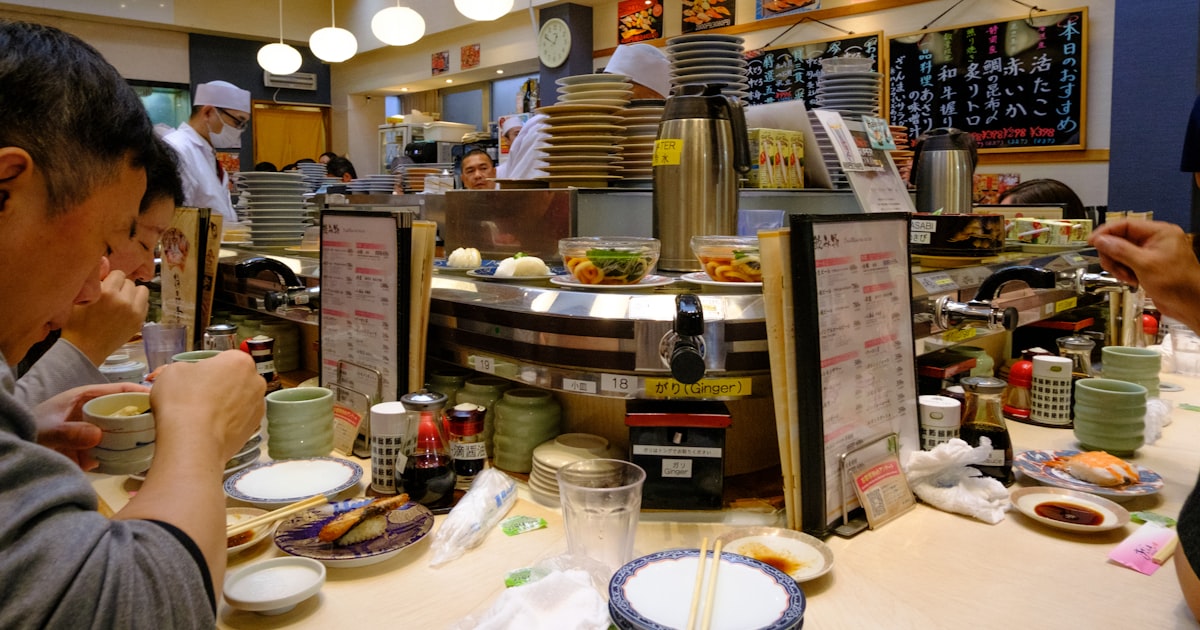
Conveyor-belt sushi (kaiten-zushi) is one of the best-value meals in Japan — a full, satisfying dinner for under ¥2,000 per person, no reservation or Japanese ability required. But the four big national chains — Sushiro, Kura Sushi, Genki Sushi, and Uobei — are not interchangeable. They differ in price, how food actually reaches your table, and how crowded they get. Here’s what to expect from each so you pick the right one for your trip.
The Four Chains at a Glance
All four use touchscreen tablets for ordering in addition to (or instead of) the classic spinning belt, and all four accept cash and most IC cards (Suica/Pasmo) plus credit cards. None require a reservation for walk-in counter seats, though Sushiro and Kura Sushi let you join a virtual queue through their apps, which is worth doing on weekends.
- Sushiro — largest chain (600+ locations), best fish quality-to-price ratio, busiest.
- Kura Sushi — “no additives” policy, gacha game for kids, very consistent quality.
- Genki Sushi — food arrives via a dedicated fast-lane track, not the shared belt.
- Uobei — no belt at all, tablet-only ordering, delivery in under a minute; mainly in central Tokyo.
Sushiro: Japan’s Biggest Belt, Best Variety
Sushiro (スシロー) is the chain most Japanese people would name first, and for good reason — it buys fish in bulk directly from ports, which keeps quality high even at entry-level prices. Standard plates run about ¥120 for two pieces (prices are tax-excluded on menus, so add 10% at checkout), with premium items like otoro, uni, or seasonal specials priced at ¥180, ¥270, ¥390, or ¥570. A filling meal for one person typically lands between ¥1,200 and ¥2,000.
You seat yourself (or check in on a tablet by the entrance), order via the touchscreen at your table, and dishes either arrive on the belt or, for anything ordered directly, on a dedicated express lane that stops right in front of you with a chime. Every eighth or so order unlocks a small capsule-toy game called Bikkura Pon on tablet screens — a nice touch if you’re dining with kids. Hours are usually 11:00–23:00, though smaller suburban branches may close earlier. Lunchtime on weekdays (11:00–14:00) and mid-afternoon are the least crowded windows; Friday and Saturday evenings can mean 30–60 minute waits at popular urban branches, so use the Sushiro app to check the queue or reserve a time slot before you go.
Kura Sushi: The “No Additives” Chain With a Game Built In
Kura Sushi (くら寿司) markets itself on its mutenka (no additives) policy — no artificial preservatives, colorings, or sweeteners in its food, which appeals to travelers with dietary sensitivities. Pricing mirrors Sushiro closely: most plates ¥115–¥125 (tax included figures are usually posted at Kura), with premium plates up to ¥400–¥500.
The signature feature is what happens after you eat: each empty plate gets slotted into a small hatch built into your table, which automatically counts and whisks it away for washing. Every five plates you insert triggers a chance at winning a toy capsule from an overhead machine — genuinely fun for families and a good icebreaker if you’re traveling with children. Order everything via the tablet; the belt mostly carries a display selection you generally shouldn’t take without confirming freshness with staff. Typical hours are 10:30/11:00–23:00. Kura Sushi is a bit less crowded than Sushiro at peak times, making it a solid backup if your first-choice Sushiro branch has a long queue.
Genki Sushi: Fast-Lane Delivery, Fewer Crowds
Genki Sushi (元気寿司) takes a different approach: the main belt often carries only décor or a few sample plates, and virtually everything you eat is ordered on a tablet and delivered via a separate high-speed rail track that runs above or alongside the belt, stopping precisely at your seat. This means less picking-over of dishes that have been circling for a while, and it’s easy to track exactly what you’ve ordered and spent on the tablet’s running total.
Prices are similar to Sushiro and Kura — most plates around ¥115–¥140 — but Genki Sushi branches tend to be smaller and less packed with tourists, so waits are shorter even on weekends. Genki Sushi is also the chain most likely to have overseas outposts (Hawaii, Hong Kong, Taiwan), so if you’ve already tried it abroad, the Japan branches will feel familiar but noticeably fresher and cheaper. Hours generally run 11:00–22:00 or 23:00 depending on the branch.
Uobei: Tokyo’s Touchscreen-Only, Tourist-Friendly Pick
Uobei (魚べい) is Genki Sushi’s sister brand, concentrated in central Tokyo — Shibuya, Shinjuku, Akihabara, and Ikebukuro are the most convenient locations for visitors. There is no rotating belt at all: you sit at a counter, order everything through a touchscreen (with an English option), and your plates arrive on an individual fast lane within about a minute, announced by a short jingle. It’s one of the fastest, most low-hassle sushi meals in Tokyo, particularly good for solo travelers or anyone short on time between sightseeing stops.
Pricing is straightforward — most plates are around ¥115 before tax, with only a handful of premium items priced higher, so it’s easy to estimate your bill in advance. Because it’s counter-heavy and tightly packed into small footprints near stations, Uobei branches turn tables quickly even during lunch and dinner rushes, and walk-in waits are usually shorter than at Sushiro. Typical hours run 11:00–23:00 or later in nightlife districts like Shibuya.
How to Order, Pay, and Avoid Common Mistakes
A few habits will smooth out your first visit at any of these chains:
- Check in before sitting down. Most locations have an entrance kiosk where you select party size and get a table number — don’t just sit at an open counter seat, even if it looks free.
- Order via tablet for anything specific. The belt is convenient for casual grazing, but items you actually want (limited seasonal fish, cooked dishes, desserts) should be ordered directly so they arrive fresh and fast.
- Track your plate count. At Sushiro and Genki Sushi, staff or a camera system counts your plates by color/pattern to calculate the bill — don’t stack plates from other tables or take extras “just in case,” since over-ordering is the single most common way solo diners overspend here.
- Tea and soy sauce are self-serve. Powdered green tea (agari) and hot water taps are usually built into the counter; soy sauce, ginger, and wasabi packets sit in a small caddy at your seat.
- Pay at a machine, not the counter. Take your printed receipt/table slip to a self-checkout machine near the exit — cash and card both work, but you generally can’t pay staff directly.
Which Chain Should You Choose?
Budget and quality first: Sushiro. It has the widest selection and the best fish for the price, especially for tuna and seasonal items, but expect a wait at dinner.
Traveling with kids: Kura Sushi, for the plate-return gacha game and additive-free reassurance.
Want speed and fewer crowds: Genki Sushi, especially outside Tokyo’s densest neighborhoods.
Solo, short on time, based in central Tokyo: Uobei — the fastest in-and-out experience of the four, and the easiest to navigate with limited Japanese.
If you’re building out a broader Osaka food itinerary — Sushiro and Kura Sushi both trace their roots to the Kansai region — it pairs naturally with a stop for Osaka’s takoyaki on the same trip. Many suburban branches of these chains sit inside roadside shopping complexes, so if you’re renting a car in Japan for a road trip, a kaiten-zushi stop makes an easy, affordable lunch break. And if you’re hopping between cities to try region-specific branches or flagship stores, check whether a regional JR rail pass covers your route before buying individual tickets. Finally, if the plastic food displays outside these restaurants catch your eye, real versions of those sushi models and the plates themselves are sold to the public at Kappabashi Kitchen Town in Tokyo.