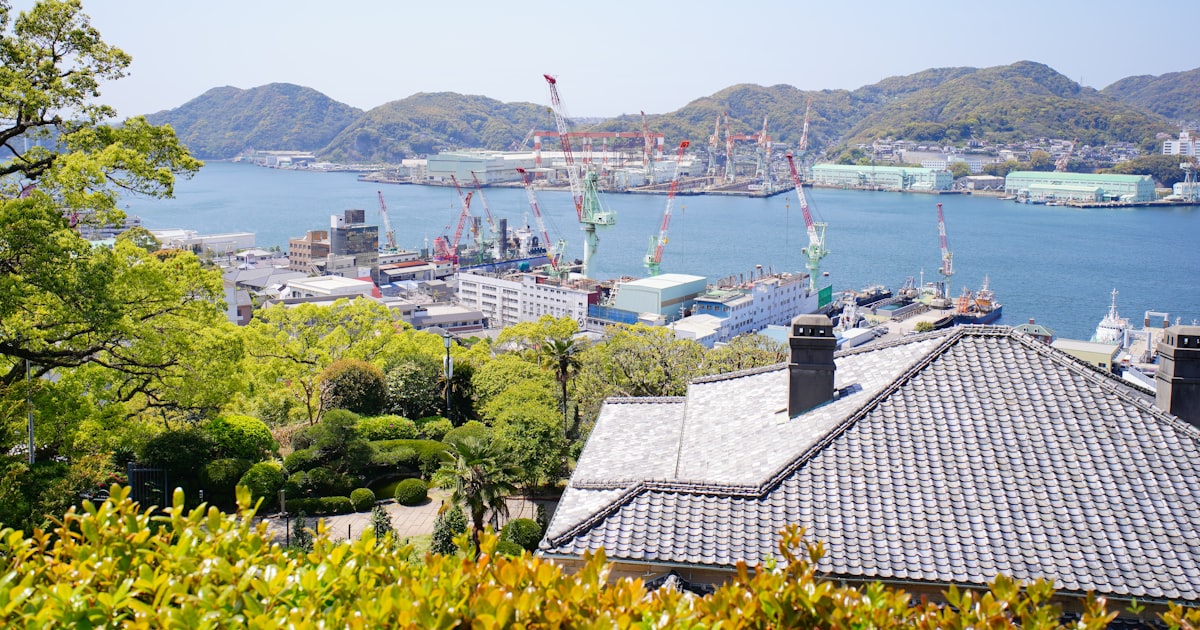
Nagasaki doesn’t fit the usual Japan itinerary — it’s tucked into the southwest corner of Kyushu, a harbor city that spent 200 years as Japan’s only legal window to the outside world. That history is still walkable in a single day: a Dutch trading post, Japan’s oldest Chinatown, and a Peace Park that anchors one of the most sobering half-days you’ll spend in the country. Here’s how to see all three properly, plus what trips people up.
Getting to Nagasaki
From Fukuoka/Hakata, take the Kamome limited express to Takeo-Onsen, then transfer across the platform to the Nishi Kyushu Shinkansen for the final leg into Nagasaki Station — the whole trip runs about 1 hour 20 minutes to 1 hour 30 minutes and costs roughly ¥6,000–6,500 one way with reserved seating. It’s a same-day-doable trip from Fukuoka, but rushed; an overnight in Nagasaki lets you actually enjoy dinner and the night view without watching the clock. If you’re driving in from elsewhere in Kyushu, the Nagasaki Expressway is straightforward, and it’s worth breaking up the drive with a stop — see our guide to Michi-no-Eki roadside stations for what to expect. Nagasaki Airport also has direct flights from Tokyo (Haneda) in around 2 hours, with a limousine bus into the city center.
Once you’re there, the city’s tram network (built in 1915 and still the main way to get around) charges a flat ¥140 per ride regardless of distance, or ¥600 for an unlimited one-day pass sold at the tourist information center inside the station. Dejima, Chinatown, and the Peace Park sit on three different tram lines, so the day pass pays for itself after about four rides.
Dejima: The Artificial Island That Opened Japan
During Japan’s roughly 220 years of national isolation (sakoku), Dejima was the single fan-shaped island in Nagasaki Harbor where Dutch traders were permitted to live and do business — the only officially sanctioned contact point between Japan and the West. Land reclamation long ago swallowed the harbor around it, so today Dejima sits inland, restored as an open-air museum of reconstructed warehouses, merchant houses, and the residence of the Dutch trade chief.
Admission is around ¥520 for adults, and it’s open daily from 8:00 am to 9:00 pm (last entry 8:40 pm) — genuinely one of the most flexible hours of any historical site in Japan, so it’s easy to slot in before dinner. Budget 60–90 minutes. One detail worth knowing before you go: Dejima is also where coffee first entered Japan, brought in by Dutch traders in the 18th century — if that kind of history appeals, it pairs nicely with a stop at one of Japan’s retro kissaten coffee shops afterward.
Nagasaki Chinatown: Champon, Sara Udon & the Lantern Festival
Shinchi Chinatown is one of Japan’s three official Chinatowns (alongside Yokohama and Kobe), and unlike the other two, it grew directly out of Dejima-era trade — Chinese merchants had their own restricted quarter here from the 1680s onward. It’s compact, just a few blocks, but dense with places to eat.
The two dishes to order are champon (a thick noodle soup loaded with pork, seafood, and vegetables in a milky broth) and sara udon (crispy fried noodles under a similar topping, sauce poured tableside). Expect ¥1,000–1,500 for a bowl at a sit-down restaurant; Shikairo, the restaurant credited with inventing champon in 1899, is the famous but touristy option — it’s fine, just expect a wait around lunch. For something cheaper, the street-food stalls sell steamed buns and pork gyoza for a few hundred yen each, good for grazing rather than a sit-down meal.
Time your visit around the Nagasaki Lantern Festival if you can — it runs for about two weeks around Chinese New Year (typically mid-to-late January into February) and turns Chinatown and the nearby Nakashima River into a sea of red lanterns and Chinese lion dances. It’s free to walk through and is by far the liveliest the city gets outside of summer.
The Peace Park & Atomic Bomb Museum
Nagasaki was the second city hit by an atomic bomb, on August 9, 1945, and the Peace Park sits near the hypocenter, about a 5-minute walk from the tram stop of the same name. The park itself — dominated by the 10-meter bronze Peace Statue, its right hand pointing skyward toward the threat, left hand extended for peace — is free and open around the clock.
The Atomic Bomb Museum next door is the part that needs real time. Admission is ¥200 for adults, and it’s open 8:30 am–5:30 pm (extended to 6:30 pm from May through August). Plan for at least 60–90 minutes; the exhibits move chronologically from the moment of the blast through the medical and social aftermath, and it’s dense with testimony, not something to rush. The small Hypocenter Park a few minutes’ walk away marks the exact point of detonation with a simple black stone pillar — quieter and easy to miss, but worth the short detour. Most visitors do the museum and both parks as one continuous 2–2.5 hour block rather than splitting it up.
Beyond the Big Three
If you have a second day, Glover Garden is the natural add-on: a hillside cluster of former foreign-merchant residences from the late 1800s, including the Glover House itself, with harbor views. Admission is around ¥620, open 8:00 am–6:00 pm (later in summer). Nearby is Megane Bridge (“Spectacles Bridge”), a stone arched bridge from 1634 whose reflection in the Nakashima River forms a pair of “eyeglasses” — free to see and a 10-minute walk from Chinatown, so it’s easy to combine.
For a splurge, ride the Nagasaki Ropeway up Mount Inasa at dusk — round-trip tickets run about ¥1,250, and the summit is ranked among Japan’s three great night views alongside Hakodate and Kobe. Buy your castella (Nagasaki’s signature sponge cake, from shops like Fukusaya or Bunmeido) before you leave the city center, since it doesn’t travel as well as sealed snacks; if you’re mailing gifts home instead of carrying them, our guide to shipping souvenirs from Japan covers post office versus courier options.
Best Time to Visit & Common Mistakes
Spring (late March–April) and autumn (November) bring the most comfortable weather and, in spring, cherry blossoms around Glover Garden and the Peace Park. Summer is hot and humid and coincides with the somber August 9 Peace Memorial Ceremony — meaningful if you want to be present for it, but expect the Peace Park to be closed to casual sightseeing that morning. Winter is quiet and mild by Japanese standards, and the Lantern Festival makes January/February a legitimate reason to visit despite the cold.
The most common mistake is treating Nagasaki as a rushed day trip from Fukuoka and trying to cram Dejima, Chinatown, the Peace Park, and Glover Garden into one afternoon — something has to give, usually the museum, which is the one place you shouldn’t rush. The second is skipping the tram day pass and paying cash each ride, which adds up fast once you’re crossing the city more than three or four times. If you’re short on time, prioritize the Peace Park and Atomic Bomb Museum plus one of Dejima or Chinatown, and save the rest for a return trip.