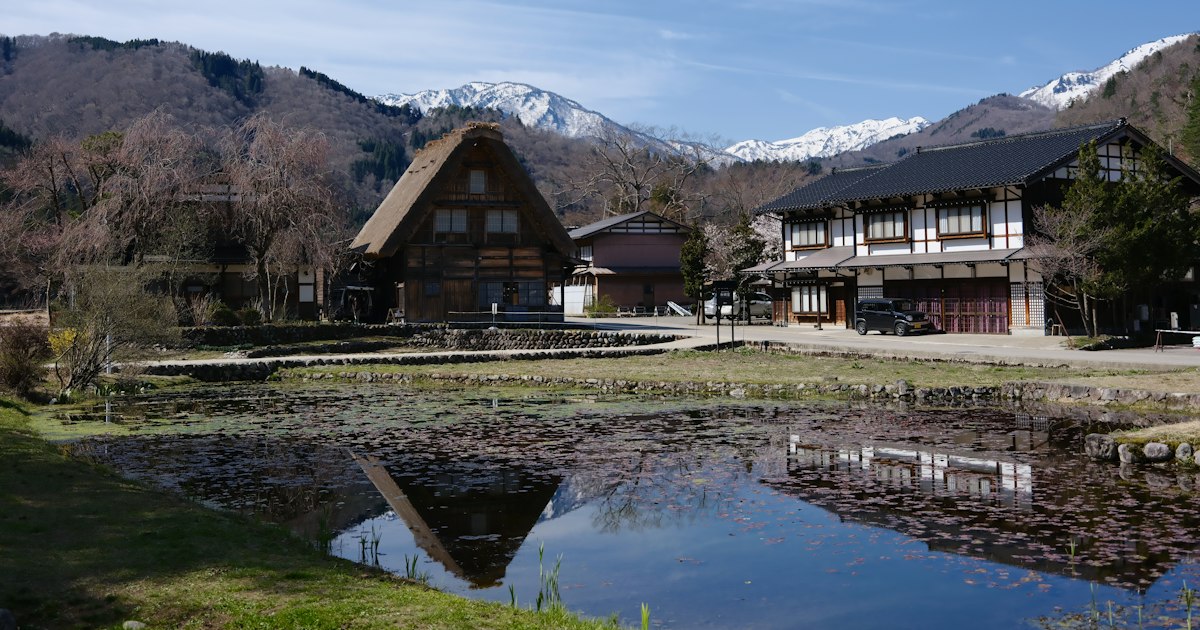
Everyone who plans a trip to the Japan Alps ends up looking at photos of Shirakawa-go’s steep, thatched-roof farmhouses. Fewer people realize that the same UNESCO World Heritage listing covers two more villages just up the road in Toyama Prefecture — Ainokura and Suganuma, together known as Gokayama. They have the same gassho-zukuri architecture, the same folk history, and a fraction of the tour buses. If you want the postcard scene without shuffling through crowds for a parking spot, this is where to go.
Why Gokayama Instead of (or in Addition to) Shirakawa-go
Shirakawa-go’s main village, Ogimachi, has around 114 gassho-zukuri houses and gets well over a million visitors a year. Gokayama’s two villages together have roughly 30 houses — about 20 in Ainokura and 9 in Suganuma — and see a small fraction of that traffic. The architecture and history are the same: steep 60-degree thatched roofs designed to shed heavy snow, built without nails, in a region so isolated that its feudal-era economy ran on silk farming and gunpowder production made from silkworm droppings fermented under the floorboards. What Gokayama lacks in scale it makes up for in quiet — you can walk the lanes at dusk without dodging selfie sticks, and several houses still function as private homes, not museum exhibits.
Ainokura vs. Suganuma: Which to Visit
If you only have time for one, choose based on what you want:
- Ainokura is the larger of the two, set on a hillside with a viewpoint above the village — the classic wide shot. It has more houses open to visitors, a folklore museum (around ¥300 entry), a few craft shops, and a couple of minshuku (guesthouses) for overnight stays.
- Suganuma is smaller and sits right on the Sho River, framed by mountains on both sides. It’s the more photogenic, compact option for a quick stop — you can see the whole village in 30-45 minutes. It also has the Gokayama Folklore Museum and the Gassho-zukuri Gunpowder Museum (Enshou-no-Yakata), each around ¥300, or a combined ticket for both for around ¥500.
If you have a car and time for both, they’re only about 9 km apart along Route 156, roughly a 15-minute drive.
How to Get There
Gokayama is genuinely rural, and this is the part first-time visitors underestimate. Without a car, your main option is the Kaetsunou “World Heritage Bus,” which runs between Takaoka Station (reachable via the Hokuriku Shinkansen from Kanazawa or Toyama) and Shirakawa-go, stopping at both Suganuma and Ainokura-guchi along the way. There are only around five to six buses a day in each direction, so check the timetable before you build your itinerary — missing the last bus back means an expensive taxi or an unplanned overnight stay. From Shirakawa-go, the ride to Ainokura takes about 25-30 minutes and costs roughly ¥800 one way; from Takaoka Station, budget closer to 75-90 minutes.
Driving is far more flexible and lets you combine both villages in one day. Parking at Ainokura’s observation-deck lot and at Suganuma’s roadside station both run around ¥500 per car for the day, since cars aren’t allowed to park inside the villages themselves. If you’re routing through on the Shinkansen with luggage, it’s worth checking our guide to Shinkansen oversized luggage rules before you book seats, since you’ll want your bags accessible for the bus transfer at Takaoka or Shin-Takaoka.
What to Do Once You’re There
Walking the villages themselves is free, and that’s most of the experience — narrow lanes between farmhouses, rice paddies, and mountains close on every side. A few things worth building in extra time for:
- Enter a house. Several gassho-zukuri buildings in both villages are open as small museums (around ¥300 each) showing the multi-story attic space once used for silkworm cultivation, plus the irori hearth that keeps the wooden beams smoke-cured and pest-resistant.
- Try washi paper-making. Gokayama Washi no Sato, near the villages in Kamitaira, is a working paper mill where you can make your own sheet of traditional washi — a postcard-sized piece runs around ¥800-1,000 and takes about 20-30 minutes. It’s a nice hands-on craft stop, similar in spirit to visiting a pottery town like Shigaraki for ceramics — a living craft rather than a shop shelf.
- Eat Gokayama tofu. The region’s tofu is famously dense and firm — locally there’s a saying that you can tie it with rope and carry it home. It shows up grilled, in hot pot, and as a souvenir at roadside shops.
Best Time to Visit
Late April into May brings fresh green against the thatched roofs and is comfortable for walking. Late October to early November has strong autumn color in the surrounding mountains. Winter (December-February) is when Gokayama looks most like the postcards, with snow piled on the steep roofs — and unlike Shirakawa-go’s tightly ticketed winter illumination nights, Gokayama runs its own light-up events on select Saturdays in January, usually with far less advance-booking pressure. Parking is still limited on those nights, so arrive early and dress for genuinely cold, snowy conditions; regional roads can be icy, so budget extra time if you’re driving.
Where to Eat and Stay
Neither village has much beyond a handful of small restaurants and shops, so don’t plan on convenience-store backup — bring cash, since card acceptance is inconsistent in both villages. For lunch, look for simple soba or tofu-based set meals at the small eateries near the parking areas. For a genuinely memorable night, a handful of the gassho-zukuri houses in Ainokura operate as minshuku, where you sleep in the loft-style rooms and eat dinner around the irori hearth — river fish, mountain vegetables, and local tofu. Expect to pay roughly ¥10,000-15,000 per person with two meals, and book well ahead, since there are only a few rooms in the whole village.
Common Mistakes to Avoid
- Assuming Gokayama is a quick add-on to Shirakawa-go. The bus schedule is thin enough that a rushed same-day visit to all three villages (Ogimachi, Ainokura, Suganuma) is tight without a car — check timetables before committing.
- Skipping Suganuma because it’s “smaller.” Its riverside setting is arguably more photogenic than Ainokura, and it takes under an hour to see properly.
- Walking into private homes. Many gassho-zukuri buildings are still lived in. Only enter ones clearly marked as open to visitors.
- Not carrying cash. Card and IC-card acceptance is unreliable at rural shops and eateries here.
Gokayama rewards the extra travel time with exactly what Shirakawa-go’s fame has made harder to find: a working mountain village you can actually stand still in. If you’re already chasing quiet, slow-paced corners of Japan the way you might at a mountain retreat like Karuizawa, or seeking out rural wildlife scenes like Jigokudani’s snow monkeys, Gokayama fits the same itinerary logic — a deliberate detour that pays off.