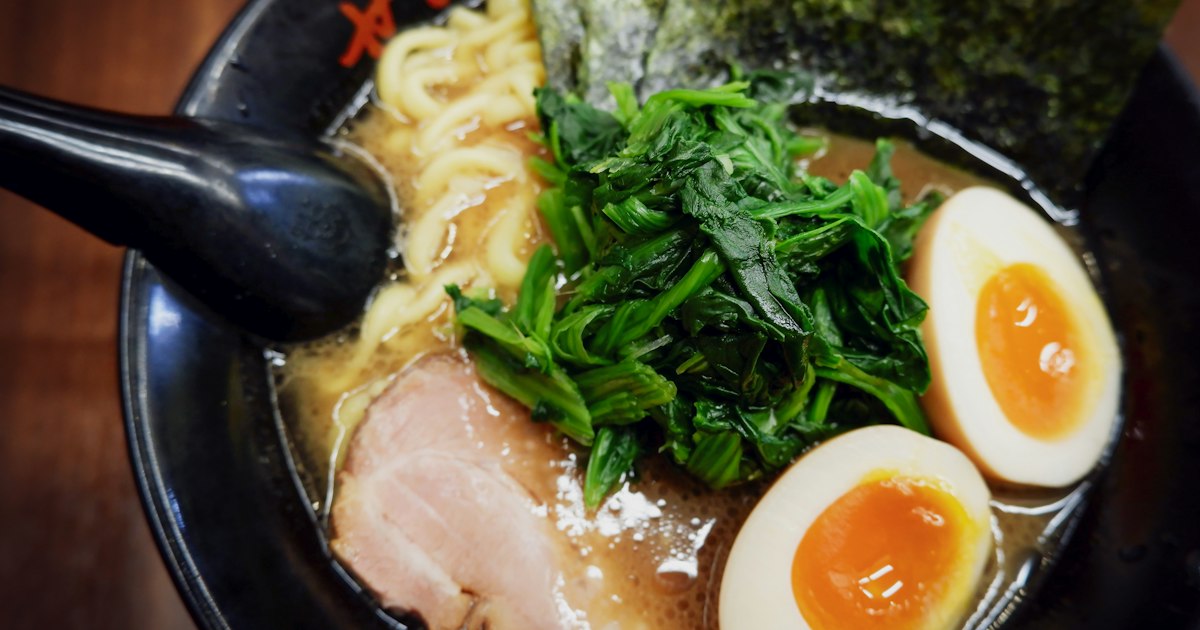
Photo by Susann Schuster on Unsplash
There is a species of ramen shop in Tokyo where the bowls look less like a meal and more like a geological event: a mountain of bean sprouts and cabbage buried in noodles, with pork slabs the size of place mats wedged into the sides. That’s Ramen Jiro. It has no English menu, no photos on the wall, and a counter staff that will ask you a question in rapid-fire Japanese the moment your bowl is almost ready — and you’re expected to answer in about three seconds. Get it right and you join a decades-old Tokyo subculture. Get it wrong and you’ll still eat well, just a little red-faced. Here’s how the system actually works.
What Is Ramen Jiro, and Why Does It Have a Cult Following?
Ramen Jiro traces back to a single shop that opened in 1968 near Keio University’s Mita campus in Tokyo — the “Mita Honten,” still considered the mothership. Over the decades, cooks who trained under founder Takumi Yamada branched out and opened their own shops under the Jiro name, and that’s the key thing to understand: Jiro isn’t a uniform chain like a convenience store. Each branch is run by an independently trained chef, so the broth’s fattiness, the garlic quantity, and even the noodle thickness shift noticeably from shop to shop. Fans (“Jiro-ian” or “Jiro-kei” otaku) argue endlessly over which branch is the “real” Jiro experience — part of the appeal is that no two visits are identical.
What unites every branch is the format: enormous portions, a short and loud ordering ritual, cash payment, elbow-to-elbow bench seating, and a house style built around raw garlic, pork back fat, and vegetables piled so high they spill over the rim.
Reading the Menu: Size, Toppings, and What It Actually Costs
Most Jiro shops sell essentially one dish — ramen — in two sizes, ordered at a ticket vending machine by the entrance. As of 2025, a small (“shou”) bowl typically runs about ¥800–900, which already includes roughly 400g of noodles — more than double what you’d get at a standard ramen shop. Oddly, at most branches “small” and “big” (ogata/dai) cost the same, since the price difference comes from noodle volume rather than toppings. That doesn’t mean you should order big: staff will sometimes quietly discourage first-timers from it if they doubt you’ll finish, because leaving food is taken seriously here.
Extras are cheap and bought as separate tickets: extra pork slices (butamore, roughly ¥150–250 for 2-3 extra pieces) and sometimes a double-noodle ticket (dabu, around ¥100–150) for noodle fiends. Toppings like extra vegetables, garlic, and fat don’t cost anything extra — they’re controlled entirely by what you say at the counter, which brings us to the part everyone gets nervous about.
The Topping “Call”: Jiro’s Famous Three-Second Ritual
After buying your ticket and handing it to staff, you sit and wait. Just before your bowl is finished, a cook will look at you and ask something like “Call?” or simply point at you expectantly. This is your one chance to specify toppings, and you’re expected to answer immediately and clearly — hesitating holds up the entire line behind you.
- Yasai (vegetables) — bean sprouts and cabbage, already piled high by default
- Ninniku (garlic) — raw, minced, and pungent
- Abura (back fat) — soft pork fat scattered over the top
- Karame (extra sauce) — a saltier, more intense flavor
You combine these with amount words: sukoshi (a little), mashi (more), or mashimashi (double more, the famous “more more”). A typical first-timer’s call is simply “Yasai!” — standard vegetables, nothing else — which is a completely normal and respected answer. If you want to push further, “Yasai mashi, ninniku” (extra vegetables, add garlic) is a common step up. There’s no shame in keeping it simple; regulars do it too.
Where to Go in Tokyo
The Mita Honten (the original shop, a short walk from Tamachi and Mita stations) is the pilgrimage site and draws the longest, most tourist-heavy lines, especially on weekends. Many Jiro otaku actually prefer other branches for a more consistent bowl — Nishi-Waseda, near Waseda University, is frequently cited as one of the best for balance between broth, fat, and noodle texture, while Ikebukuro and Kanda have their own loyal regulars. If a line looks unmanageable at one branch, it’s often worth checking a nearby one rather than waiting it out — Jiro branches are scattered across central Tokyo, with a few more in Kanagawa, Saitama, and Chiba.
Best Time to Go (and When You’ll Be Turned Away)
Jiro shops run split hours — typically lunch from around 11:00 to 14:00 and dinner from roughly 17:00 to 20:00, with the shop closed in between and often closed entirely one or two days a week (varies by branch, so check signage or recent reviews before heading over). Critically, Jiro shops close the moment they run out of noodles for the session, sometimes well before the posted closing time — a popular branch can sell out by 13:00 on a busy Saturday. Arriving right at opening on a weekday morning is your best shot at a short wait; weekend lunch lines can stretch past an hour. Winter is slightly more forgivable for queueing outdoors than the brutal heat of a Tokyo August, so factor season into your plan if you’re queue-averse.
Counter Etiquette and Common First-Timer Mistakes
A few habits will mark you as a rookie — or worse, slow down a shop that runs on speed:
- Treating “small” as actually small. It’s a full, calorie-dense meal (often 1,500–2,000+ kcal); don’t order a side dish expecting room.
- Freezing up at the call. Decide your answer while you wait, not when you’re asked.
- Asking for menu customizations. There’s no broth substitution, no spice level, no noodle swap — only the four call options.
- Lingering after finishing. Seats are scarce and shared; eat, pay (cash is standard — cards are rare), and clear out.
- Leaving food unfinished. It’s considered disrespectful at Jiro specifically, more so than at an ordinary restaurant — size up honestly before you order.
- Bringing big luggage. Counters are narrow with no storage; this isn’t a shop to visit straight from the airport with rolling suitcases in tow.
If Jiro Isn’t Quite Your Speed
If the queue culture and shouting match isn’t appealing but you still want Tokyo’s line-worthy food experiences, the pork bun counter at 551 Horai runs on a similarly intense but far gentler system, and Japan’s other cult food-chain obsession, Mister Donut, needs zero bravado to order from. For noodle soup without the mountain of garlic and fat, Okinawa soba is a completely different, far more relaxed bowl worth seeking out if you make it south. But if you do brave Jiro, go in with a plan, a clear call ready on your tongue, and an appetite that means business — it’s one of the few meals in Tokyo that doubles as a small act of courage.